
Apocalypse Now
Apocalypse Now (1979) is Francis Ford Coppola’s epic Vietnam War film inspired by Joseph Conrad’s Heart of Darkness, noted for its troubled production, striking imagery, and lasting cultural impact.
Overview
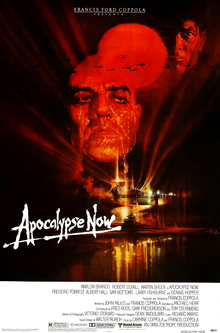
Apocalypse Now is a 1979 American epic war drama film directed by Francis Ford Coppola. The screenplay adapts themes from Joseph Conrad’s novella Heart of Darkness to a fictional narrative set during the Vietnam War era. The film follows a U.S. Army captain sent upriver on a patrol boat to locate and either retrieve or neutralize a renegade Special Forces colonel said to have abandoned reason and set up his own domain. From its release the picture has been widely discussed for its visual style, moral ambiguity, and psychological intensity.
Image gallery
3 Images

Plot and themes
Rather than a detailed blow-by-blow account of military operations, the film is structured as a journey into progressively darker and more chaotic territory. Its central themes include the corrosive effects of war on individuals and institutions, the thin line between civilization and savagery, and the pursuit of meaning amid violence. The river voyage and encounters along the way are designed to undermine easy moral judgments and to mirror the existential drift of the protagonist.
Production and challenges
The production became as famous as the film itself for its difficulties. Principal photography took place largely in the Philippines and was disrupted by severe weather, logistical problems, and budget overruns. Lead actor Martin Sheen experienced a public breakdown and suffered a heart attack during filming. The actor Robert Duvall delivered one of the film’s most memorable supporting performances. Editing the vast amount of material took years, and an unfinished version was screened at the Cannes Film Festival, where it provoked strong reactions.
Versions, restoration, and running time
Apocalypse Now has been released in several versions. The original theatrical release differs from a longer "Redux" edition that restored substantial deleted material, and Coppola later supervised a "Final Cut" that premiered in 2019. The Final Cut tightened pacing while preserving the film’s epic scope; this definitive edition runs over three hours and reflects the director’s later revisions of tone and structure.
Reception and legacy
While divisive at first, the film’s reputation has grown; it is frequently cited among significant achievements in late 20th-century cinema. At the Academy Awards it received multiple nominations, including Best Picture and Best Director, and it won technical honors such as Best Cinematography and Best Sound. Critics and scholars continue to analyze its imagery, use of music, and staging of combat. It appears regularly in surveys of great films and is often referenced in discussions about how Hollywood represents modern war.
Notable elements and cultural impact
- Visuals: The cinematography is frequently singled out for its dramatic lighting and composition.
- Soundtrack and sound design: Music and effects play a central role in shaping mood and contrast.
- Performances: Aside from the lead, the film features striking turns that helped cement the reputations of its principal cast.
- Intertextuality: The transfer of Conrad’s river journey from the Congo to Southeast Asia reframes colonial themes in a modern military setting.
- Production mythology: Tales of on-set crises and improvisation have entered film lore and scholarship alike.
Further reading and resources
- Apocalypse Now (film) — general reference and overview.
- Francis Ford Coppola — director and producer biography.
- Coppola filmography and context — broader career context.
- Heart of Darkness — Joseph Conrad’s novella that inspired the film.
- Vietnam War context — historical background for the film’s setting.
- Cambodian theater references — regional geography that factors into the plot.
- Joseph Conrad — the writer of the original source material.
- Congo River (original setting) — the backdrop for Conrad’s tale.
- Martin Sheen — lead actor and his role in the film’s production history.
- Film editing — the lengthy post-production and editing process.
- Cannes Film Festival — the festival screening that drew attention to the troubled cut.
- Academy Awards (Best Picture nomination) — awards recognition and nominations.
- Best Director nomination — Coppola’s recognition by peers.
- Robert Duvall — notable supporting performance in the film.
- Awards: Best Cinematography — technical accolades received.
- Best Sound — another technical Oscar awarded to the production.
For viewers new to the film, it is best approached as both a product of its time and an artistic meditation on war’s psychological consequences. Scholars continue to debate its meanings, and multiple releases allow audiences to experience different editorial choices that shape interpretation.
Related articles
Author
AlegsaOnline.com Apocalypse Now Leandro Alegsa
URL: https://en.alegsaonline.com/art/4889