
April Love (1957 film)
A 1957 American musical romantic drama directed by Henry Levin, starring Pat Boone and Shirley Jones. Based on the novel Phantom Filly and distributed by 20th Century Fox; Academy Award nominee in 1958.
Overview
April Love is a 1957 American musical romantic drama directed by Henry Levin and released by 20th Century Fox. The picture adapts the novel Phantom Filly by George Andrew Chamberlain and centers on themes of youthful restlessness, family ties, and the healing power of affection and responsibility. The film was notable at the time for pairing popular singer-actor Pat Boone with established screen actress Shirley Jones.
Image gallery
1 Image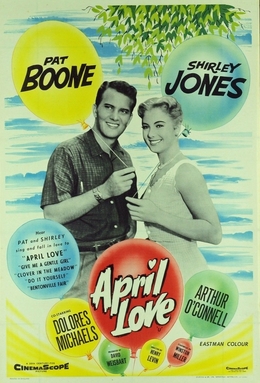
Cast and principal crew
The principal cast includes Pat Boone, Shirley Jones and Arthur O'Connell, supported by Dolores Michaels, Matt Crowley and Jeanette Nolan. Henry Levin served as director, and the studio production was handled by 20th Century Fox. Boone's presence lent a musical emphasis to the film, while Jones contributed her experience in song-and-dance storytelling.
Characteristics and themes
Although rooted in romantic and family drama, April Love is structured as a musical vehicle for its star. Songs are woven into scenes to underline emotional beats and the developing relationship between the leads. The source novel's focus on horses and rural life informs the film's setting and some plot elements, giving it a pastoral backdrop that contrasts with urban or juvenile restlessness.
Production and music
Produced during the 1950s studio era, the film was designed to showcase mainstream appeal: a familiar leading man with a singing career, a leading lady from musical cinema, and a supporting ensemble. Musical numbers in the film were tailored to highlight Boone's vocal style and to support the romantic storyline rather than as standalone set pieces.
Reception and awards
Upon its release the film found an audience among fans of light musicals and the film's stars. It gained industry recognition with a nomination at the Academy Awards in 1958, reflecting attention to some element of its production. Contemporary reviews tended to treat it as a pleasant, if not groundbreaking, example of mid-century American musical filmmaking.
Legacy and notable facts
- April Love is often remembered for its star pairing and for adapting a rural-themed novel into a mainstream musical format.
- The film is part of Pat Boone's screen career that capitalized on his popularity as a pop singer in the 1950s.
- Its nomination at the Academy Awards in 1958 is a frequent citation in retrospective overviews of the film's place in that decade's studio output; see the Academy mention here.
For further details on cast filmographies and the source novel, consult studio records and published bibliographies of 1950s American cinema. Additional context about the principal performers can be found via their official or archival profiles, such as those linked above.
Questions and answers
Q: When was April Love released?
A: April Love was released in 1957.
Q: Who directed April Love?
A: Henry Levin directed April Love.
Q: What is the basis for the movie April Love?
A: April Love is based on the book Phantom Filly by George Andrew Chamberlain.
Q: Who are some of the actors in April Love?
A: Some of the actors in April Love include Pat Boone, Shirley Jones, Arthur O'Connell, Dolores Michaels, Matt Crowley, and Jeanette Nolan.
Q: Who distributed April Love?
A: April Love was distributed by 20th Century Fox.
Q: Was April Love ever nominated for an Academy Award?
A: Yes, April Love was nominated for an Academy Award in 1958.
Q: What category was April Love nominated for at the Academy Awards?
A: The specific category that April Love was nominated for at the Academy Awards is not specified in the given text.
Tags
Related articles
Author
AlegsaOnline.com April Love (1957 film) Leandro Alegsa
URL: https://en.alegsaonline.com/art/5060