
Islamic calligraphy
Islamic calligraphy (Arabic calligraphy) is the artful, devotional and decorative practice of writing Arabic script used in manuscripts, architecture, objects and contemporary art; styles, tools and cultural roles summarized.
Overview
Islamic calligraphy, often called Arabic calligraphy, is the artistic discipline of writing the Arabic script with attention to proportion, rhythm and beauty. It developed in regions where Arabic served religious, administrative and literary functions and became a major visual art across the Middle East, North Africa, South Asia and parts of Europe. While Qur'anic verses are a central subject, calligraphy also records poetry, proverbs, names, legal documents and commemorative inscriptions. It appears in manuscripts, on buildings, ceramics, textiles, coins and everyday objects.
Image gallery
10 Images





Characteristics and notable styles
Practice emphasizes the quality of line, consistency of letterforms and the relationship of space to text. Tools and hand posture shape distinctive strokes. Several principal script families evolved for different uses and scales:
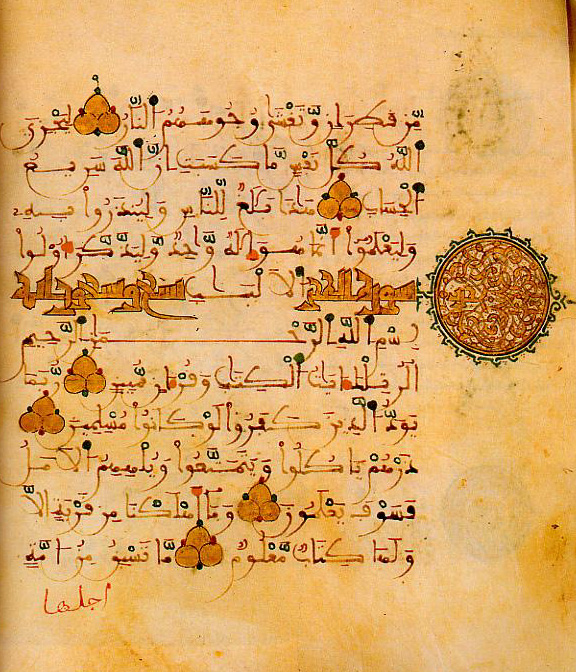
- Kufic — an early, angular and often monumental script used on stone, coins and early Qur'ans, prized for formal inscriptions.
- Naskh — a rounded, legible hand widely used for book copying and later adapted for printed type.
- Thuluth — large, flowing letters with elongated verticals used for headings and architectural bands.
- Nastaʿlīq — a cursive, sloping Persianate script favored for Persian, Urdu and Ottoman lyrical manuscripts.
- Diwani — an ornate Ottoman court script notable for dense, interlaced forms in official correspondence and decrees.
History and development
From the early centuries of Islam the written word gained cultural prominence. Practical needs for administration and Qur'anic copying led to the refinement of hands and the gradual codification of proportional rules. Workshops, royal courts and religious institutions became centers for style-making and teaching. Over time calligraphers developed measured systems to control pen angle, letter proportions and spacing, producing both highly legible bookhands and elaborate display scripts for monuments and ceremonial objects.
Tools, materials and techniques
Traditional tools are intentionally simple but precise: a cut reed pen (qalam), specially prepared ink, paper or parchment, and often gold leaf or pigments for illumination. Pens are trimmed to specific angles and widths to produce distinct strokes; ink viscosity and paper sizing are adjusted for the desired effect. For architectural or ceramic work, calligraphic designs are translated into stone carving, carved wood, glazed tilework or metalwork. Many mosques and palaces feature calligraphic bands and tilework; some examples can be explored via decorative tiles and inscriptions.
Uses, meanings and contemporary practice
Beyond ornament, calligraphy has served devotional, educational and administrative roles. The transcription of Qur'anic text has often been regarded as an act of reverence; calligraphic inscriptions also conveyed political authority and commemorated patrons. In modern times calligraphy remains a living art: it is taught in traditional workshops and formal conservatories, practiced by contemporary artists who blend classical techniques with abstraction, and adapted into digital fonts and graphic design. Contemporary exhibitions and publications highlight both continuity and innovation within the tradition.
Teaching, preservation and cultural significance
Traditional transmission relied on master-disciple relationships and long apprenticeships, with practice copies and model sheets used for study. Today teaching takes place in diverse settings, from private ateliers to university departments. Conservation of historic manuscripts and architectural inscriptions is an important field that combines art-historical knowledge with conservation science. Because calligraphy links text and image, it occupies a special place in visual culture and public space across societies that use the Arabic script.
Distinctions and influence
Islamic calligraphy differs from ordinary handwriting by its aesthetic rules and institutional traditions; it also differs from typography, which standardizes letterforms for printing. The practice influenced writing and decorative arts in Persian, Ottoman Turkish, Urdu and other literatures that used Arabic characters. Its legacy continues to inspire artistic practice, design and scholarship worldwide. For further introductory resources see related decorative and historical materials.
Related articles
Author
AlegsaOnline.com Islamic calligraphy Leandro Alegsa
URL: https://en.alegsaonline.com/art/48399