
In Cold Blood (1967 film)
1967 film adaptation of Truman Capote's nonfiction book about the 1959 murders of the Clutter family in Kansas, directed by Richard Brooks in a stark, documentary-like style and shot in black and white.
Overview
In Cold Blood is a 1967 American crime and drama film adapted from Truman Capote's influential nonfiction book of the same name. Directed by Richard Brooks, the film dramatizes the real 1959 killings of the Clutter family in rural Kansas and the subsequent investigation, arrest, trial and punishment of the perpetrators. It was released on 14 December 1967 and was given an R rating for violence.
Image gallery
1 Image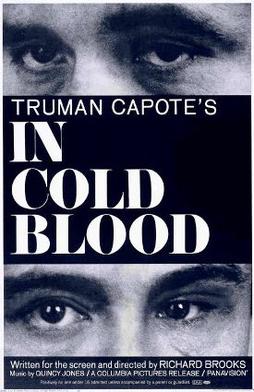
Plot and principal cast
The narrative follows two drifters, Richard Hickock and Perry Smith, their journey after committing the crime — including stops in Las Vegas and travel toward Mexico — their capture by law enforcement and the legal proceedings that followed. The film stars Robert Blake as Perry Smith and Scott Wilson as Richard Hickock; contemporary credits and coverage note Scott Wilson's performance among the principal roles. After arrest, the men are taken into custody by the police, prosecuted at trial and ultimately sentenced following the trial.
Production and style
Brooks chose a tonal approach that emphasizes restraint and a quasi-documentary atmosphere. The film was shot in stark black-and-white, with cinematography by Conrad L. Hall and a measured musical score by Quincy Jones, choices that enhance a feeling of realism rather than melodrama. The direction and technical design favor close attention to procedure, character detail and the geography of midwestern life over sensational presentation.
Historical context and themes
The movie is an adaptation of one of the best-known works of literary journalism and emerged at a time when true-crime narratives were gaining broader public attention. It treats themes such as the nature and causes of violence, psychological portraiture of offenders, the impact of a brutal crime on a small community, and the ethical questions that arise when nonfiction reporting is dramatized for the screen.
Reception and legacy
On release the film attracted critical attention for its performances, visual restraint and fidelity to the procedural elements of the story. Critics and scholars frequently cite it as an early and influential example of cinematic true-crime adaptation; it remains a reference point in discussions of how investigative reporting is converted into dramatic narrative and how filmmakers balance factual detail with filmic storytelling.
Notable credits and further reading
- Director: Richard Brooks
- Principal cast: Robert Blake, Scott Wilson
- Source material: Truman Capote's nonfiction book In Cold Blood
- Key locations in the story: Kansas, Las Vegas, Mexico
- Investigation and prosecution: coverage of the police inquiry and the trial
- Genre and rating: crime, drama (rated R)
For further study, readers can consult film histories and editions of Capote's book to compare the reporting with the screenplay's choices and to explore the ethical and artistic questions surrounding dramatizations of real crimes.
Related articles
Author
AlegsaOnline.com In Cold Blood (1967 film) Leandro Alegsa
URL: https://en.alegsaonline.com/art/46933