
Ich bin ein Berliner — John F. Kennedy’s 1963 West Berlin address
A clear account of John F. Kennedy’s June 26, 1963 speech in West Berlin, its Cold War context, memorable phrases, language notes and long-term political and cultural legacy.
Overview
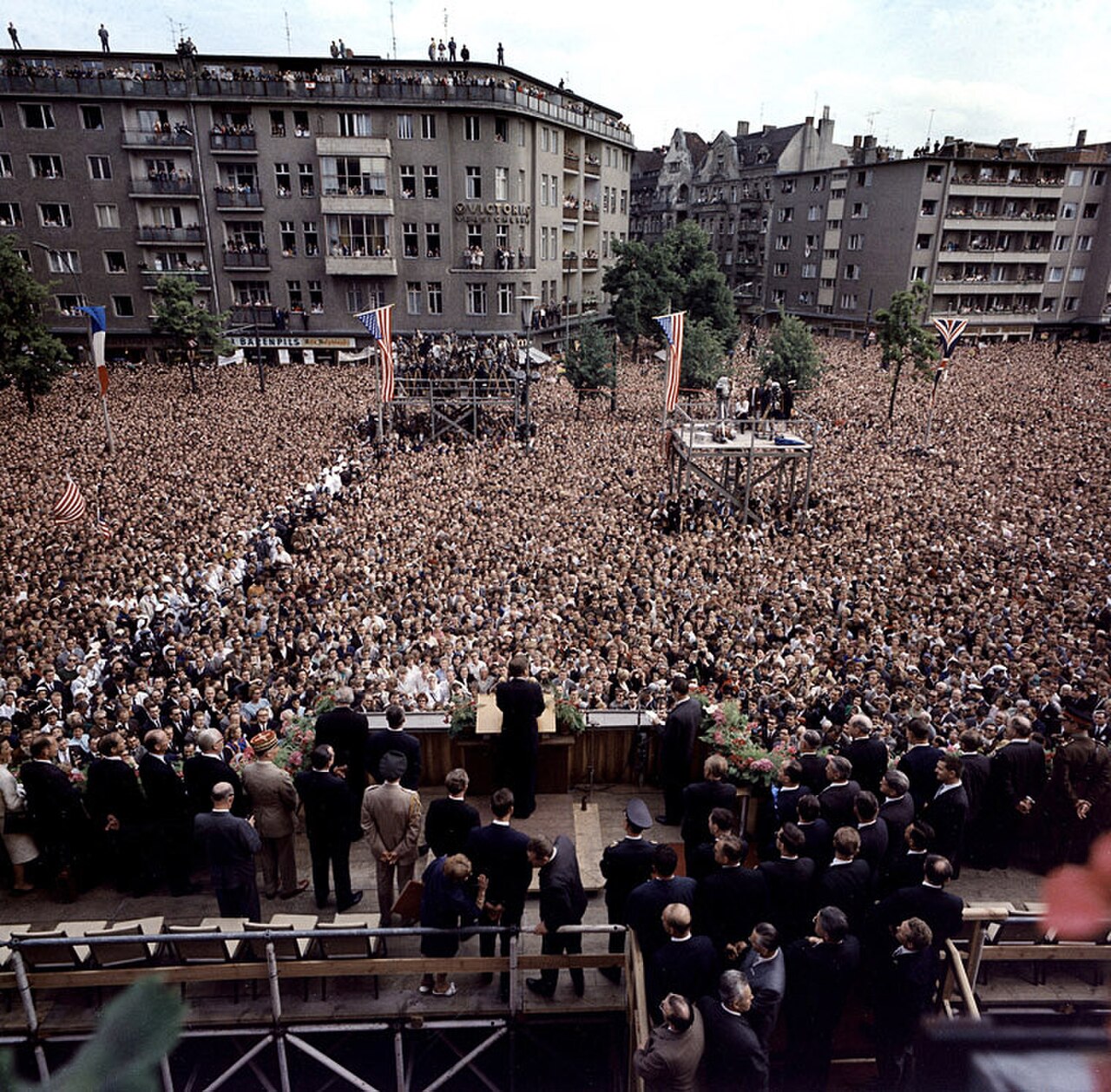
"Ich bin ein Berliner" (English: "I am a Berliner") is the best-known line from a public address delivered by John F. Kennedy on June 26, 1963. The speech was given in West Berlin to express American solidarity with the city's residents after the erection of the Berlin Wall. It has since become a defining moment of Cold War rhetoric and a lasting symbol of support for democratic freedom.
Image gallery
5 Images


Historical context and setting
Delivered during the height of Cold tensions, the speech sought to reassure West Berliners that the United States stood with them against communist pressure and the separation imposed by the Berlin Wall. Kennedy spoke from the steps of the city hall in West Berlin before a large crowd and international media coverage. The event is often referenced by its location or by coordinate markers such as coordinates used in historical records. It formed part of a broader U.S. diplomatic effort to reinforce Western unity during the Cold War.
Content and memorable phrases
The address combined praise for Berlin's resilience with a pointed contrast to totalitarian systems. Kennedy invoked the classical line civis romanus sum ("I am a Roman citizen") and reframed it for the modern struggle: "Today, in the world of freedom, the proudest boast is 'Ich bin ein Berliner!'" He followed with lines emphasizing common citizenship in freedom: "All free men, wherever they may live, are citizens of Berlin, and therefore, as a free man, I take pride in the words 'Ich bin ein Berliner!'" Those passages are often quoted separately because they captured the speech’s intent to personify U.S. commitment to Berlin's liberty.
Language notes and popular myths
Kennedy reportedly wrote phonetic guidance on his speech notes — often cited as "ish bin ein Bearleener" — to help his pronunciation of German. A persistent popular myth claims that by saying "Ich bin ein Berliner" he inadvertently declared himself a jelly doughnut (a "Berliner" in some German regions). Linguists and historians caution that in the context and construction Kennedy used, native speakers understood the phrase as an expression of solidarity with Berliners rather than a literal claim. Contemporary German listeners at the event interpreted it as intended: a rhetorical identification with the city's people.
Impact and legacy
The speech reinforced Kennedy's international image and became a staple example of Cold War public diplomacy. It bolstered morale in West Berlin and served as a declaration of U.S. resolve that was cited in diplomatic and educational contexts for decades. The address remains a frequent subject of study in courses on rhetoric, Cold War history, and American foreign policy. Its lines are reproduced in commemorations, museum exhibits and scholarly works examining symbolic leadership during geopolitical crises.
Notable facts
- The speech date: June 26, 1963; it is regularly cited in timelines of Cold War events.
- Primary purpose: to demonstrate U.S. support for West Berlin in the face of the Berlin Wall and to mark its one-year anniversary.
- Format: a public address delivered before a large crowd and international press, widely broadcast.
- Documentation: the event and its text appear in many historical archives and recordings labelled as a major Cold War speech.
- Legacy links: the address is often linked in discussions of U.S.–German relations and transatlantic solidarity; see references associated with West Berlin histories and broader Cold War studies.
For further reference one may consult archival materials and translations of the full text, as well as biographies of John F. Kennedy that place the address within his presidency. The site and historical markers that note the location sometimes cite the event with precise coordinates, and scholarly discussions continue to examine how short rhetorical moments shape public memory and political identity.
Additional background and source collections often use the phrase and event as a case study in international communication, leadership rhetoric and the symbolic geography of the divided city. Scholars and curators include the speech among key artifacts that illustrate the emotional and political dimensions of the Berlin Wall era, and it remains a vivid example of how words can support a geopolitical stance during times of tension.
See also material indexed under speeches by administrations of the period and collections relating to transatlantic policy in the early 1960s; these resources frequently mention the speech's role in shaping contemporary public opinion and diplomatic posture.
Related articles
Author
AlegsaOnline.com Ich bin ein Berliner — John F. Kennedy’s 1963 West Berlin address Leandro Alegsa
URL: https://en.alegsaonline.com/art/46459
Sources
- books.google.com : Kennedy in Berlin