
Impact event: collisions between space objects and planets
An impact event is a collision between space objects and a planet. This article explains what they are, how craters form, historical examples, frequency, consequences, and efforts to detect or mitigate them.
An impact event occurs when two bodies in space collide, typically when a smaller body strikes a larger planetary body. Such a collision can involve many different objects moving through space. Most systems of planets and smaller bodies experience impacts routinely; they are a normal part of dynamics in a planetary system such as our own Solar System. The incoming objects are commonly fragments of rock or ice: asteroids, comets and small meteors are typical examples.
Image gallery
10 Images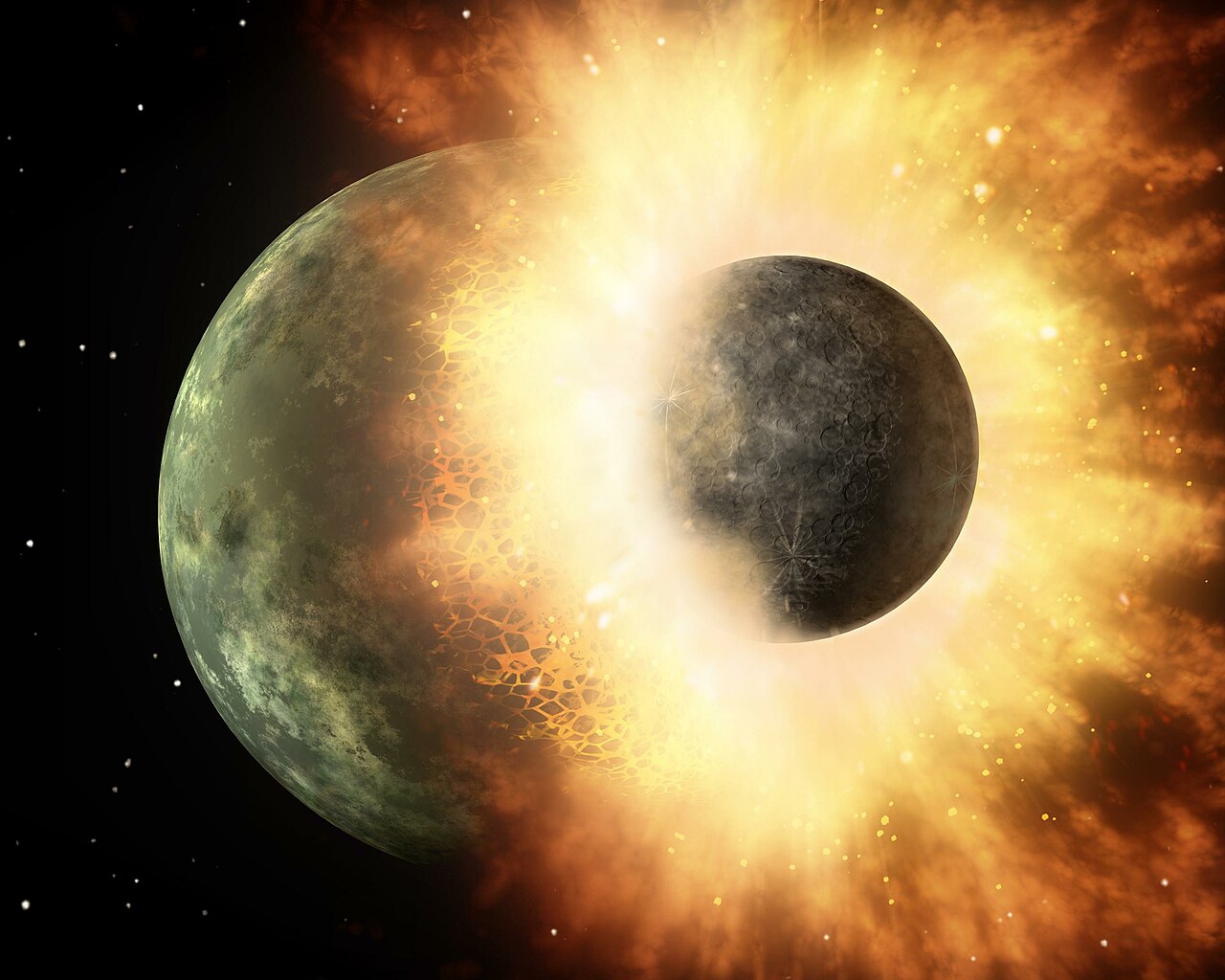


Characteristics and how impacts work
When a small body strikes a planet it converts kinetic energy into heat, shock waves and excavation. The outcome depends on the size, speed, composition and entry angle of the projectile, and on the target’s atmosphere and surface. For a terrestrial planet like the Earth, a thin atmosphere provides some protection: tiny meteoroids burn up during passage, larger ones may explode or fragment, and the largest reach the surface to form a crater.
Impact processes leave distinct features. An impact crater typically has a raised rim, ejecta blanket and, for very large impacts, a central peak or multi-ring structure. Craters are abundant on bodies with little erosion or tectonics, such as the Moon and Mars. On Earth, geological activity and vegetation often obscure older impact evidence.
Frequency, sizes and observable events
Impacts span a huge range of scales and recurrence intervals. Very small objects (a few metres across) strike Earth frequently and are usually destroyed in the atmosphere, often producing bright fireballs or bolides; many such events are wholly vaporised. Objects about a kilometre across are far rarer, with typical intervals of hundreds of thousands of years between collisions, and multimillion-year spacing for impacts measuring several kilometres—sizes capable of causing global environmental change.
- Small (centimetres to metres): common, usually harmless.
- Medium (tens to hundreds of metres): can cause regional damage.
- Large (kilometres): infrequent but globally significant.
Historical examples and geological importance
Impacts have shaped planetary evolution. A hypothesized giant impact event early in Earth’s history is widely invoked to explain the Moon’s origin. On geological timescales, the history of Earth shows that collisions can affect climate and biosphere; the Chicxulub impact is linked to the end-Cretaceous extinction. Observed modern examples include the dramatic 1994 collision of comet Shoemaker–Levy 9 with Jupiter, which was tracked by telescopes and satellites. On Earth in recent times, the 2013 Chelyabinsk meteor exploded over Russia and caused many injuries from glass and shock waves. Earlier, the 1908 Tunguska event flattened forest in Siberia and remains a key case study.
Detection, prediction and mitigation
Modern astronomy and space science devote significant effort to impact prediction and risk assessment. Surveys scan the sky for near-Earth objects using ground and space observatories. When potential threats are identified, models estimate whether atmospheric entry will reduce their hazard. For objects on impact trajectories, options under study include deflection, disruption, or evacuation planning; practical mitigation depends on lead time, object size and composition.
Why impacts matter and notable distinctions
Impacts are important for several reasons: they record the dynamical history of a planetary system, create geological features, can trigger ecological crises, and occasionally offer raw materials (meteorites) that help us study early Solar System chemistry. Distinctions to keep in mind include object type (rocky asteroid versus icy comet), the role of an atmosphere in ablating incoming mass, and whether an event produces an airburst or a ground impact.
For quick reference and further reading, see these topic-linked resources:
- collision
- objects
- space
- planetary system
- Solar System
- asteroids
- comets
- meteors
- planet
- Earth
- impact prediction
- explode
- impact craters
- Mars
- Moon
- Shoemaker–Levy 9
- Jupiter
- telescopes
- satellites
- solar system evolution
- history of Earth
- giant impact event
- atmosphere
- vaporised
- Chelyabinsk meteor
- Tunguska
- Siberia
Questions and answers
Q: What is an impact event?
A: An impact event is a collision between objects in space, such as asteroids, comets or meteors. These collisions can have serious effects on the planet they hit.
Q: How do we try to predict when an impact will happen?
A: We use something called impact prediction to try and find out when one is going to hit Earth. Depending on the size of the object, much of the impact is reduced by the planet's atmosphere.
Q: Are there any evidence of major impacts in our Solar System?
A: Yes, some of the largest are on Mars and the Moon. These are said to be evidence of major impact events. The first time an impact event was recorded was in July 1994 with a comet colliding with Jupiter.
Q: What effect did impacts have on how our Solar System has changed since it was formed?
A: Impact events appear to have had a major effect on how our Solar System has changed since it was formed. Major impacts have also shaped the history of Earth including its evolution of life.
Q: Is it thought that an asteroid caused one of Earth's extinction events?
A: It is thought that a giant asteroid known as Chicxulub impacted 66 million years ago and caused what is known as Cretaceous–Paleogene extinction event. There is debate over whether other extinction events throughout history were caused by impacts or not.
Q: How often do asteroids with a diameter of 4 meters (13 ft) collide with Earth?
A: On average, asteroids with this size collide with Earth about once per year but usually explode in the upper atmosphere before reaching ground level so no damage occurs at ground level from these smaller objects.
Q: How often do larger asteroids (5 km/3 mi) collide with Earth?
A: Large collisions like this happen once every twenty million years approximately
Related articles
Author
AlegsaOnline.com Impact event: collisions between space objects and planets Leandro Alegsa
URL: https://en.alegsaonline.com/art/46864
Sources
- nssdc.gsfc.nasa.gov : "Comet Shoemaker–Levy 9 Collision with Jupiter"
- nssdc.gsfc.nasa.gov : "Ulysses and Voyager 2"
- nature.com.myaccess.library.utoronto.ca : "Repeated Blows"
- ui.adsabs.harvard.edu : 1998Sci...282..927S
- doi.org : 10.1126/science.282.5390.927
- pubmed.ncbi.nlm.nih.gov : 9794759
- instruct.uwo.ca : "Impacts, volcanism and mass extinction: random coincidence or cause and effect?"
- ui.adsabs.harvard.edu : 2001AuJES..52..725K
- doi.org : 10.1080/08120090500170393 · web.archive.org
- ui.adsabs.harvard.edu : 2001Natur.412..708C
- doi.org : 10.1038/35089010
- pubmed.ncbi.nlm.nih.gov : 11507633
- es.ucsc.edu : es.ucsc.edu/~rcoe/eart206/canup_Moon_Nature_01.pdf
- adsabs.harvard.edu : "Dynamics of Lunar Formation"