
Hydrogen atom: structure, isotopes, and scientific importance
An overview of the hydrogen atom — the simplest atom — covering its structure, isotopes, quantum description, spectral properties and roles in chemistry, astrophysics and precision physics.
Overview
The hydrogen atom is the simplest atomic system and the basic constituent of the chemical world. A typical reference is the hydrogen atom itself, which embodies fundamental concepts of atomic physics and quantum theory. It arises from the chemical element hydrogen, the lightest and most abundant element in the universe.
Image gallery
4 Images


Basic structure
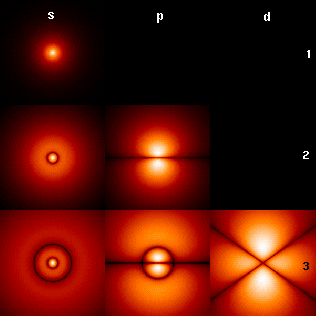
At its simplest, a hydrogen atom consists of a single negatively charged electron bound to a compact nucleus that carries positive charge. In the most common isotope the nucleus is a lone proton. The attractive electrostatic interaction that holds the electron and nucleus together is the classical Coulomb force, but a full description requires quantum mechanics rather than a simple orbit picture.
Isotopes and nuclear variants
Hydrogen has several isotopes distinguished by nuclear composition. The ordinary form, protium, has no neutrons. Deuterium contains one neutron in the nucleus and is stable; Tritium carries two neutrons and is radioactive. More generally such differences are referred to as isotopes, and they affect mass, nuclear properties and some physical behavior while leaving the simple electron–nucleus electric interaction largely similar.
Quantum description and spectra
Early models pictured the electron moving in a circular orbit, but the correct framework is quantum mechanics: the electron occupies discrete energy levels described by wavefunctions. Transitions between these levels produce characteristic spectral lines that have been crucial for developing atomic theory and for identifying hydrogen in astronomical objects. Precision measurements of hydrogen spectra remain a benchmark test for quantum electrodynamics and fundamental constants.
Uses and significance
Hydrogen atoms play key roles across science: they dominate the composition of stars and the interstellar medium, underpin simple chemical bonding (for example H2 molecules), and serve as a testing ground for theoretical physics. Laboratory applications include isotope labeling, nuclear fusion research, and high-resolution spectroscopy. Because of its simplicity, the hydrogen atom is often the first system used to teach atomic structure.
Notable features and distinctions
- Simplicity: With one electron and (usually) one proton, hydrogen is the model atom for theory and computation.
- Ionization: Removing the electron produces a proton; the bound-to-free transition is a fundamental reference point in atomic physics.
- Astrophysical marker: Hydrogen spectral lines reveal conditions in stars and galaxies and trace large-scale structure.
For further reading and technical references see introductory texts and specialized reviews on atomic structure, spectroscopy and nuclear isotopes (hydrogen atom, elemental hydrogen).
Related articles
Author
AlegsaOnline.com Hydrogen atom: structure, isotopes, and scientific importance Leandro Alegsa
URL: https://en.alegsaonline.com/art/46091