
Coulomb's law: the inverse-square law of electrostatic force
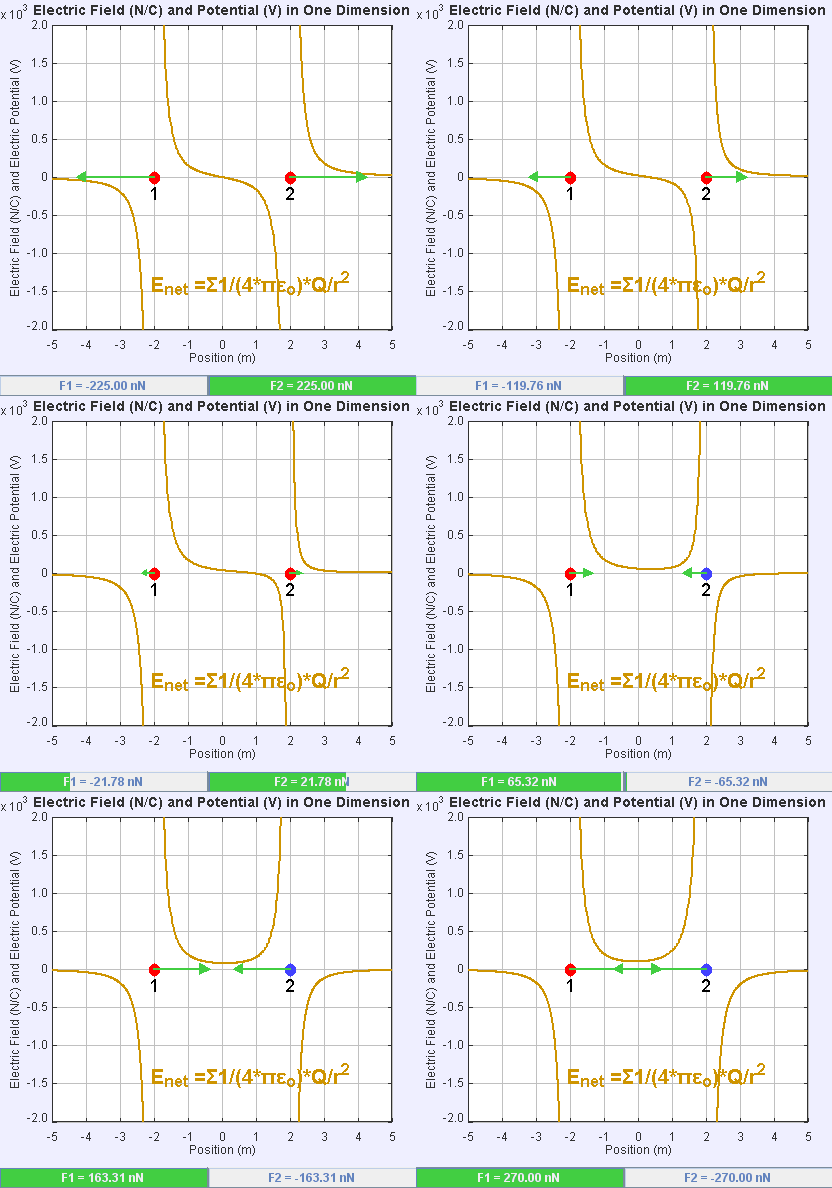
Coulomb's law describes the magnitude and direction of the electrostatic force between stationary point charges; it is an inverse-square law central to classical electrostatics and Maxwell's theory.
Overview: Coulomb's law gives the strength and direction of the electrostatic interaction between two stationary electric charges. In its simplest form it states that the force between two point charges is proportional to the product of their charges and inversely proportional to the square of the distance between them. The concept was formulated in the 1780s; see the original experimental development as a function explained here and the scientist Charles‑Augustin de Coulomb.
Image gallery
4 Images


Mathematical expression
In scalar form the magnitude is commonly written as F = k |q1 q2| / r^2, where q1 and q2 are charges, r is the separation, and k is Coulomb's constant. The constant k can be expressed in terms of the vacuum permittivity ε0 as k = 1/(4π ε0). The full vector form gives direction: like charges repel and unlike charges attract, with the force acting along the line joining the charges. This electrostatic force follows an inverse‑square dependence similar to Newton's law of gravitation.
Assumptions and limitations
Coulomb's law applies exactly to point charges or to spherically symmetric charge distributions outside the objects. It assumes charges are stationary (no magnetic effects) and that the surrounding medium is linear and uniform; in a dielectric material the effective force is reduced by the material's permittivity. For systems of many charges the principle of superposition allows pairwise forces to be summed.
History and theoretical context
Charles‑Augustin de Coulomb established the empirical law using a torsion balance in the late 18th century. The law became a cornerstone of classical electrostatics and was later incorporated into Maxwell's equations, which place Coulomb's law in a broader dynamical theory of electric and magnetic fields.
Uses and notable facts
- Practical calculations: design of capacitors, high‑voltage engineering, particle separation and manipulation.
- Scientific applications: estimating forces at atomic and molecular scales, explaining ionic bonding trends and Coulomb barriers in nuclear physics.
- Distinction: Coulomb's law describes static electric interactions; moving charges require the full framework of electromagnetism.
Coulomb's law remains a fundamental, experimentally verified rule for electrostatics and a useful approximation in many physical and engineering contexts. For more detailed historical or mathematical treatments consult specialized texts or resources on the subject.
Questions and answers
Q: Who developed Coulomb's law?
A: Coulomb's law was developed by physicist Charles-Augustin de Coulomb in the 1780s.
Q: What does Coulomb's law explain?
A: Coulomb's law explains how strong the force will be between two electrostatic charges.
Q: What does electrostatic mean?
A: Electrostatic means electric charges without any motion.
Q: What is the significance of Coulomb's law?
A: Coulomb's law is significant in understanding the behavior of electric charges and their interactions with each other.
Q: Can Coulomb's law be used for moving charges?
A: No, Coulomb's law only applies to electrostatic charges without any motion.
Q: Is Coulomb's law a recent discovery?
A: No, Coulomb's law was developed in the 1780s, making it a centuries-old discovery.
Q: How might Coulomb's law be applied in everyday life?
A: Coulomb's law can help explain the behavior of electric charges, making it useful in fields such as electricity, electronics, and engineering.
Related articles
Author
AlegsaOnline.com Coulomb's law: the inverse-square law of electrostatic force Leandro Alegsa
URL: https://en.alegsaonline.com/art/23428