
HR 5171 (V766 Centauri): a massive yellow hypergiant
HR 5171 (V766 Cen) is an extreme yellow hypergiant — one of the largest and most luminous evolved stars known, in a multiple system with at least one close companion and a distant hot star.
HR 5171, also catalogued as V766 Centauri, is an evolved luminous star classified as a yellow hypergiant. It ranks among the largest and brightest stars identified in our galaxy. Estimates of its physical size and output vary between studies, but interferometric and spectroscopic work consistently place it far beyond ordinary supergiants in radius and luminosity.

Image gallery
4 Images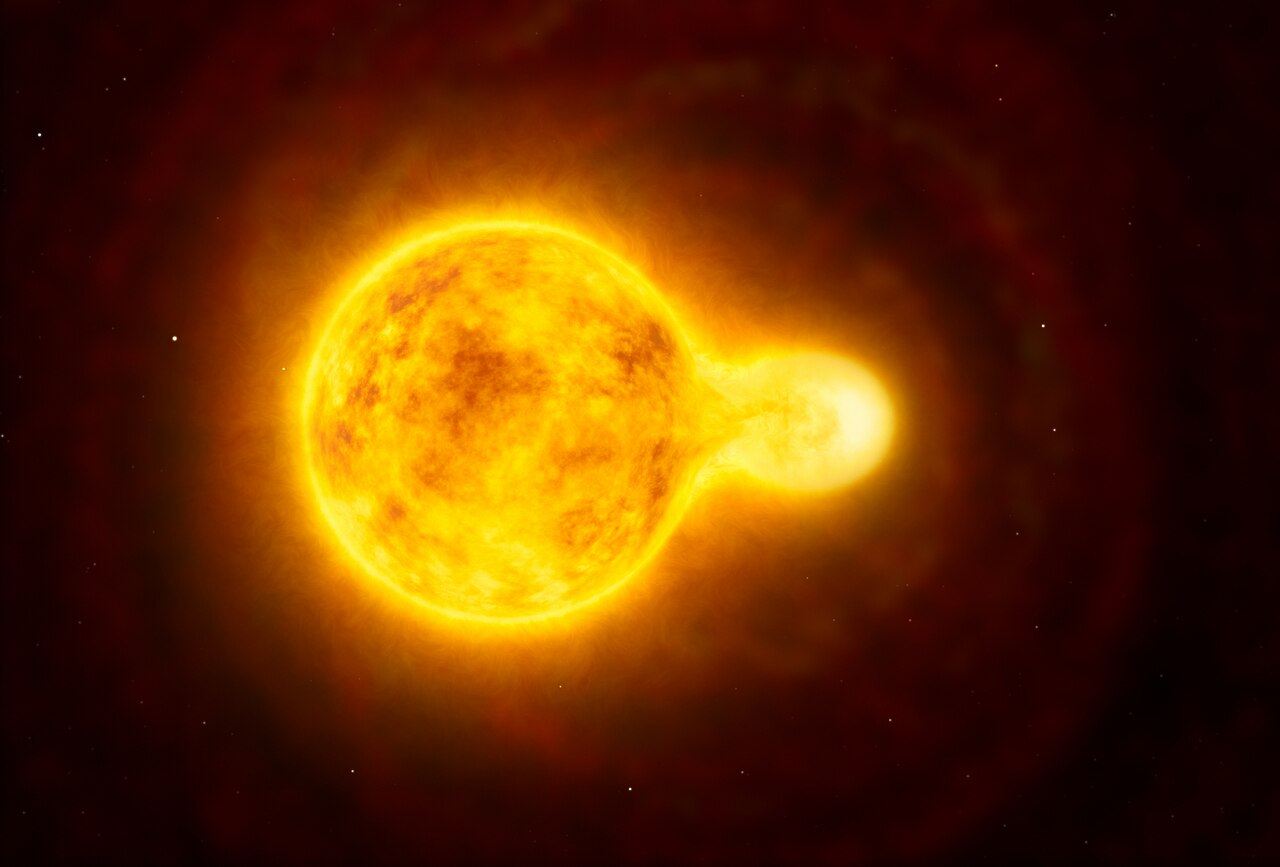


Basic characteristics
As a hypergiant, HR 5171 exhibits a cool, extended atmosphere with a spectral appearance typical of late-type supergiants. Published radius estimates range roughly from about 1,300 to 1,500 times that of the Sun, and its bolometric luminosity is hundreds of thousands of times solar. The star is photometrically variable and surrounded by circumstellar gas and dust produced by strong mass loss.
Companions and system architecture
HR 5171 is not solitary. High-resolution observations indicate at least one close companion that appears to share an extended common envelope with the primary — a configuration sometimes described as contact or near-contact. A more distant, hotter blue companion has also been identified, making the whole object a multiple system. The interactions between components influence observed variability and the shape of the primary's envelope.
Observations and research
Modern optical interferometry and spectroscopy have been essential to resolve HR 5171's large angular size, measure its complex shape, and detect companions. These techniques complement photometric monitoring and infrared studies that trace dust and mass loss. Because parameters depend on distance and model assumptions, published values carry significant uncertainties.
Significance and context
HR 5171 provides a nearby laboratory for late stages of massive-star evolution: extreme mass loss, envelope inflation, and binary interaction. Such systems are important for understanding progenitors of supernovae and merging massive stars. For a general description of stars like this, see the entry on star.
- Also known as V766 Cen and listed in the Bright Star Catalogue.
- Shows irregular variability and evidence of episodic mass ejection.
- Because of size and instability, its parameters are actively revised as new observations appear.
Related articles
Author
AlegsaOnline.com HR 5171 (V766 Centauri): a massive yellow hypergiant Leandro Alegsa
URL: https://en.alegsaonline.com/art/45466
Sources
- aanda.org : "The yellow hypergiant HR 5171 A: Resolving a massive interacting binary in the common envelope phase"
- doi.org : 10.1051/0004-6361/201322421
- worldcat.org : 1432-0746
- aanda.org : "Multi-epoch VLTI-PIONIER imaging of the supergiant V766 Cen - Image of the close companion in front of the primary"
- doi.org : 10.1051/0004-6361/201731569