
Hubble Deep Field — landmark HST image revealing thousands of distant galaxies
Survey of the Hubble Deep Field (1995): its observation toward Ursa Major, discovery of thousands of faint galaxies, scientific importance, methods and lasting legacy for studies of the distant Universe.
Overview
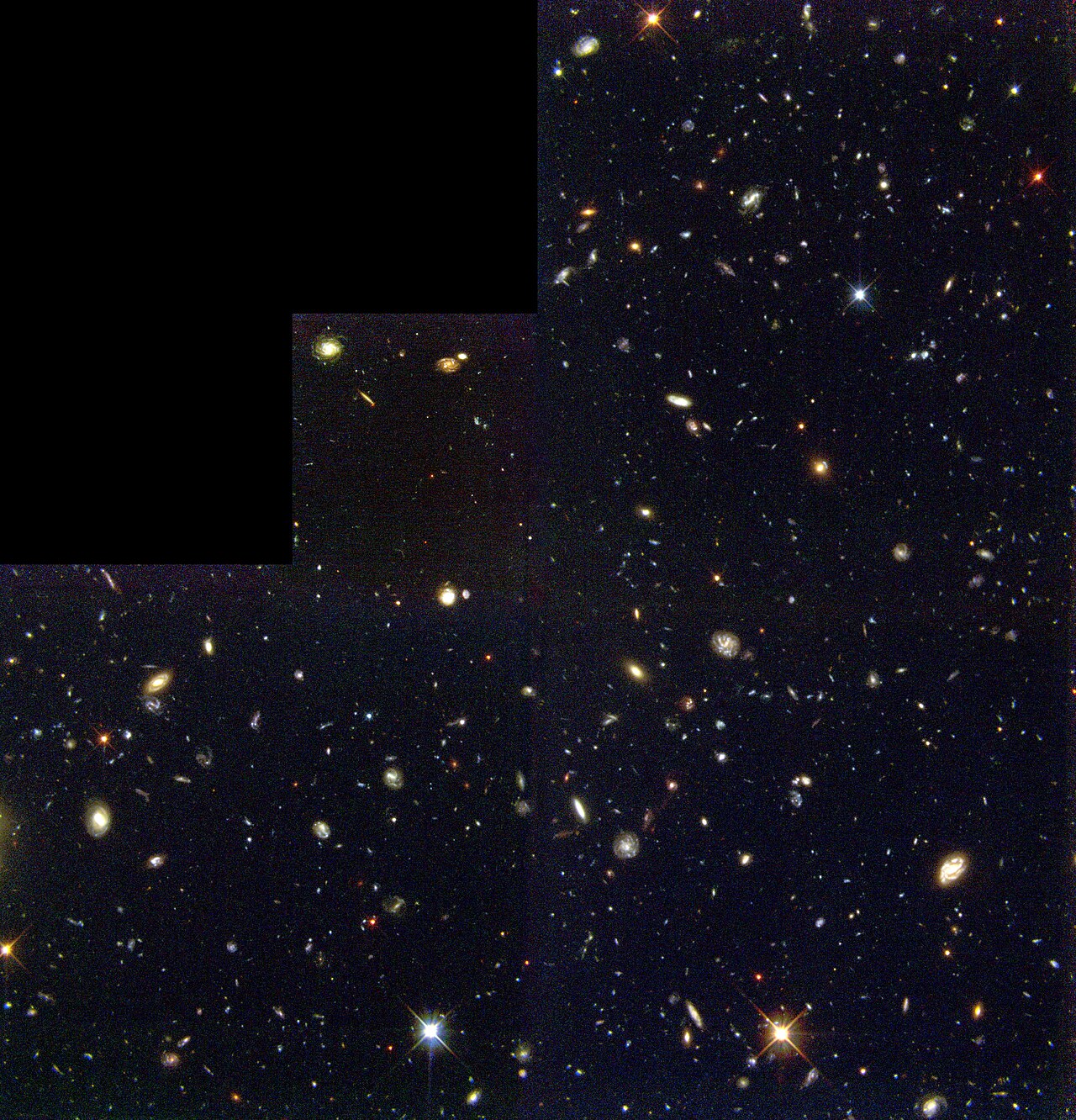
The Hubble Deep Field (HDF) is a landmark deep astronomical image produced from a concentrated series of observations by the Hubble Space Telescope in 1995. The project targeted a small, apparently empty patch of sky in the direction of Ursa Major to probe the faintest detectable galaxies. By integrating light for many orbits and combining exposures taken through several filters, the HDF revealed an extraordinary population of distant galaxies that were invisible in shorter exposures.
Image gallery
10 Images




Observations and instruments
The image was obtained with Hubble's imaging camera and used multiple optical filters to capture colour information, enabling basic estimates of galaxy types and distances. Observers deliberately selected a region that avoided bright foreground stars and known nearby galaxies so that the long exposures could reach very faint sources. Although the field of view is tiny compared with everyday sky references — much less than the apparent width of a full Moon — it contains thousands of resolved galaxies.
Why the HDF matters
Because light travels at a finite speed, the HDF records objects as they appeared in the past: the faintest, most distant galaxies are seen as they were billions of years ago. The time delay in reception of light means that many galaxies in the HDF are observed in an early stage of their evolution, so the image offers a direct window into how galaxies assembled and changed. Observations made from Earth and space have used the HDF to study the history of star formation, galaxy morphology, and the growth of stellar mass across cosmic time.
Scientific results and methods
The HDF revealed more than three thousand galaxies within its tiny footprint, showing a wide variety of shapes, sizes and colours. To interpret the image, astronomers applied techniques such as photometric redshifts (using colour information to estimate distance) and later obtained spectroscopic confirmations for many objects. These methods allowed researchers to compile number counts, luminosity distributions and rough evolutionary sequences for galaxies out to high redshift. The HDF played a central role in developing practical tools for deep-sky analysis and for testing theoretical models of galaxy formation under the broader framework of the Universe.
Follow-up, multiwavelength work and confirmation
After the original HDF, scientists conducted extensive follow-up using ground-based telescopes and other space observatories across the electromagnetic spectrum. Observations in the infrared, radio and X-ray bands complemented the optical data, providing information on dust, active nuclei and star formation that is hard to obtain at optical wavelengths alone. The HDF also motivated a southern counterpart field, deeper and larger surveys, and the use of photometric techniques to prioritise targets for spectroscopic campaigns.
Legacy and influence
The Hubble Deep Field is often cited as a turning point in observational cosmology because it demonstrated the scientific value of very deep, long exposures on small, carefully chosen fields. It influenced survey design for subsequent projects such as the Hubble Ultra Deep Field and other deep multiwavelength campaigns. The dataset served as a training set for image analysis, a benchmark for estimating galaxy counts and the evolving rate of star formation, and a source of targets for many follow-up studies by professional astronomers.
Context in cosmology
Interpretation of HDF results makes use of general cosmological ideas such as the cosmological principle, which assumes the Universe is statistically similar on very large scales. Under that principle, a tiny, deep survey like the HDF can provide representative information about the distant Universe when combined with other fields and wavelengths. Although the HDF covers a minute fraction of the sky, its depth and quality turned that small patch into a key probe of the early stages of galaxy assembly and of the broad patterns of cosmic evolution.
Notable facts
- The HDF revealed thousands of galaxies in a field far smaller than common sky references, demonstrating the richness of the distant sky.
- It was a practical proof of concept that long, repeated exposures produce high scientific return and guide the design of later deep surveys.
- The HDF dataset remains a useful reference for observational techniques and for comparing models of galaxy formation and evolution.
Continued relevance
Decades after the original observation, the Hubble Deep Field retains historical and scientific importance. Its approach — deep, multi-filter imaging of carefully chosen fields with coordinated follow-up — continues to shape observational programs that probe the earliest and faintest structures in the cosmos. For students and researchers studying the growth of structure in the Universe, the HDF remains an instructive example of how focused, high-quality data can reveal the distant past and inform models of cosmic history.
Questions and answers
Q: What is the Hubble Deep Field?
A: The Hubble Deep Field is an image of a small part of the night sky taken by the Hubble Space Telescope in 1995.
Q: Why is the Hubble Deep Field important?
A: The Hubble Deep Field is important because it shows some of the earliest galaxies ever seen, over 3000 in total. It allows scientists to look at what the Universe was like over 10 billion years ago and how it has changed.
Q: In what direction was the Hubble Deep Field taken?
A: The Hubble Deep Field was taken in the direction of the constellation Ursa Major.
Q: What is the area of the sky that the Hubble Deep Field was taken in?
A: The area of the sky that the Hubble Deep Field was taken in makes up less than 1/10th the width of a full Moon.
Q: How many galaxies are in the Hubble Deep Field?
A: There are over 3,000 galaxies in the Hubble Deep Field.
Q: Why do many galaxies in the Hubble Deep Field look the same as they did over 10 billion years ago?
A: Many galaxies in the Hubble Deep Field look the same as they did over 10 billion years ago because of the time it takes for light from these galaxies to reach Earth.
Q: What is the cosmological principle in relation to the Hubble Deep Field?
A: The cosmological principle, which suggests that on large scales the Universe is roughly the same no matter what direction you look, is important in relation to the Hubble Deep Field. It becomes a very important tool for astronomers studying how the Universe has changed.
Related articles
Author
AlegsaOnline.com Hubble Deep Field — landmark HST image revealing thousands of distant galaxies Leandro Alegsa
URL: https://en.alegsaonline.com/art/45509
Sources
- hubblesite.org : "Hubble's deepest view of the Universe unveils bewildering galaxies across billions of years"
- csep10.phys.utk.edu : "The Cosmological Principle"
- google.co.uk : "Google search:Hubble Deep Field"