
Hubble eXtreme Deep Field (XDF)
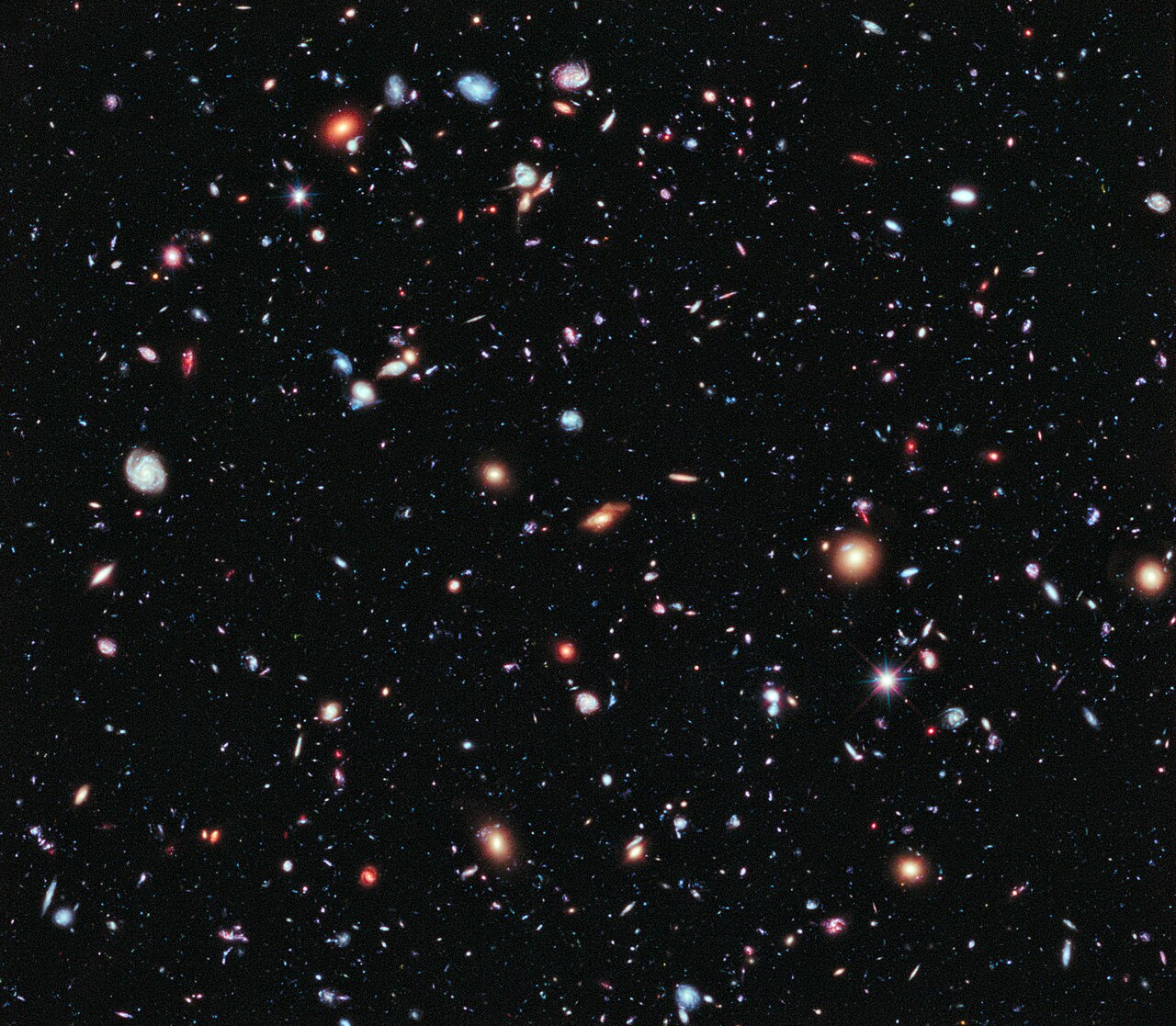
A composite Hubble Space Telescope image of a tiny patch of sky in Fornax, released in 2012, showing some of the faintest and most distant galaxies known and probing the early universe.
Overview
The Hubble eXtreme Deep Field (XDF) is a composite image created from many exposures taken by the Hubble Space Telescope that focuses on an extremely small region of the sky. It sits within the area previously imaged as the Hubble Ultra Deep Field and looks in the direction of the southern constellation Fornax. When it was released in 2012, the XDF represented the deepest optical and near-infrared view of the universe available, revealing thousands of galaxies at a wide range of distances and ages.
Image gallery
10 Images


Key characteristics
The XDF combines roughly a decade of Hubble observations into a single, very long-exposure image. Total exposure time for the assembled image was on the order of two million seconds (about 23 days) accumulated across many visits and instruments. The result reaches extremely faint light levels — objects visible in the XDF can be billions of times dimmer than what the unaided human eye can detect. The image contains a rich assortment of galaxies: large mature systems, small irregular galaxies, and many faint sources whose light began its journey more than 13 billion years ago.
History and construction
The XDF was produced by reprocessing and combining archival Hubble data, including observations from different cameras and programs carried out over about ten years. It built on earlier deep fields (such as the Hubble Deep Field and the Hubble Ultra Deep Field) by adding newer exposures and improved processing techniques to increase depth and clarity. Instrumental contributions included optical data and near-infrared imaging, which together allow astronomers to detect galaxies at very high redshift and to sample light that has been stretched by cosmic expansion.
Scientific importance and uses
Deep-field images like the XDF are essential tools for studying galaxy formation and evolution. By measuring the colors, shapes, and number densities of galaxies in the field, astronomers can infer when stars first formed, how early galaxies assembled and merged, and how the overall population changed over cosmic time. The XDF has been used to identify candidate galaxies from the universe's first billion years and to select targets for spectroscopic follow-up and study with other observatories.
Notable facts and distinctions
- The XDF covers a minute fraction of the sky—an area comparable to a small grain of sand seen at arm's length—but it reveals thousands of galaxies within that patch.
- Many of the faint objects visible in the XDF represent very young galaxies seen when the universe was only a few hundred million to a few billion years old; their light provides a glimpse into the epoch of early galaxy assembly.
- At the time of its release, the XDF added several thousand faint galaxies to the catalog of known deep-field sources, extending earlier Hubble surveys in sensitivity and wavelength coverage.
Further reading and resources
- Project overview and basic facts
- Technical details and instrument contributions
- Optical and near-infrared considerations
- Catalogs of galaxies identified in the field
- Exposure time and data processing notes
- Context with previous Hubble deep fields
The XDF remains an iconic example of how deep, targeted imaging over a tiny area can transform our view of the distant universe and provide a foundation for future observations with other facilities.
Questions and answers
Q: What is the Hubble eXtreme Deep Field?
A: The Hubble eXtreme Deep Field is an image of a small part of space in the center of the Hubble Ultra Deep Field. It is the deepest optical view into space.
Q: When was the XDF image released?
A: The XDF image was released on September 25, 2012.
Q: How long did it take to create the XDF image?
A: The XDF image combined 10 years of images taken by the Hubble telescope.
Q: What is the exposure time for the XDF image?
A: The exposure time for the XDF image was two million seconds, or about 23 days.
Q: How old are some of the galaxies shown in the XDF image?
A: The XDF image shows galaxies that are over 13.2 billion years old.
Q: How bright are the least bright galaxies in the XDF image?
A: The least bright galaxies in the XDF image are one ten-billionth the brightness of what the human eye can see.
Q: What kinds of galaxies are shown in the XDF image?
A: Many of the smaller galaxies shown in the XDF image are very young galaxies, and some of them became the major galaxies, like the Milky Way and other galaxies in our galactic neighborhood.
Related articles
Author
AlegsaOnline.com Hubble eXtreme Deep Field (XDF) Leandro Alegsa
URL: https://en.alegsaonline.com/art/45510
Sources
- space.com : "Hubble Telescope Reveals Farthest View Into Universe Ever"
- nasa.gov : "Hubble Goes to the eXtreme to Assemble Farthest-Ever View of the Universe"
- timesofindia.indiatimes.com : "New 'extreme' Hubble telescope shows deepest view yet of night sky"