
Anonymous (hacktivist collective)
Overview of Anonymous: origins, structure, tactics, notable actions, symbolism and controversies surrounding the decentralized hacktivist collective.
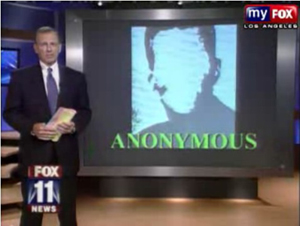
Anonymous is a loosely affiliated, decentralized collective of online activists and self-described hacktivists associated with a range of internet-based protests, direct-action campaigns and occasional cyber operations. The label is applied to diverse, independently acting participants who coordinate without formal membership or central leadership, and who often adopt the name to claim responsibility for actions or to express solidarity for causes. Analysts and journalists have traced many early connections to image-board culture and to ad hoc collaboration on public forums and chat platforms.
Image gallery
7 Images


Characteristics and organisation
Anonymous has no fixed hierarchy, membership rolls or single doctrine. Instead, it functions as a shared identity and tactical repertoire that individuals and groups adopt. Coordination typically occurs through online channels such as message boards, social-media threads, and encrypted chat, and it has at times relied on sites associated with early activity like 4chan and other communal forums. Because participants act independently, operations attributed to Anonymous vary greatly in scale, method and motivation; some efforts are spontaneous protests, others are organized campaigns that persist for weeks.
Origins and history
The name emerged from the culture of anonymous posting on image boards and message forums, where many contributions were unsigned. Over the years the label came to describe a series of pranks, publicity stunts and protest campaigns, and later a set of online tactics used in support of political or social causes. Public attention increased after several high-profile interventions that drew media coverage and prompted public debate over digital civil disobedience, online rights and criminal liability. Commentators and mainstream outlets have offered varied interpretations, with some framing the phenomenon as a form of grassroots activism and others emphasizing risks and legal consequences; for example, a major magazine included a discussion of the collective in its annual influential-people coverage.
Tactics and notable operations
Actions associated with Anonymous have included public demonstrations, information releases, coordinated social-media campaigns and technical measures designed to disrupt online services. A frequently reported technical tactic is the distributed denial-of-service (DDoS) attack, intended to overload and temporarily disable websites; such campaigns have at times targeted payment processors such as PayPal and public-sector portals including the U.S. Department of Justice. Other published accounts describe activities to pressure organizations perceived to restrict free expression or to punish perceived wrongdoing, including the release of leaked material or the exposure of internal documents.
- Common stated goals: defending freedom of speech, opposing censorship, and challenging perceived political corruption.
- Modes of action: internet-based protests, targeted leaks, DDoS campaigns, and street demonstrations coordinated online.
- Study and analysis: researchers and commentators have documented organizational features and online dynamics of the collective in academic and journalistic accounts (analysis).
Legal issues, arrests and public perception
Because some operations attributed to Anonymous have been illegal in multiple jurisdictions, law-enforcement investigations and arrests have followed in several countries. Reported prosecutions and detentions have occurred in nations including the United States, the United Kingdom, Australia, the Netherlands, Spain and Turkey. Public opinion is deeply divided: supporters and sympathizers sometimes characterise participants as defenders of digital rights or as "digital Robin Hoods" (description), while critics and some officials describe certain actions as reckless, harmful or criminal. Legal debates often focus on questions of collective responsibility, intent, attribution and the boundary between protest and unlawful conduct.
Symbols, culture and public tactics
Anonymous has become associated with a set of visual and performative symbols intended to signal anonymity and collective identity. A widely adopted emblem is the Guy Fawkes mask popularized by the graphic novel and film V for Vendetta; the mask has been worn at protests and featured in media depictions. In public appearances many participants attempt to conceal identity using masks, face coverings, voice distortion tools or pseudonymous accounts, and some adopt particular slogans or imagery that blend internet humour with political critique. The group’s culture combines elements of online trolling, direct-action activism and oppositional politics, creating a complex, often contradictory public image.
Debate, research and legacy
Scholars and commentators study Anonymous as a case of networked protest and emergent collective action, examining how decentralized identities and low-cost coordination can produce both political mobilisation and legal risk. Critics point to the uneven ethics of some operations and to harms that can arise when accountability is diffuse. Supporters highlight the group’s role in drawing attention to issues of censorship, privacy and corporate behaviour. Media profiles and reflective pieces in the early 2010s helped cement the group’s place in public debates about internet-era protest and the limits of online dissent (coverage).
Because the label is open and leaderless, its future actions will likely continue to be heterogeneous: ranging from expressive protests to technically disruptive campaigns. Researchers and policy makers continue to watch the collective for evidence about how decentralized online communities mobilize and interact with legal and political institutions, and for lessons about balancing online civil disobedience with rule-of-law concerns. For further context on activism and participant descriptions, see commentary by various writers and activists (activists).
Related articles
Author
AlegsaOnline.com Anonymous (hacktivist collective) Leandro Alegsa
URL: https://en.alegsaonline.com/art/4496
Sources
- mercurynews.com : "Freedom fighters or vandals? No consensus on Anonymous"
- cbc.ca : "From Anonymous to shuttered websites, the evolution of online protest" · webcitation.org
- mediacommons.futureofthebook.org : "Anonymous: From the Lulz to Collective Action" · webcitation.org
- highbeam.com : "Hackers step up war on security services"
- time.com : "The 100 Most Influential People In The World"
- bbc.com : "The man behind the V for Vendetta mask"
- bu.edu : "Investing in a Centralized Cybersecurity Infrastructure: Why 'Hacktivism' can and should influence cybersecurity reform" · archive.org
- books.google.com : We Are Anonymous: Inside the Hacker World of LulzSec, Anonymous, and the Global Cyber Insurgency · web.archive.org
- mediashift.org : mediashift.org
- rferl.org : "Parmy Olson On Anonymous: 'A Growing Phenomenon That We Don't Yet Understand'" · webcitation.org