
Homo antecessor — early human of Pleistocene Europe
Homo antecessor is an extinct human species known from Atapuerca (Spain), dated to about 1.2–0.8 million years ago. Its fossils combine primitive and modern features and include evidence of butchery and debated cannibalism.
Overview
Homo antecessor is an extinct human taxon described from fossils recovered in the Sierra de Atapuerca, northern Spain. Dated broadly to the Early Pleistocene (commonly cited as about 1.2–0.8 million years ago), these remains represent some of the earliest securely documented hominins in western Europe. The fossils attracted attention because they show a mosaic of features that has important implications for how researchers reconstruct early human dispersal and evolution in temperate Eurasia.
Image gallery
10 Images



Discovery and context
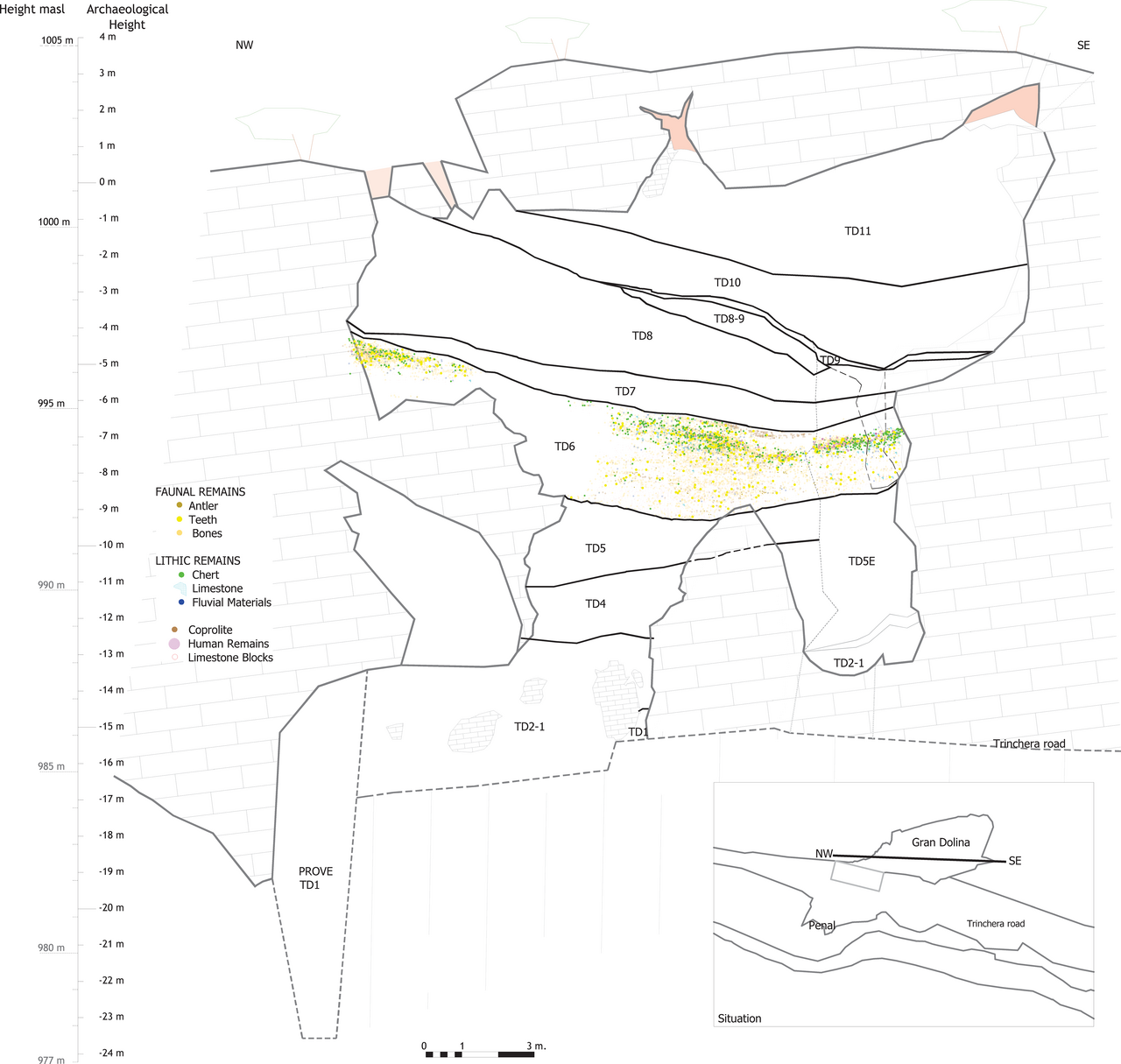
The taxon was named and described following large-scale excavations at the Gran Dolina level of the Atapuerca complex, led by Spanish teams including Eudald Carbonell, Juan Luis Arsuaga and J. M. Bermúdez de Castro. Excavations recovered a mix of cranial, dental and fragmentary postcranial remains representing multiple individuals, including a well-preserved maxilla of a juvenile. Geological and palaeontological work at the site, using a variety of stratigraphic and dating approaches, has placed these finds within the Early Pleistocene and linked them to rich assemblages of animal remains and simple stone artefacts.
Anatomy and morphology
H. antecessor displays a combination of derived and primitive traits. Some aspects of the midface and dental morphology have been described as relatively modern in appearance, whereas cranial vault features and other skeletal elements retain archaic characteristics observed in earlier Homo populations. This mixture has led researchers to view the species as potentially close to the root of later European lineages, although its exact relationship to later forms such as Homo heidelbergensis, Neanderthals and early modern humans remains debated.
Behaviour, tools and environment
Associated materials at Gran Dolina include simple stone flakes and abundant faunal remains showing cut marks and percussion marks produced by stone tools. The animal evidence indicates repeated hominin access to carcasses and systematic butchery. Human bones from the assemblage also show cut and fracture marks consistent with deliberate processing; these traces have been interpreted by some researchers as evidence of cannibalism, while others emphasise alternative explanations such as ritual activity, secondary burial disturbance or postmortem treatment. The Atapuerca deposits preserve fauna indicating a mosaic environment of open spaces and woodlands suitable for large mammals and repeated seasonal occupations by hominins.
Significance and scientific debate
Homo antecessor is important for understanding early hominin presence in temperate Europe and the morphological changes that occurred during the Early Pleistocene. Because the specimens combine features found in later European populations with more primitive anatomy, the species has been variously interpreted as an early branch related to later European Homo or as part of a broader, variable population of early Homo in Eurasia. No definitive ancient DNA has been recovered from these fossils, so researchers rely primarily on comparative anatomy, stratigraphy and improved dating to refine hypotheses about its place in our evolutionary tree. Ongoing fieldwork at Atapuerca and reanalysis of the material continue to inform these debates.
Further resources
Related articles
Author
AlegsaOnline.com Homo antecessor — early human of Pleistocene Europe Leandro Alegsa
URL: https://en.alegsaonline.com/art/44924