
Homo heidelbergensis (Heidelberg Man)
Homo heidelbergensis is an extinct human lineage from the Middle Pleistocene that lived in Africa and Eurasia and is often considered an ancestor of Neanderthals and modern humans.
Overview
Homo heidelbergensis is the name used for a group of Middle Pleistocene human fossils found across Africa and Eurasia. These fossil remains show features intermediate between earlier Homo, such as Homo erectus, and later populations that include Neanderthals and anatomically modern humans. The species is generally placed in the time span from roughly 700,000 to 200,000 years ago, although dates and regional variation are debated. Many specimens are fragmentary and challenging to date precisely, which contributes to continuing discussion about their classification.
Image gallery
10 Images




Anatomy and physical characteristics
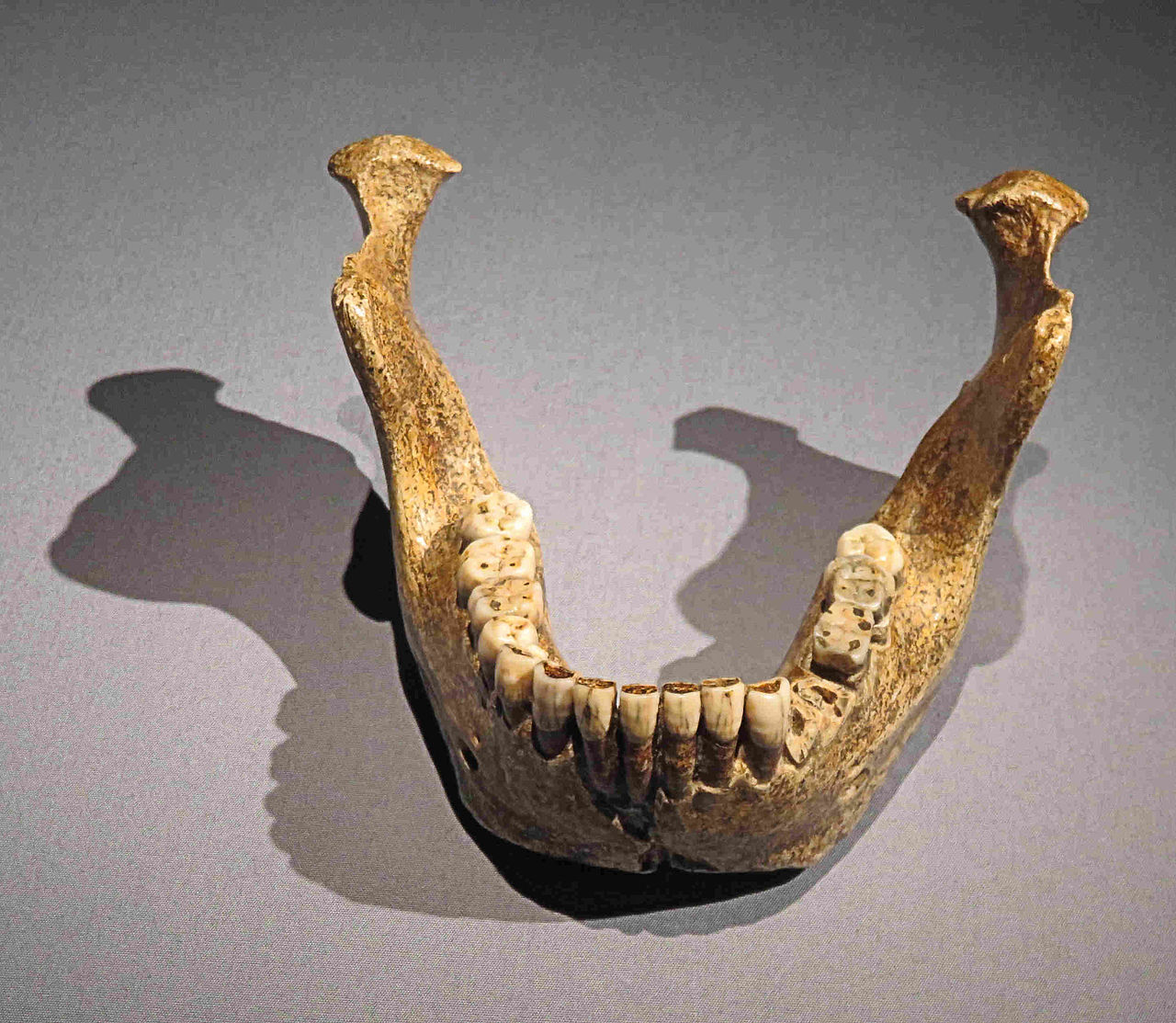
Specimens attributed to H. heidelbergensis typically have a large, thick-boned skull with pronounced brow ridges, a brain size approaching the lower range of modern humans, and a robust postcranial skeleton adapted to a physically demanding lifestyle. Dental and jaw proportions are often reduced compared with earlier Homo, but more robust than those of late Pleistocene humans. Because many finds are isolated bone fragments, reconstructions rely on combining information from several sites and individuals.
Key discoveries and dating
The species is named after the Mauer mandible, discovered near Heidelberg, Germany, in 1907. Other important assemblages include the Sima de los Huesos material from Atapuerca in Spain and African specimens sometimes grouped under names like H. rhodesiensis. Fossils appear across Africa, western and central Europe, and possibly parts of western Asia, reflecting a wide geographic range and regional diversity. Dating methods applied to these sites—stratigraphy, radiometric techniques and paleomagnetism—provide age estimates but also leave room for differing interpretations.
Behavior, technology and ecology
Populations often attributed to H. heidelbergensis made and used Acheulean stone tools and likely hunted large animals using wooden spears and coordinated strategies. Finds such as the wooden spears at Schöningen, Germany, are frequently associated with Middle Pleistocene hunters and suggest complex planning and tool use. Evidence points to flexible diets and adaptation to varied environments, from temperate Europe to parts of Africa. Some sites show possible evidence of controlled use of fire, though its timing and extent remain debated.
Taxonomy and scientific debate
There is no universal agreement on whether these fossils represent a single species or a series of related regional populations. Scientists differ in assigning particular specimens to H. heidelbergensis, labeling some remains as early Homo sapiens, or grouping European material closer to the Neanderthal lineage. Some researchers use broader terms like "archaic humans" or apply alternative names; others see H. heidelbergensis as ancestral to both Neanderthals and modern humans. These differing viewpoints reflect the fragmentary record and gradual evolutionary transitions rather than abrupt species boundaries.
Significance and distinctions
H. heidelbergensis occupies a pivotal place in human evolution, representing a stage in which traits of later humans were forming while retaining robust archaic features. Its study helps illuminate the origins of Neanderthals and the emergence of traits found in Homo sapiens. Because of overlapping morphology and regional variation, careful comparison of fossils, tools, and contexts is required; terms such as "archaic human" or "early species of Homo" are sometimes used for specimens that fall near the margins of definition. For summaries and further reading, consult specialist synthesis pages or museum resources that compile the many regional finds and interpretations: species discussions, early Homo surveys, and curated site reports available through major paleoanthropology portals.
- Notable sites: Mauer (Germany), Atapuerca/Sima de los Huesos (Spain), sites in Africa and Central Europe.
- Typical tools: Acheulean handaxes, wooden spears and diverse cutting tools.
- Debates: species boundaries, regional variation, and relationships to Neanderthals and modern humans.
For more detailed fossil lists, imaging, and updated chronological reviews see museum catalogues and recent synthesis articles: site reports, comparative anatomy, and multidisciplinary studies linking archaeology and paleoenvironmental data: tool and technology, African records, European records, and broader fossil databases.
Questions and answers
Q: What is Homo heidelbergensis?
A: Homo heidelbergensis is the name given to a number of human fossil remains that are older than fossils of Neanderthals.
Q: What does the abbreviation H. heidelbergensis stand for?
A: H. heidelbergensis stands for Homo heidelbergensis.
Q: Are scientists sure whether the remains attributed to Homo heidelbergensis belong to a distinct species?
A: No, scientists are not sure whether these remains are from a distinct species.
Q: Can the fragments attributed to Homo heidelbergensis be dated exactly?
A: No, most fragments cannot be dated exactly.
Q: What were the fragments referred to as in older texts?
A: In the older texts, they were simply called archaic humans or "early Homo sapiens."
Q: Which other species of Homo have well-defined remains been found?
A: There have been well-defined remains of Homo erectus found in Africa from very early in human history, and there have also been well-defined remains of Homo neanderthalensis found in Europe from later in history.
Q: Do some scholars use the terms "archaic humans," "early Homo sapiens," or Homo heidelbergensis to describe remains that seem to come from between these two periods in history?
A: Yes, some scholars use the terms "archaic humans," "early Homo sapiens," or Homo heidelbergensis to describe remains that seem to come from between these two periods in history.
Related articles
Author
AlegsaOnline.com Homo heidelbergensis (Heidelberg Man) Leandro Alegsa
URL: https://en.alegsaonline.com/art/44931
Sources
- sciencedirect.com : sciencedirect.com/science?_ob=ArticleURL&_udi=B6WJS-4VPV8MK-1&_user=10&_rdoc=1&_fmt=&_ori…
- books.google.com : The Human Lineage
- archeo.uw.edu.pl : "Human Evolution in the Middle Pleistocene: the role of Homo heidelbergensis"
- doi.org : 10.1002/(SICI)1520-6505(1998)6:6<218::AID-EVAN4>3.0.CO;2-6
- humanorigins.si.edu : "Kabwe 1"
- creationstudies.org : "The Ancestry of Man from Homo habilis to Homo floresiensis"
- anthro.palomar.edu : "Evolution of Modern Humans: Homo heidelbergensis"
- humanorigins.si.edu : The Mystery of the Pit of Bones, Atapuerca, Spain: Species Homo heidelbergensis.
- bbc.co.uk : "The first Europeans – One million years ago"
- britarch.ac.uk : '700,000 years old: found in Pakefield'
- suffolk.gov.uk : The Archaeology of the Suffolk Coast
- news.bbc.co.uk : Tools unlock secrets of early man