
Hero of Alexandria — Greek engineer and mathematician
First‑century Greek mathematician and engineer known for the aeolipile, Heron's formula, practical treatises on pneumatics, automata, surveying and methods that preserved Hellenistic technology.
Overview
Hero of Alexandria (Greek: Ἥρων ὁ Ἀλεξανδρεύς) was an ancient Greek‑speaking scholar active in Alexandria in the early Roman imperial period, conventionally placed in the 1st century AD. He is widely described as both a mathematician and an engineer. Alexandria, a city founded by Alexander the Great, remained a major centre of learning and practical technology when Hero worked there. Biographical details are sparse and some of the works attributed to him may be compilations of earlier Hellenistic technical knowledge.
Image gallery
4 Images

Surviving works
Several technical treatises are preserved under his name, notably Pneumatica, Automata, Metrica and Dioptra. These texts survive in Greek manuscripts and in later translations. In general they combine descriptive geometry, rules of measurement and explicit constructional instructions, and they were intended for practising surveyors, artisans and engineers rather than for purely theoretical mathematicians.
Devices and inventions
Hero described a variety of mechanical and hydraulic devices. Among the best known are:
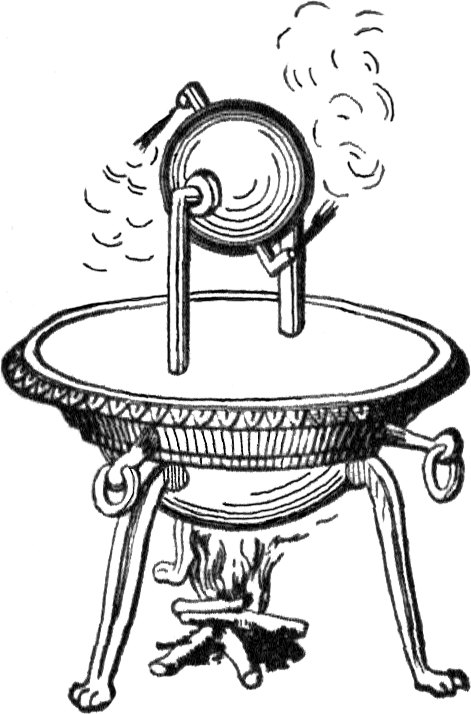
- Aeolipile — a hollow sphere mounted to rotate by reaction from steam jets, often cited as an early demonstration of steam power.
- Automatic mechanisms such as coin‑operated machines, theatrical automata and self‑acting temple doors that used clever combinations of pneumatics and weights.
- Hydraulic and pneumatic devices including pumps, fountains and valves that illustrate principles of pressure, siphons and airflow.
Mathematical methods
Hero set out practical computational techniques alongside his machines. He gave an iterative rule for extracting square roots, a procedure later recognized as a special case of the Newton–Raphson method, and he recorded the formula for the area of a triangle that bears his name, Heron's formula. Rather than long abstract proofs, his treatments favour worked examples and numerical recipes suited to craftsmen and surveyors.
Instruments and surveying
The treatise Dioptra and parts of Metrica discuss instruments for measuring distances, angles and areas. Hero describes a form of dioptra (a sighting and leveling instrument) together with procedures for triangulation and area computation that reflect a continuing tradition of practical surveying from Hellenistic Egypt.
Historical context and influence
Scholars note the contrast between Hero's applied approach and the more axiomatic style of authors such as Euclid. Through manuscript transmission and translations his writings influenced Byzantine and Islamic engineers and, later, medieval and Renaissance Europeans. Important translators and commentators reached his texts in Arabic and Latin, and his clear, instruction‑based presentation helped preserve Hellenistic techniques in hydraulics, pneumatics and automata. Modern collections and introductions often treat Hero as a key source for the technology of antiquity; see general discussions of ancient mathematics and the role of Alexandria in the history of science for further context.
Assessment
Hero's corpus is valued chiefly for its technical detail and for preserving concrete procedures rather than for original theoretical advances alone. Commentators such as Florian Cajori described him as essentially a practical surveyor and mechanic, a characterization that explains the procedural and example‑based nature of his surviving writings. For readers interested in primary translations and modern commentary, survey editions and scholarly introductions collect his key texts and compare them with both earlier Hellenistic sources and later technical traditions.
Further resources
Introductory discussions and editions of Hero's texts appear in collections that examine ancient engineering, pneumatics and automata. Readers may consult modern overviews of ancient applied science and specialized studies of devices such as the aeolipile or the surveying methods in Metrica. For bibliographic entries and links to translations, search resources under topics including mathematics, applied mechanics and the history of Alexandria.
Related articles
Author
AlegsaOnline.com Hero of Alexandria — Greek engineer and mathematician Leandro Alegsa
URL: https://en.alegsaonline.com/art/43856