
Euclid of Alexandria — Greek mathematician and author of the Elements
Greek mathematician active in Alexandria c. 300 BC, author of the Elements; foundational figure in geometry, axiomatic method, and mathematical education.
Overview
Euclid (Greek: Εὐκλείδης) was an ancient Greek mathematician who lived and worked in Alexandria, Egypt, during the early Hellenistic period. Exact details of his birth and private life are unknown; traditional dates place him around 325–265 BC. He is often associated with the scholarly circle around the Library of Alexandria and is sometimes said to have been active under Ptolemy I, though these connections are not documented with certainty.
Image gallery
8 Images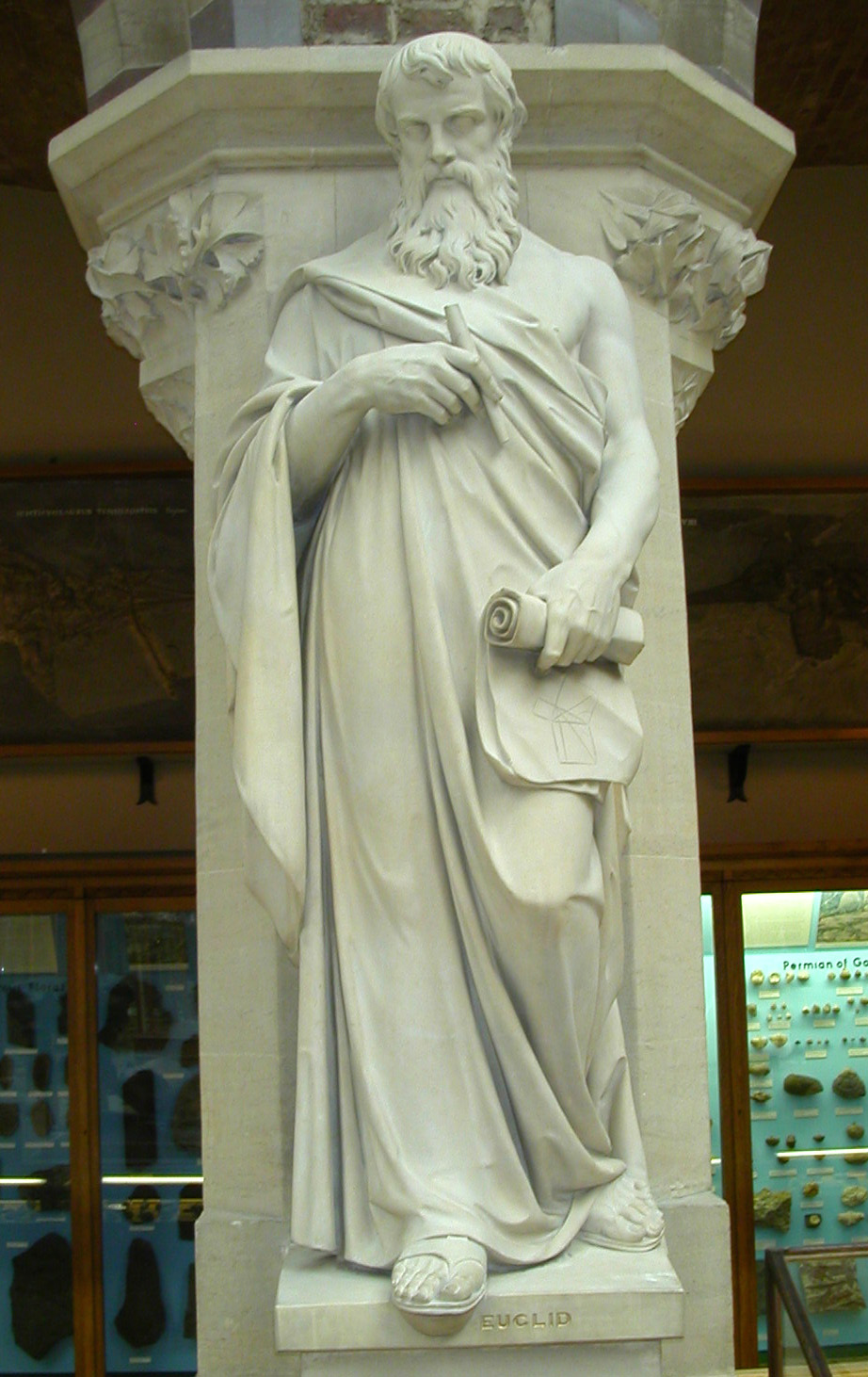




Major works and structure
The work that secured Euclid's reputation is the Elements, a compilation and systematic treatment of the mathematics known in his time. The Elements arranges definitions, postulates (axioms), and propositions into a logical sequence of proofs. It covers plane and solid geometry, elementary number theory, and the theory of proportion. Other writings attributed to him include Data, Optics, and Phaenomena, though some of these survive only in part or as later copies and commentaries.
Method and characteristics
Euclid's distinguishing contribution was methodological: he presented mathematics as a deductive discipline. Starting from a small set of definitions and postulates, he derived many propositions by rigorous logical proof. The five postulates in the Elements—most famously the parallel postulate—served as the foundation for plane geometry for two millennia. His style emphasized clarity, modular proof structure, and the reuse of established results to build more complex arguments.
Historical context and life
Biographical information about Euclid is scant. Ancient sources provide only brief and sometimes anecdotal notices. Modern historians view Euclid as both a compiler of earlier Greek mathematics and an original organizer whose selection, ordering, and proofs shaped the subsequent development of the subject. The scholarly environment of Alexandria, with its collections and teachers, offered the intellectual setting in which his work could be preserved and widely copied.
Legacy and influence
The Elements became the standard textbook for teaching geometry and remained central to mathematics education until the 19th century; it has influenced logic, science, engineering, and architecture. Debates about the parallel postulate eventually led to the discovery of non-Euclidean geometries in the 19th century, which expanded mathematical thought but did not diminish the practical importance of Euclidean methods. Euclid is commonly called the "father of geometry" for his role in organizing and formalizing geometric knowledge.
Notable facts and distinctions
- Elements: one of the most widely transmitted textbooks in history, surviving in many manuscripts and translations.
- Method: early and influential example of the axiomatic method in mathematics.
- Reception: studied continuously in the Islamic world and in Europe; used as the basis for mathematics instruction for centuries.
Although much about his personal life remains uncertain, Euclid's name endures through the structure and style he gave to mathematical exposition. His work continues to be a starting point for elementary geometry and a reference for the historical development of mathematical rigor.
Questions and answers
Q: Who was Euclid of Alexandria?
A: Euclid of Alexandria was a Greek mathematician who lived in Alexandria, Egypt and worked at the Library of Alexandria.
Q: When did Euclid live?
A: Euclid lived around 325 BC–265 BC.
Q: Where did Euclid work as a mathematician?
A: Euclid worked at the Library of Alexandria in Egypt.
Q: What is known about Euclid?
A: Little is known about Euclid except that he lived in Alexandria when Ptolemy I was Pharaoh.
Q: Is it known where Euclid was born?
A: It is not known where or when Euclid was born.
Q: What is Euclid known for?
A: Euclid is known for writing a book called "Elements" which is considered one of the most important works in the history of mathematics.
Q: What was the significance of Euclid's work?
A: Euclid's work was significant because it laid the foundations for modern mathematics and is still studied today.
Related articles
Author
AlegsaOnline.com Euclid of Alexandria — Greek mathematician and author of the Elements Leandro Alegsa
URL: https://en.alegsaonline.com/art/32463
Sources
- math.ubc.ca : "One of the oldest extant diagrams from Euclid"
- wikidata.org : wikidata.org/wiki/Q8747
- authority.bibsys.no : 90205202
- catalogo.bne.es : XX1000405
- catalogue.bnf.fr : cb11901997s
- data.bnf.fr : (data)
- cantic.bnc.cat : a10476970
- ci.nii.ac.jp : DA00733282
- d-nb.info : 118638955
- isni.org : 0000 0001 2321 3955
- id.loc.gov : n50043341
- aleph.nkp.cz : jn20011024099
- data.bibliotheken.nl : 069356378
- aleph.rsl.ru : 000002326
- libris.kb.se : 185706