
Hectogon (100-sided polygon)
A hectogon, also called a hectagon, is a polygon with 100 sides and vertices. This article explains its properties, regular form, formulas, symmetry, history, and common uses.
A hectogon (also spelled hectagon) is a polygon that has exactly one hundred sides and one hundred vertices. In its most symmetric form the figure is a regular hectogon, with all sides equal and all interior angles equal. The word derives from the Greek hekaton, meaning "one hundred," combined with gonia, meaning "angle". For a concise basic definition see this reference.
Image gallery
4 Images

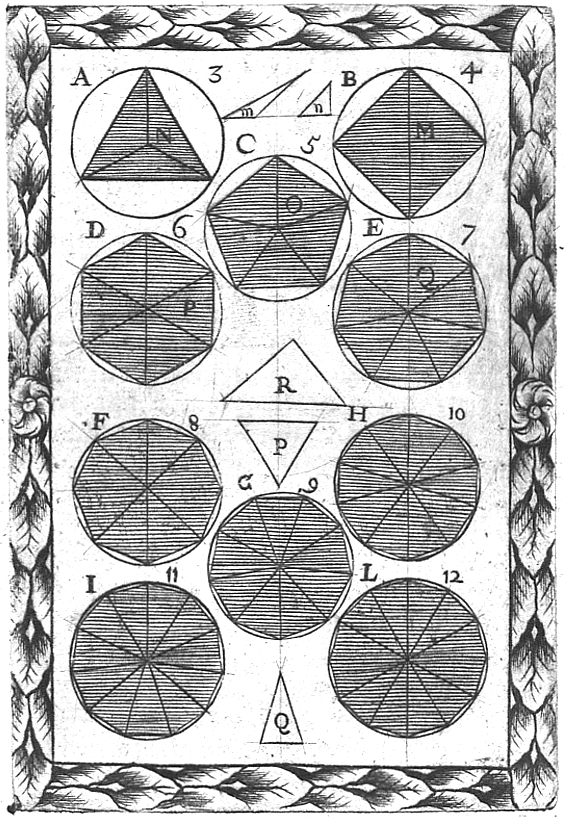
Basic characteristics
- Sides and vertices: 100 each.
- Interior angle (regular): (100−2)×180°/100 = 176.4° per vertex.
- Exterior angle (regular): 360°/100 = 3.6°.
- Number of diagonals: n(n−3)/2 = 100×97/2 = 4,850 diagonals.
- Perimeter (regular): 100 × s, where s is the side length.
- Area (regular): A = (100·s²) / (4·tan(π/100)), where s is the side length.
The regular hectogon is often denoted by the Schläfli symbol {100}. It has dihedral symmetry D100 of order 200, comprising 100 rotational symmetries and 100 reflections. Irregular hectogons may have very different shapes but still satisfy the defining count of sides and vertices.
Constructibility and related polygons
Classical compass-and-straightedge constructibility of polygons depends on the number theory of the number of sides. A regular 100-sided polygon is not constructible with a classical compass and straightedge because 100 = 2^2·5^2 includes a repeated odd prime factor (5) and thus does not meet the criterion requiring a product of a power of two and distinct Fermat primes. Simpler polygons such as the regular 20-gon (2^2·5) are constructible, but the squared factor in 100 prevents a straightedge-and-compass construction.
History, notation, and star forms
The naming follows classical Greek roots common to polygon terminology. In addition to the convex regular {100}, one can form regular star polygons using the same vertex set but connecting every k-th vertex; these are written {100/k} for suitable integers k. Such star forms are often studied in recreational geometry and in algebraic contexts where rotational symmetry plays a role.
Uses and notable facts
Though uncommon in everyday architecture or tiling, hectogons appear in mathematical examples to illustrate limits: as the number of sides grows, the regular polygon approximates a circle more closely. They are useful in computational geometry, graphic design, and numeric experiments where many-sided polygons serve as circle approximations. Because a regular hectogon’s interior angle is 176.4°, its shape is very close to circular when drawn with equal side lengths.
For further reading on polygon properties and related topics, consult general polygon references or the linked definition above: definition and basics.
Related articles
Author
AlegsaOnline.com Hectogon (100-sided polygon) Leandro Alegsa
URL: https://en.alegsaonline.com/art/43186