
Harpalyke (moon)
Harpalyke is a small irregular retrograde moon of Jupiter, about 4 km across. Discovered in 2000, it belongs to the Ananke group and orbits at ~21 million km with a ~624-day period.
Overview
Harpalyke is one of Jupiter's many small irregular satellites. Designated Jupiter XXII and originally catalogued as S/2000 J 5, it is a non-spherical body roughly 4 kilometres in diameter. Harpalyke follows a distant, retrograde orbit around Jupiter and has surface properties that make it appear grey, resembling primitive C-type asteroids.
Image gallery
1 Image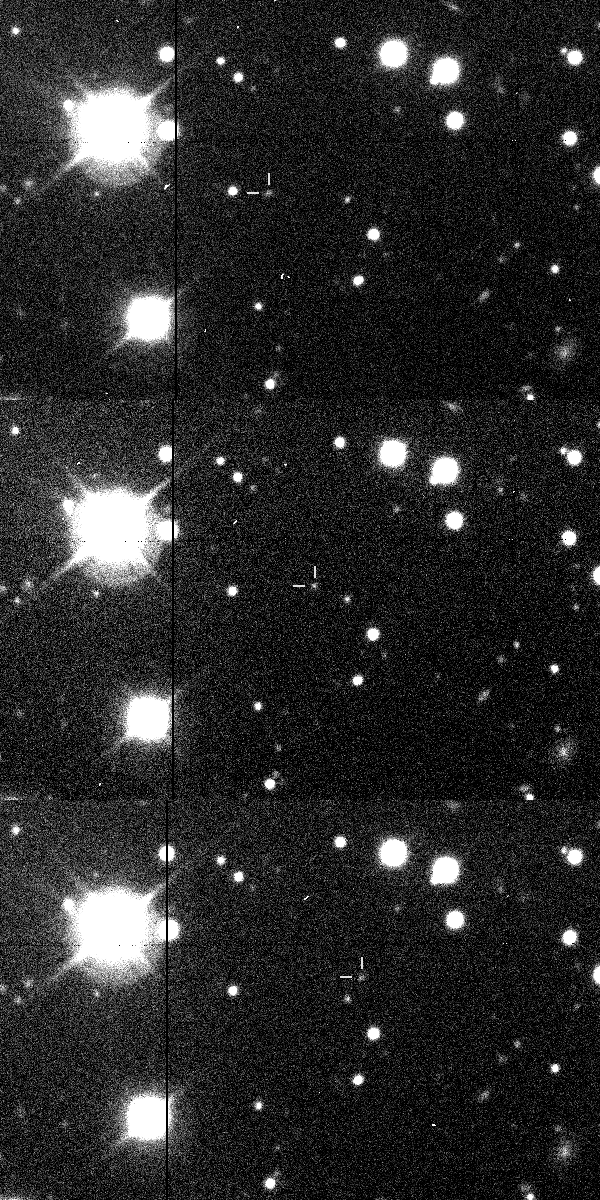
Discovery and name
The moon was discovered in the year 2000 by a team of astronomers from the University of Hawaii led by Scott S. Sheppard. Following confirmation of its orbit, it received the permanent name Harpalyke in 2003, drawn from Greek mythology. In myth she is described as a daughter of Klymenos and in some accounts a lover of Zeus, the Greek counterpart of Jupiter.
Orbit and physical characteristics
Harpalyke follows an eccentric, inclined, and retrograde path around Jupiter. Key orbital characteristics include:
- Average orbital distance: about 21,064,000 km from Jupiter
- Orbital period: approximately 624.5 days
- Inclination: about 147° to the ecliptic (retrograde relative to Jupiter's rotation)
- Orbital eccentricity: roughly 0.244
The moon's small size and irregular shape indicate it lacks the gravity to pull itself into a spherical form. Its grey colour suggests a composition similar to carbonaceous asteroids.
Ananke group and origin
Harpalyke is classified as a member of the Ananke group, a collection of retrograde moons that share similar orbits. Astronomers interpret this group as fragments of a single captured asteroid that later broke apart, rather than objects that formed in place with Jupiter. Shared orbital elements and spectral similarities among the group members support a collisional origin.
Observation and significance
Because of its small size and faintness, Harpalyke is observable only with large ground-based telescopes or specific survey instruments. Studying Harpalyke and related moons helps astronomers understand the capture and collisional history of the Jovian system, the population of irregular satellites around giant planets, and the broader dynamics of small-body fragmentation in the outer solar system.
Further reading and resources
- Discovery announcement and observational data
- University of Hawaii survey information
- Research profile for Scott S. Sheppard
- Chronology of Jupiter satellite discoveries
- Mythological background on Harpalyke
- Overview of the Ananke group of moons
- Comparisons with C-type asteroids
- Technical details on orbital inclination
- Orbital eccentricity and dynamics references
Related articles
Author
AlegsaOnline.com Harpalyke (moon) Leandro Alegsa
URL: https://en.alegsaonline.com/art/42526
Sources
- cfa-www.harvard.edu : IAUC 7555: Satellites of Jupiter
- cfa-www.harvard.edu : MPEC 2001-A28: S/2000 J 2, S/2000 J 3, S/2000 J 4, S/2000 J 5, S/2000 J 6
- cfa-www.harvard.edu : IAUC 7998: Satellites of Jupiter
- ifa.hawaii.edu : An Abundant Population of Small Irregular Satellites Around Jupiter
- journals.uchicago.edu : Orbital and Collisional Evolution of the Irregular Satellites
- ifa.hawaii.edu : Jupiter's Outer Satellites and Trojans
- arxiv.org : Photometric Survey of the Irregular Satellites
- cfa-www.harvard.edu : IAU-MPC NSES
- ssd.jpl.nasa.gov : NASA JPL