
Helene (moon of Saturn)
Helene is a small icy moon that shares Dione’s orbit at a stable Lagrange point, discovered from Earth in 1980 and later imaged by spacecraft; notable as a Trojan companion of a larger satellite.
Overview
Helene is a minor natural satellite of Saturn that occupies a co-orbital position with the larger moon Dione. It sits approximately 60 degrees ahead of Dione in the same path around the planet, a location associated with a stable Lagrange point. Because of this configuration Helene is classed as a Trojan moon: a small body that shares the orbit of a larger companion while remaining near one of the two stable Lagrange points.
Image gallery
10 Images


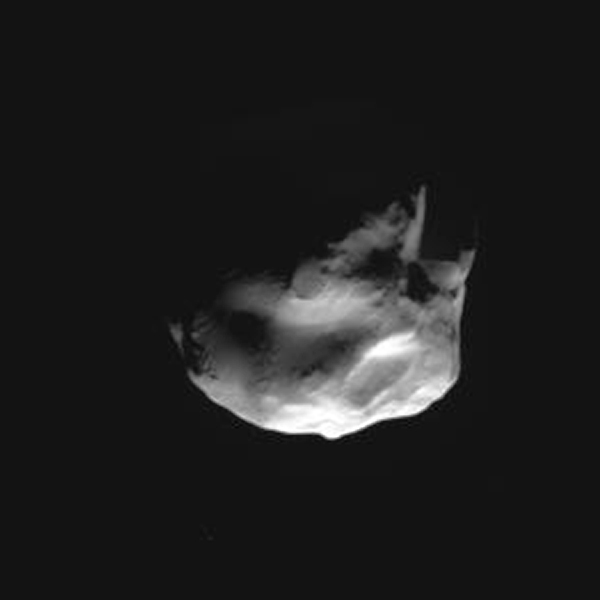
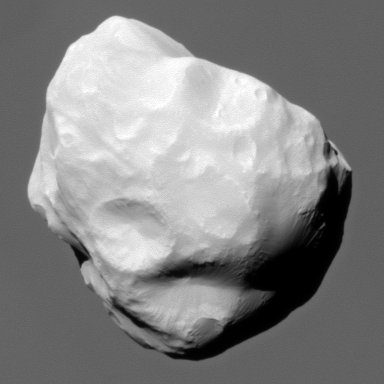

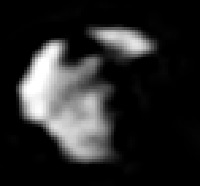
Physical characteristics
Helene is a small, irregularly shaped object composed largely of water ice with a surface that reflects sunlight relatively strongly. Its appearance is influenced by impact craters and by the accumulation and redistribution of loose icy material. As a low-gravity body, Helene’s topography and surface deposits can differ markedly from larger moons in Saturn’s system, and its overall mass and size are modest compared with major satellites.
Discovery and exploration
The moon was first identified in 1980 from ground-based observations by a pair of astronomers who were studying images of Saturn and its vicinity. Subsequent missions to the Saturn system, most notably the Cassini spacecraft, returned detailed imagery and measurements that improved knowledge of Helene’s orbit, shape and surface properties. For contemporary researchers the original detection remains an example of how careful photographic and telescopic work from Earth can reveal faint companions of the giant planets. See more on the observational history and studies at discovery records and general Earth observations.
Significance and scientific interest
Helene is scientifically interesting because it demonstrates the dynamics of Trojan co-orbitals in a complex planetary satellite system. Studying its motion and interactions with Dione helps scientists test theories about orbital stability, migration and the capture of small bodies. The moon also contributes to broader comparisons among Saturn’s satellites and to models of circumplanetary processes such as regolith movement and surface modification.
Context and related moons
- Helene leads Dione in its orbit around Saturn at a Lagrangian point often labeled L4.
- Other Saturnian moons show similar Trojan behavior; such pairings provide multiple case studies for co-orbital dynamics.
- Because Helene is relatively small and distant from Earth, observations require powerful telescopes or spacecraft encounters to resolve fine detail.
Although Helene does not influence human activities, it remains an important target for comparative planetology and for understanding how small icy bodies behave when locked into resonant configurations with much larger moons.
Related articles
Author
AlegsaOnline.com Helene (moon of Saturn) Leandro Alegsa
URL: https://en.alegsaonline.com/art/43340