
Hati (moon) — Saturn XLIII, a small retrograde irregular satellite
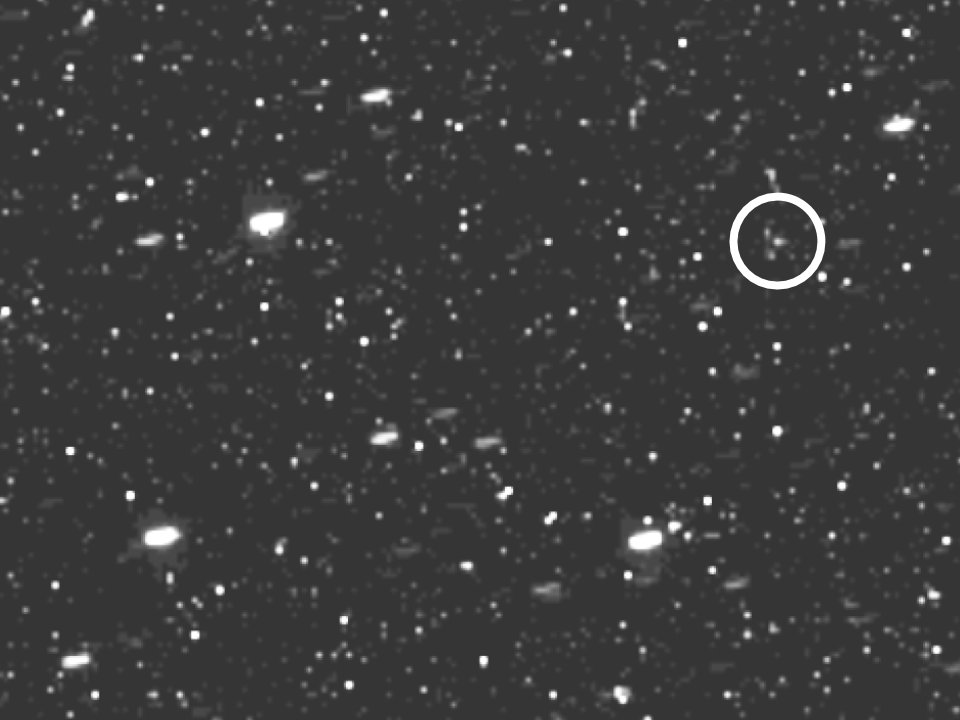
Hati is a small irregular, retrograde moon of Saturn (Saturn XLIII), about 6 km across. Discovered in 2004–2005, it orbits far from Saturn and belongs to the Norse group of satellites.
Overview
Hati, also designated Saturn XLIII and provisionally S/2004 S 14, is one of Saturn's numerous small outer satellites. With an estimated diameter of roughly 6 kilometres, it is far too small to be rounded by its own gravity and is classified among the irregular satellites because of its distant, inclined and eccentric orbit. Hati follows a retrograde path around Saturn, meaning it moves in the opposite direction to the planet's rotation.
Image gallery
4 Images


Physical characteristics
Because Hati is very small and faint, detailed physical information is limited. Observations indicate that it is likely an irregularly shaped, rocky or icy body with a dark surface typical of many outer satellites. Its small size implies low surface gravity and no atmosphere. Like other members of its class, Hati is probably a fragment of a larger body or a captured object from the outer Solar System.
Orbit and group
Hati orbits Saturn at an average distance of about 20,303,000 kilometres and completes one orbit in approximately 1080.1 days. Its orbit is markedly inclined and eccentric: the inclination is around 163° to the ecliptic (about 165° relative to Saturn's equator), and the eccentricity is near 0.291. These parameters place Hati within the Norse group, a collection of retrograde irregular satellites that share broadly similar orbits and are thought to be related by a common origin or capture process.
Discovery and name
The discovery of Hati was announced on 4 May 2005 by a team of astronomers after analysis of images taken between December 2004 and March 2005. The announcement credited observers including Scott S. Sheppard and David C. Jewitt, along with collaborators. Precise orbital elements were derived from follow-up observations that established its long, inclined retrograde path around Saturn. In April 2007 the moon received the name Hati, drawn from Norse mythology: Hati is a giant wolf, son of the monstrous Fenrir and twin brother of Sköll, a naming choice consistent with the mythological theme used for this group of Saturnian moons; see Norse myth sources for background.
Scientific context and significance
Small irregular moons such as Hati are important to planetary scientists because they provide clues about the history of the Saturn system and the wider outer Solar System. Their eccentric, inclined and often clustered orbits suggest histories involving gravitational capture, collisions and fragmentation. Studying the population, sizes and orbital configurations of these satellites helps constrain models of how giant planets acquired their retinues of small bodies and how collisional families form and evolve.
Notable facts and distinctions
- Designation: Saturn XLIII (S/2004 S 14) reflects the provisional naming convention for newly discovered satellites.
- Retrograde motion and high inclination mark Hati as an irregular satellite, contrasting with the closer, larger regular moons that have low-inclination, prograde orbits.
- Its orbital eccentricity is relatively large for satellites, a trait that contributes to the dynamical diversity of the Norse group; see orbit data references inclination notes and eccentricity details.
Because of its small size and faintness, Hati is observable only with substantial telescopes and careful image analysis. It remains one of many minor, but scientifically useful, members of Saturn's extended satellite system.
Questions and answers
Q: What is Hati?
A: Hati is a moon of Saturn.
Q: Who announced the discovery of Hati?
A: The discovery of Hati was announced by Scott S. Sheppard, David C. Jewitt, Jan Kleyna, and Brian G. Marsden.
Q: When was Hati discovered?
A: Hati was discovered between December 12, 2004, and March 11, 2005.
Q: What is the diameter of Hati?
A: Hati has a diameter of about 6 kilometers.
Q: What is Hati's average distance from Saturn?
A: Hati orbits Saturn at an average distance of 20,303,000 km.
Q: What is the inclination of Hati's orbit to the ecliptic?
A: Hati's orbit is inclined at an angle of 163° to the ecliptic.
Q: Why was Hati named after a giant wolf from Norse mythology?
A: Hati was named after Hati, a giant wolf from Norse mythology and the son of Fenrisulfr and twin brother of Skoll, in April 2007.
Related articles
Author
AlegsaOnline.com Hati (moon) — Saturn XLIII, a small retrograde irregular satellite Leandro Alegsa
URL: https://en.alegsaonline.com/art/42803
Sources
- ifa.hawaii.edu : Institute for Astronomy Saturn Satellite Data
- ifa.hawaii.edu : Jewitt's New Satellites of Saturn page
- cfa-www.harvard.edu : IAUC 8523: New Satellites of Saturn
- cfa-www.harvard.edu : MPEC 2005-J13: Twelve New Satellites of Saturn
- cfa-www.harvard.edu : IAUC 8826: Satellites of Jupiter and Saturn