
Halberstadt CL.II
German World War I two-seat light escort and ground-attack biplane. Agile and well-armed for close-support, escort and intruder missions, serving the Luftstreitkräfte in 1917–1918.
Overview
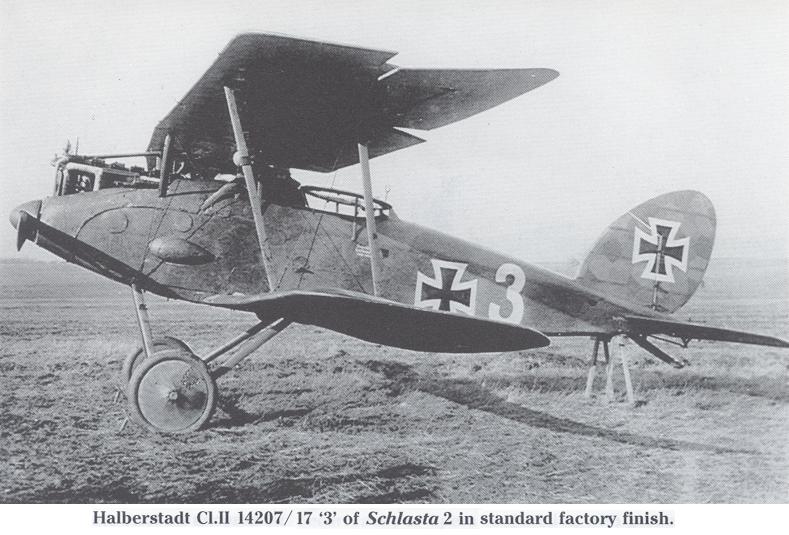
The Halberstadt CL.II was a German two-seat light escort and ground-attack biplane used by the Luftstreitkräfte during World War I. Introduced in the later stages of the conflict, it belonged to the "CL" category — compact, better-armed and more maneuverable than earlier two-seat C-types — and was intended to protect reconnaissance aircraft, support ground troops and undertake offensive intruder operations.
Image gallery
5 Images


Design and characteristics
The CL.II combined a relatively small, streamlined fuselage with a two-bay biplane wing arrangement and conventional fixed undercarriage. Its construction used timber framing with fabric and plywood coverings typical of German designs of the period. The crew sat in tandem: a pilot in the forward cockpit and an observer/gunner to the rear. Armament normally comprised a forward-firing synchronized machine gun for the pilot and a flexible machine gun on a ring mount for the observer, and the type could also carry small bombs for ground-attack tasks.
Operational history
Halberstadt CL.IIs entered service in the latter part of the war and saw frontline service throughout 1917–1918. They were used for close escort of reconnaissance two-seaters, low-level strafing and bombing of enemy positions, and night intruder missions against enemy airfields and lines of communication. The type was valued for its agility compared with larger two-seat fighters and for the protection it offered to vulnerable reconnaissance formations.
Typical characteristics
- Role: light escort, reconnaissance protection, ground-attack
- Crew: two (pilot and observer/gunner)
- Construction: mixed wood and fabric with plywood elements
- Weapons: fixed forward-firing gun, flexible rear gun, and small bomb load
Notable facts and legacy
The CL.II illustrates the wartime evolution toward specialized two-seat combat aircraft that combined maneuverability and firepower. Individual machines were occasionally captured; for example, on October 25, 1918 a Halberstadt from Reconnaissance Flight 279 was taken intact. For further context on German air operations in the period see German Air Force in World War I.
Related articles
Author
AlegsaOnline.com Halberstadt CL.II Leandro Alegsa
URL: https://en.alegsaonline.com/art/41852
Sources
- books.google.com : Summary of Air Information 1918 .p.227