
Harpers Ferry Armory
The United States Armory and Arsenal at Harpers Ferry was the second federal armory, noted for early American arms manufacture, innovations in interchangeable parts, John Brown’s raid, and Civil War destruction.
Overview
The United States Armory and Arsenal at Harpers Ferry—commonly called the Harpers Ferry Armory—was the second federally established armory in the United States, founded at the turn of the 19th century. Located at the confluence of the Potomac and Shenandoah rivers (today in West Virginia, formerly Virginia), it was built to produce small arms and to supply the early republic with military hardware. Officials sometimes referred to it as the "mother arsenal," a phrase used by late 18th‑century naval and military administrators.
Image gallery
5 Images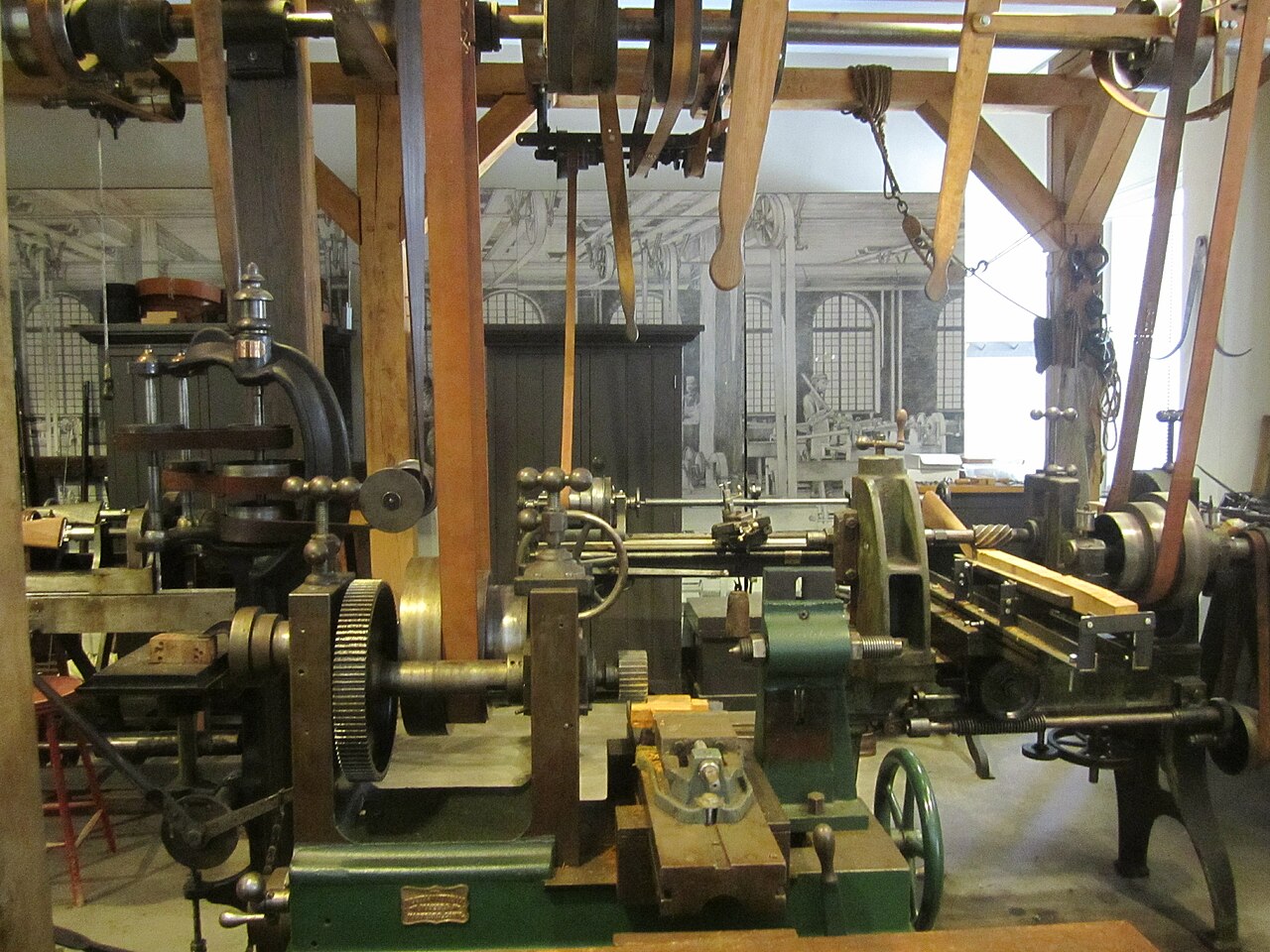


Site, design, and operation
The armory’s location was chosen for practical reasons: river power for mills, access to transport routes, and nearby raw materials. Buildings included workshops for forging, machining, and finishing firearms, as well as storehouses and offices. The facility combined skilled craft labor with emerging machine tools, allowing it to produce muskets, rifles, and other accoutrements for the U.S. government.
Manufacturing innovations
Harpers Ferry became important in the story of American industrialization because it adopted and demonstrated early techniques of precision machining and standardized parts. Over time the armory implemented methods that moved production away from wholly hand‑made components toward systems in which parts were interchangeable. Those advances influenced later armories and private industry and helped shape 19th‑century manufacturing practices.
John Brown’s raid and the Civil War
The armory figures prominently in antebellum and Civil War history. In 1859 the abolitionist John Brown led an armed raid on the Harpers Ferry complex intending to seize weapons and ignite a slave insurrection; the raid failed but intensified national tensions over slavery. During the Civil War the armory’s location made it strategically vulnerable; it changed hands and portions of the complex were deliberately destroyed to keep facilities and materiel from opposing forces. After the war the federal government did not fully reestablish Harpers Ferry as a national armory.
Legacy and preservation
Although the original armory buildings were damaged or removed, the site remains a significant historic and educational resource. It is preserved within the Harpers Ferry National Historical Park and interpreted through museums, exhibits, and reconstructed machinery so visitors can learn about early federal arms production, industrial innovation, and the complex events—social, political, and military—tied to the place.
Notable points
- Second federal armory after the Springfield Armory in Massachusetts.
- Closely associated with early uses of machine tools and interchangeable parts.
- Site of John Brown’s 1859 raid, an event that accelerated sectional conflict.
- Destroyed in part during the Civil War and not revived as a major federal factory afterward.
Further reading and resources
For more information, consult primary and secondary sources and official site materials linked below:
- Federal armory history overview
- Technical history of armory workshops
- Harpers Ferry National Historical Park
- State and regional context (Virginia/West Virginia)
- Early naval and military correspondence
- Biographical notes on late 18th‑century officials
- Comparison with Springfield Armory
- Nomenclature and historical spellings
- Wider United States military history resources
- Collections, archives, and museum catalogs
These resources offer maps, catalogued artifacts, interpretive essays, and curated exhibits that help explain why Harpers Ferry remains important to American industrial, military, and social history.
Questions and answers
Q: What is Harpers Ferry Armory?
A: Harpers Ferry Armory is the second federal armory commissioned by the United States government.
Q: Where is Harpers Ferry Armory located?
A: Harpers Ferry Armory is located in Harpers Ferry, West Virginia (then part of Virginia).
Q: What was Harpers Ferry Armory also known as?
A: Harpers Ferry Armory was also known as the "mother arsenal", a term coined in 1797 by the first Secretary of the Navy Benjamin Stoddert.
Q: What was the first federal armory commissioned by the United States government?
A: The first federal armory commissioned by the United States government was the Springfield Armory located in Springfield, Massachusetts.
Q: Why is the town sometimes called “Harper’s Ferry” with an apostrophe?
A: The town is sometimes called “Harper’s Ferry” with an apostrophe because some books use this spelling.
Q: What historical events is the national armory associated with?
A: The national armory has been associated with many historical events throughout the history of the United States.
Q: What is the significance of the national armory at Harpers Ferry?
A: The national armory at Harpers Ferry played an important role in the history of the United States as a federal armory commissioned by the government and as a site associated with many significant historical events.
Related articles
Author
AlegsaOnline.com Harpers Ferry Armory Leandro Alegsa
URL: https://en.alegsaonline.com/art/42533
Sources
- nps.gov : "Harpers Ferry Armory and Arsenal"
- civilwar.org : "Ten Facts about Harpers Ferry 1859-1865"
- nps.gov : "Robert Harper"
- nps.gov : "Harpers Ferry NHP Armory and Arsenal"
- wvencyclopedia.org : "Harpers Ferry Armory and Arsenal"
- history.com : "John Brown's Harpers Ferry"