
Gyrocompass — Non‑magnetic navigation instrument
A gyrocompass is a navigation instrument that finds true (geographic) north using a fast-spinning rotor and Earth’s rotation rather than magnetism; widely used at sea and in inertial systems.
Overview
A gyrocompass is a non-magnetic heading device that seeks true (geographic) north by exploiting the behavior of a spinning mass and the rotation of the Earth. Unlike a conventional magnetic compass, it is not influenced by nearby sources of magnetism or ferrous structures. Because it aligns with true north rather than magnetic north, it has been an important tool for shipping, aircraft and navigation systems where magnetic interference would make ordinary compasses unreliable.
Image gallery
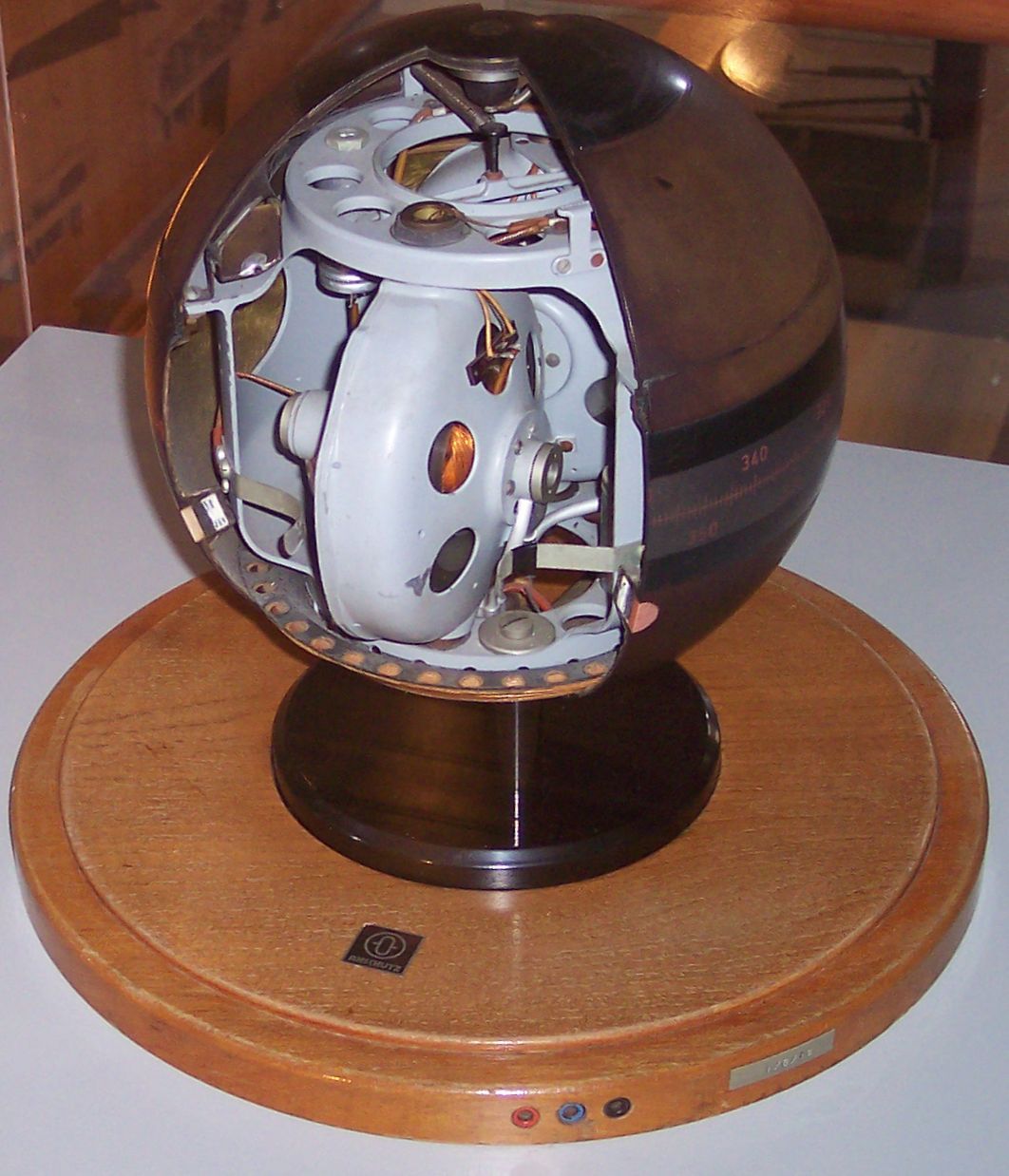
3 Images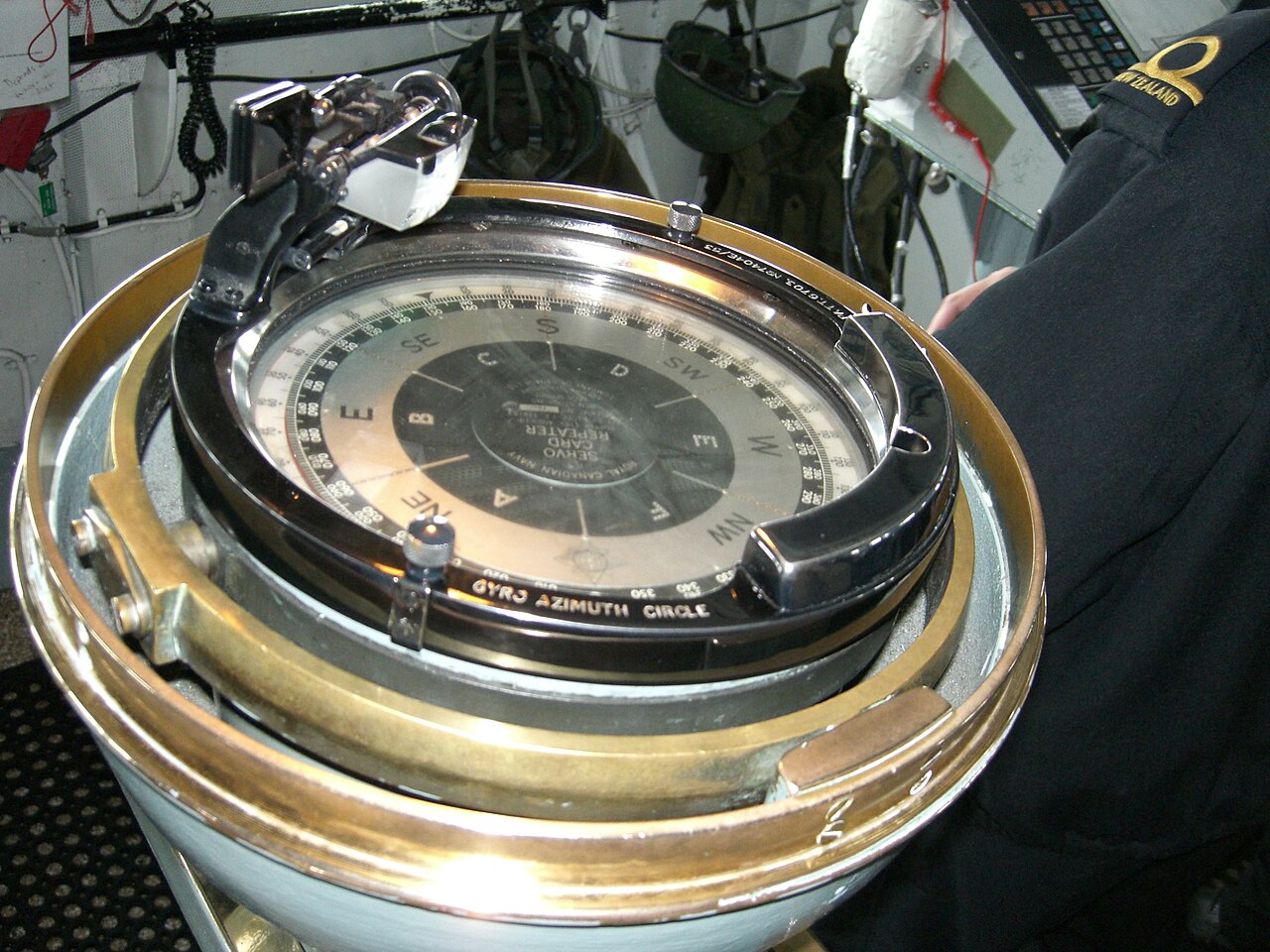

How it works
At the heart is a rapidly spinning rotor similar to a gyroscope. The rotor resists changes in its spin axis due to conservation of angular momentum, and the rotation of the Earth (Earth's rotation) causes predictable apparent motions of that axis as seen in a terrestrial frame. A gyrocompass adds a controlled bias or correction so the rotor will precess toward the meridian: when the axis is not aligned with geographic north, a mechanical or electronic mechanism applies a corrective torque that gradually reorients it toward true north (north). Damping elements prevent persistent oscillation and help the instrument settle to a steady heading.
Key components
- Spinning rotor or wheel mounted in gimbals to allow free motion.
- Sensors and control vanes that detect misalignment and apply corrective torques.
- Damping system to remove oscillations and stabilise the reading.
- Power and bearings designed for continuous operation in a marine or vehicle environment, often hardened to tolerate vibration and the presence of nearby ferrous metal.
History and development
Gyrocompass technology was developed in the early 20th century as a response to the limitations of magnetic compasses aboard steel ships and in other magnetically noisy environments. Inventors and engineers in several countries produced working instruments and refinements that improved reliability, automatic leveling and damping. Over time electronic sensors and later optical gyros and solid‑state devices provided similar directional references with fewer moving parts.
Uses and importance
Marine navigation is the classic application: a gyrocompass provides a stable heading reference for helms, autopilots and integrated bridge systems where local magnetic anomalies would distort a magnetic compass. It is also used in aircraft, submarines and land vehicles as a primary heading source or as a component of an inertial navigation system. Modern navigation frequently combines gyrocompasses with satellite navigation and inertial sensors to deliver continuous, accurate headings even when GPS signals are degraded.
Distinctions, advantages and limitations
- Advantages: points true north, immune to magnetic interference, provides a stable reference suitable for automation.
- Limitations: requires power and time to settle, can be affected by acceleration or ship motion, and historically needed maintenance for mechanical gyros.
- Modern variants: ring laser gyros and fiber‑optic gyros perform the same role without a heavy spinning rotor while solid‑state inertial systems often replace or augment traditional gyrocompasses.
For further technical background and practical guidance, readers may consult introductory materials on compasses (magnetic compass) and gyroscopic instruments (gyroscope), or resources about Earth dynamics and navigation systems (Earth's rotation, magnetism). Other useful references discuss mechanical details such as applied torque and the effects of nearby ferrous metal on navigational instruments; manufacturers and technical standards describe installation and maintenance practices for reliable operation (north alignment procedures).
Related articles
Author
AlegsaOnline.com Gyrocompass — Non‑magnetic navigation instrument Leandro Alegsa
URL: https://en.alegsaonline.com/art/41621