
Hair clipper
A hair clipper is a handheld tool for cutting hair close to the scalp; this article explains its parts, operation, types, history, maintenance and common uses.
Hair clippers are tools designed to cut hair quickly and uniformly by shearing with two closely fitted blades. They differ from scissors by using a sliding, scissor‑like action between a fixed comb‑like blade and a moving blade to trim multiple strands at once. Clipper blades are often removable and come in a variety of materials and finishes to suit different cutting needs; see the description of blades below.
Image gallery
6 Images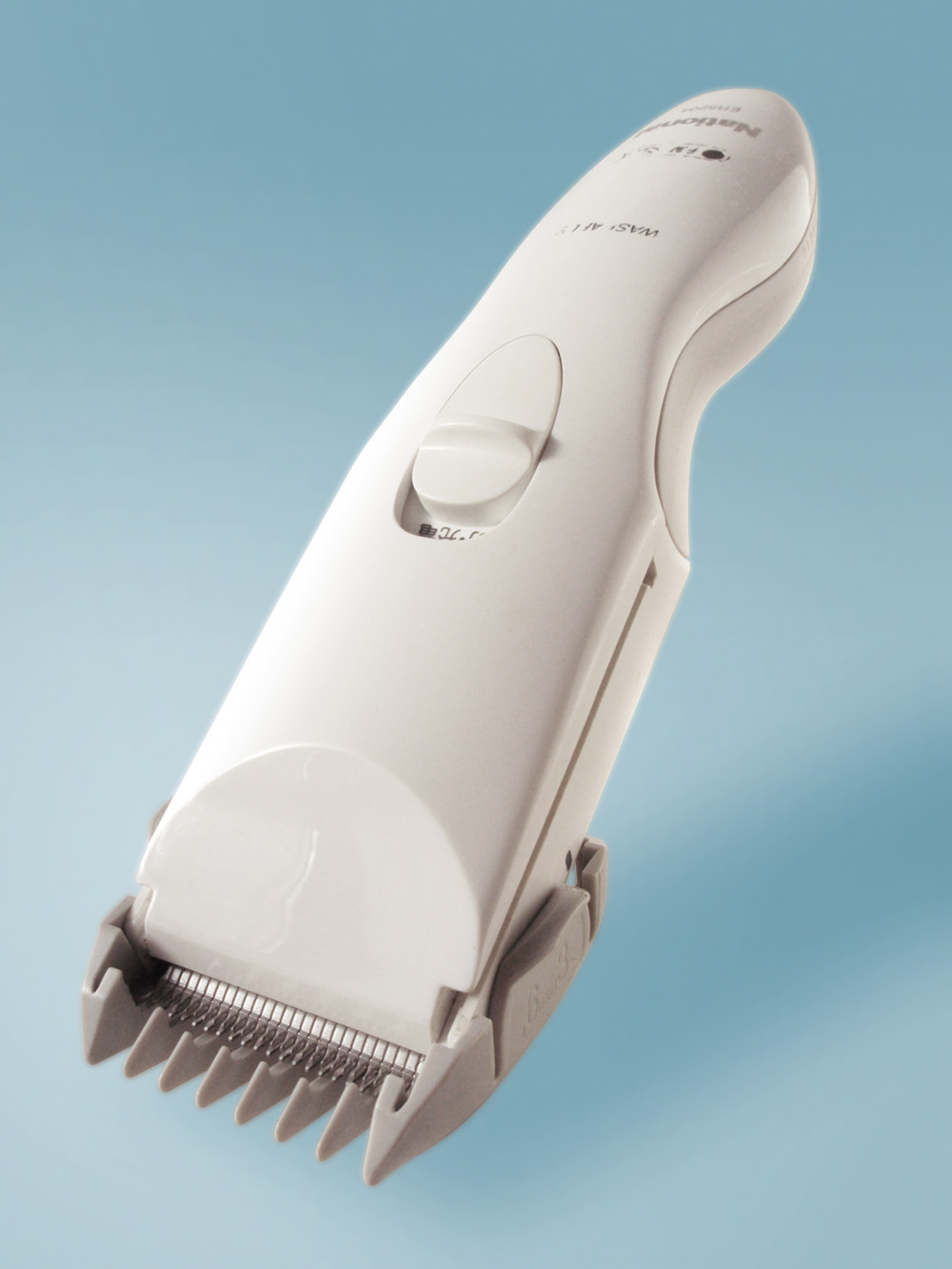


Main parts and operation
Typical clippers consist of a motor or mechanical drive, a cutting head with two blades, and an external housing. Removable guards (also called combs) snap onto the head to control cutting length. Electric clippers convert rotary or oscillating motion into lateral movement of the top blade, producing the rapid back‑and‑forth shear against the stationary blade. Manual versions use a hand crank or spring‑action mechanism to achieve the same sliding action.
Types and common features
- Electric corded clippers: continuous power and often stronger motor torque.
- Battery (cordless) models: greater mobility, variable run time and charging considerations.
- Professional vs. home clippers: differences in motor durability, blade quality and cooling.
- Specialized trimmers: finer blades for edging, beards and close detailing.
Blades are usually made from stainless steel, carbon steel or ceramic. Ceramic blades run cooler and resist corrosion; steel blades are common and can be sharpened or replaced. Guard sizes are numbered to indicate the amount of hair left, enabling consistent results for fades, buzz cuts and other styles.
History and development
Hand‑operated shears and clipper mechanisms have roots in traditional grooming and livestock shearing. During the late 19th and early 20th centuries inventors adapted mechanical systems to human hair cutting, and the advent of small electric motors led to the modern electric clipper. Since then, innovations have focused on motor efficiency, battery technology, quieter operation and improved blade metallurgy.
Uses, maintenance and safety
Clippers are used in barbering and personal grooming to achieve short, even cuts, to taper hair, and to maintain styles. They are also adapted for animal grooming and sheep shearing, though heavy‑duty shears differ in design and power. Regular maintenance includes cleaning trapped hair, oiling moving parts, occasional blade alignment and replacing worn blades. For safety, use the correct guard, keep blades sharp and avoid cutting damaged skin.
Notable distinctions include the difference between clippers and scissors (bulk removal vs precise cutting) and between clippers and trimmers (trimmers offer finer detail work). Choosing a clipper depends on intended use, desired finish, and considerations such as noise, weight and upkeep.
Questions and answers
Q: What are hair clippers used for?
A: Hair clippers are tools used to cut hair close to the head.
Q: What are similar tools used to cut?
A: Similar tools are used to cut wool from sheep.
Q: How do hair clippers work?
A: Hair clippers have a pair of sharpened comb-like blades in close contact one above the other and the side which slide sideways relative to each other.
Q: What is the purpose of the comb-like blades on hair clippers?
A: The comb-like blades on hair clippers are used to position the hair between the teeth and cut it with a scissor action when one blade slides sideways relative to the other.
Q: How do you use hair clippers?
A: The clipper is moved so that hair is positioned between the teeth of the comb and cut with a scissor action by sliding one blade sideways to the other.
Q: Is it possible to adjust the length of the cut with hair clippers?
A: Yes, it is possible to adjust the length of the cut with hair clippers by using different blade attachments or adjusting the blades.
Q: Are hair clippers only used by professionals?
A: No, hair clippers can be used by anyone at home as well as by professionals.
Related articles
Author
AlegsaOnline.com Hair clipper Leandro Alegsa
URL: https://en.alegsaonline.com/art/41798
Sources
- ehow.com : ehow.com
- thefreelibrary.com : "WAHL IN THE FAMILY. - Free Online Library"