
Groundhog (Marmota monax): North American burrowing marmot
A compact encyclopedia entry on the groundhog (Marmota monax): its appearance, burrowing behavior, diet, reproduction, predators, hibernation, and cultural role such as Groundhog Day.
Overview
The groundhog (Marmota monax), also commonly called the woodchuck, whistlepig, or ground-pig, is a stout-bodied rodent in the squirrel family. As a member of the group often referred to as marmots, the groundhog is one of the best-known burrowing mammals in eastern North America. It is primarily terrestrial, occupying fields, forest edges and areas near human habitation where soil is suitable for digging.
Image gallery
10 Images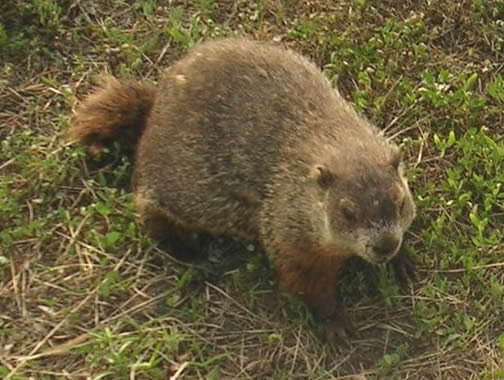


Physical characteristics and behavior
Groundhogs are compact and muscular with short strong legs, sharp claws for digging, and a bushy tail. Their coats range from brown to gray and help them blend into grassy and wooded habitats. Like other members of the order Rodentia, they have ever-growing incisors used for gnawing and cropping vegetation; see rodent for broader context on this group. Groundhogs are primarily diurnal and are known for a high-pitched whistle they use as an alarm call—hence the name "whistlepig."
Burrows and habitat
One of the species' most notable behaviours is digging complex burrow systems. A groundhog burrow typically has a main entrance surrounded by a mound of excavated soil. Tunnels can branch to form multiple entrances and include specialized chambers for nesting, food storage and hibernation. Burrows provide shelter from weather and predators and are sometimes reused seasonally. Groundhogs occupy a variety of habitats where there are open areas for feeding and earth suitable for tunneling.
Diet and ecological role
Groundhogs are primarily herbivorous. Their diet includes grasses, clover, dandelions, agricultural crops, and garden vegetables, along with occasionally eating fruits, bark and young tree shoots. Because they consume large amounts of plant material, groundhogs can be considered both seed dispersers and agricultural pests, depending on context. They are also prey for carnivores such as foxes, coyotes, birds of prey and domestic dogs, and their burrows provide shelter for other species once abandoned.
Reproduction, hibernation and lifecycle
Groundhogs breed once a year, typically in early spring after emerging from hibernation. Females give birth to a litter of several blind, furred young that develop rapidly in the safety of the burrow. Groundhogs are true hibernators: as winter approaches they accumulate fat, enter their burrows, and reduce metabolic rate and body temperature for several months. Lifespan in the wild is limited by predation and disease; some individuals may live several years, while captive animals can survive longer.
Human interactions and cultural significance
Groundhogs frequently live near farms, suburban gardens and roads, leading to frequent encounters with people. They can damage crops and landscaping, and their burrows may undermine structures or create hazards for livestock and machinery. At the same time, they are an important part of local ecosystems and valued for wildlife viewing. The species also has a prominent place in popular culture through the North American tradition of Groundhog Day, when a single groundhog's emergence and reaction to its shadow is celebrated as a folk indicator of the arrival of spring.
Notable facts and distinctions
- Taxonomy: Marmota monax places the groundhog among ground-dwelling squirrels called marmots.
- Names: Common names such as woodchuck and whistlepig reflect regional language and the animal's vocal habits; the origin of "woodchuck" is often traced to an Algonquian word.
- Engineering: Their extensive burrows influence soil turnover and local microhabitats, affecting plant community composition and providing refuges for other animals.
For readers seeking more detail about related groups or broader classification, see resources on marmots and ground squirrels and the general entry on rodents.
Related articles
Author
AlegsaOnline.com Groundhog (Marmota monax): North American burrowing marmot Leandro Alegsa
URL: https://en.alegsaonline.com/art/41041
Sources
- ncdc.noaa.gov : "Groundhog Day"