
Great Plains Narrowmouth Toad (Gastrophryne olivacea)
Small, secretive amphibian of the central North American plains. Overview of appearance, range, behavior, reproduction, and conservation of Gastrophryne olivacea.
The Great Plains Narrowmouth Toad (Gastrophryne olivacea) is a small, ground-dwelling amphibian native to the central North American plains. It belongs to the family Microhylidae and is sometimes labeled a "toad" because of its terrestrial habits and squat body, though it is not a member of the true toad family. For a basic species reference see species information.
Image gallery
1 Image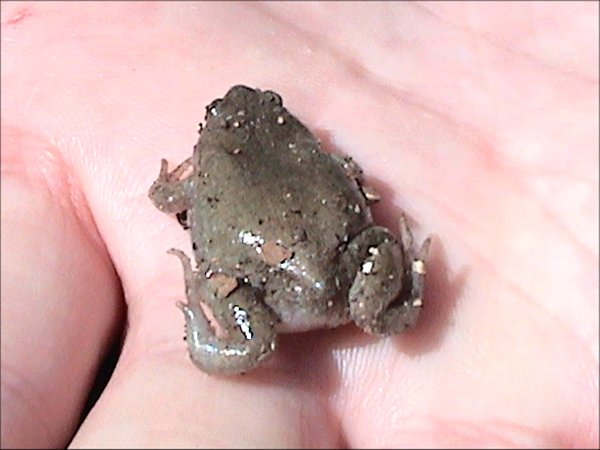
Identification and characteristics
These animals are compact with a noticeably narrow mouth, an adaptation linked to their specialised diet. Their skin is typically smooth or mildly granular and colored in shades of brown, olive or gray, often with subtle patterning that helps them blend into prairie soils and leaf litter. They are small compared with many other North American amphibians and are mainly active at night or during wet conditions.
Range and habitat
The Great Plains Narrowmouth Toad occurs across the south-central United States and into adjacent parts of Mexico. It is reported from states such as Nebraska and Texas, and extends into northern Mexico. Within this range it inhabits grasslands, open woodlands, sandy or loamy soils, and other well-drained sites where it can shelter under debris, in cracks, or just below the surface. For a regional overview see south central United States distribution.
Behavior, diet and reproduction
Narrowmouth toads are secretive, often fossorial, and largely nocturnal. They feed primarily on ants and other small arthropods that suit their narrow mouths. Breeding usually follows seasonal rains; males produce distinctive high-pitched calls at temporary pools or flooded hollows. Territorial behavior can be observed, particularly around calling sites and during breeding, and this tendency is noted in field accounts (territorial).
Conservation and notable facts
- They are not true toads (family Bufonidae) despite the common name.
- Populations are affected locally by habitat conversion, pollution and changes to temporary wetlands used for breeding.
- Because of their secretive habits they are less often seen than other amphibians, but they play a useful role controlling ant and insect populations.
For further reading on the family and relatives consult resources on Microhylidae or regional amphibian guides. Researchers and naturalists often rely on local field observations and wet-season surveys to monitor this species' status and behavior.
Related articles
Author
AlegsaOnline.com Great Plains Narrowmouth Toad (Gastrophryne olivacea) Leandro Alegsa
URL: https://en.alegsaonline.com/art/40533
Sources
- iucnredlist.org : Gastrophryne olivacea
- zo.utexas.edu : Herps of Texas: Gastrophryne olivacea
- research.amnh.org : Amphibian Species of the World: Gastrophryne olivacea