
Great white shark (Carcharodon carcharias)
A large, widely distributed predatory shark species known for powerful hunting, serrated teeth, long migrations and cultural notoriety; an apex marine predator with specialized senses and conservation concerns.
The great white shark (Carcharodon carcharias) is a broadly distributed, large predatory shark in the order Selachimorpha and family Lamnidae, often referenced simply as the great white. It is the largest living predatory fish: mature adults typically reach lengths of up to about six metres, with exceptional reports of larger individuals that remain unconfirmed. Great whites are powerful, fast swimmers and are adapted to hunt large marine vertebrates; they can maintain elevated temperatures in some body regions, a condition known as regional endothermy, which supports high activity levels in cool waters.
Image gallery
10 Images


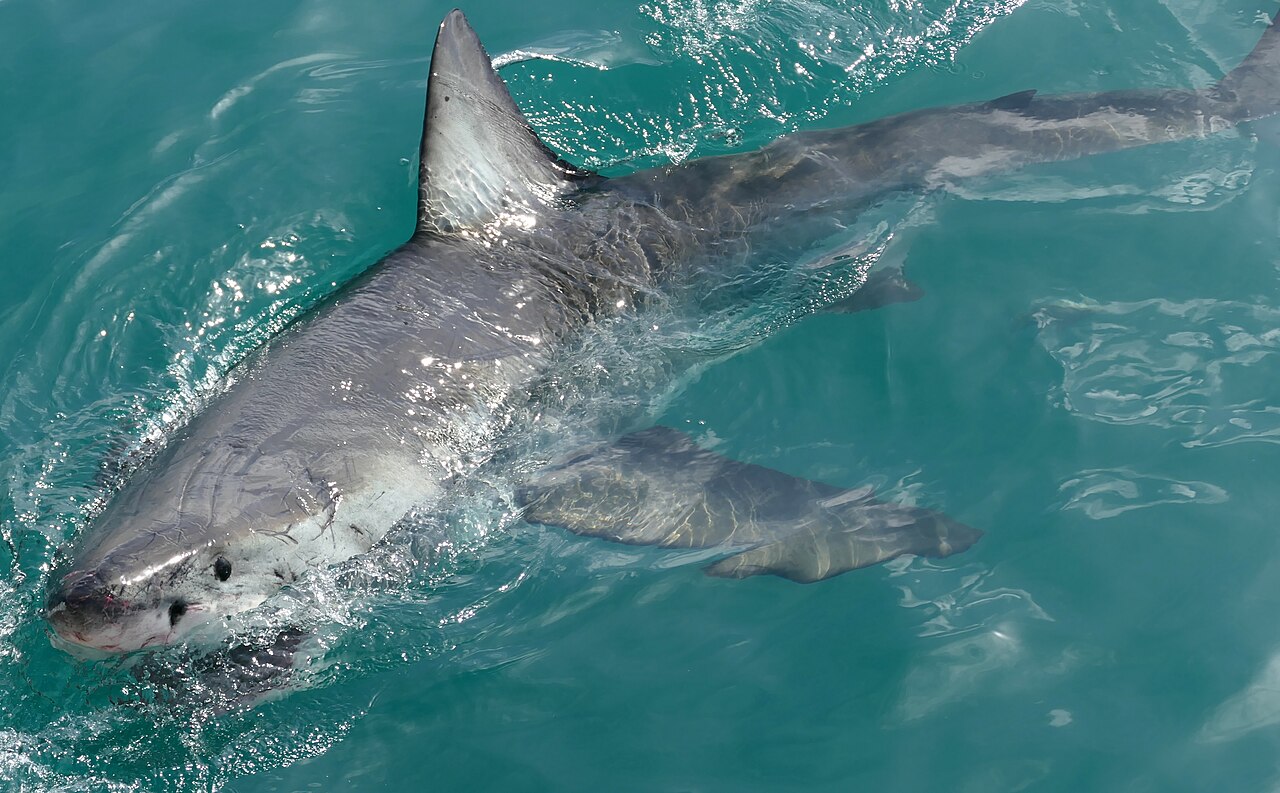

Physical characteristics
Great whites have a robust, streamlined body, crescent-shaped tail and a broadly conical snout. They possess roughly 300 serrated, triangular teeth arranged in multiple rows: the forward rows are used to seize and slice prey while rear rows replace teeth that are lost or worn. The teeth’s characteristic shape and edge serrations allow efficient cutting of flesh and blubber. Adults can accelerate rapidly and are capable of dramatic surface breaches when ambushing seals and other prey.
Feeding, senses and diet
As true carnivores, great whites are apex predators that feed on a variety of marine animals. Typical prey includes fish, seals, sea lions, penguins and occasionally small cetaceans. They also consume cephalopods such as squid and octopuses, crustaceans like crabs and shrimp, and other marine animals including stingrays and sea turtles. Great whites use a suite of senses—keen olfaction, sensitive vision, and electroreception via the ampullae of Lorenzini—to detect prey. They are frequently described as an apex predator because they sit near the top of marine food chains.
Behaviour, life cycle and predators
Great whites are often solitary but may gather at productive hunting sites or along migration routes. They reach sexual maturity relatively late, around their mid-teens, and reproduce through a form of live birth (ovoviviparity) in which eggs hatch inside the uterus and pups are born fully formed. Lifespan estimates extend several decades and have been reported to exceed fifty years in some studies. Their only known regular predators are certain populations of killer whales, which have been observed immobilizing sharks by flipping them and inducing tonic immobility, a behavior sometimes described as paralysis, causing the shark to lose normal respiration and suffocating it; sharks rely on movement to ventilate gills and obtain oxygen.
Distribution, migration and habitat
Great whites inhabit temperate and subtropical coastal and offshore waters worldwide. They show complex movement patterns, with some individuals demonstrating long-distance migrations between feeding and breeding areas, while others remain seasonally resident around productive islands and continental shelves. Known hotspots for observations and research include coastal regions where pinniped populations are abundant.
Human interactions and cultural impact
Although rare, unprovoked attacks on humans have occurred; among shark species, the great white has one of the higher numbers of documented fatal incidents, leading to popular fear. Cultural portrayals—most famously the novel Jaws and the film adaptation by Steven Spielberg based on a book by Peter Benchley—have intensified public perception of the species as a human predator. In reality humans are not preferred prey and many encounters are likely investigatory or mistargeted bites.
Conservation and notable facts
Great whites are protected in several jurisdictions and face threats from bycatch, directed fishing, habitat change and declining prey populations; international assessments classify them with conservation concern. Notable biological facts include their complex tooth replacement system (with around 300 teeth arranged in rows), their tooth morphology—triangular with serrated edges (triangular, sometimes described simply as a triangle)—and their role as a keystone marine predator. They are true carnivores, adaptable hunters that have been documented eating a wide range of species from seabirds such as seagulls to marine mammals like dolphins and even small whales. For further reading and conservation resources, consult specialized marine biology texts and authoritative databases that track shark populations and legal protections (taxonomy, general information).
Questions and answers
Q: What species of shark is the great white shark?
A: The great white shark (Carcharodon carcharias) is a species of shark.
Q: How large can mature great white sharks grow?
A: Mature sharks may grow up to 6.4 m (21 ft) in length and 3,324 kg (7,328 lb) in weight. There also have been a few reports of great white sharks measuring over 8 m (26 ft).
Q: At what age does the great white shark reach sexual maturity?
A: This shark reaches its sexual maturity around 15 years of age.
Q: What is the lifespan of a great white shark?
A: The lifespan of a great white shark may be as long as 70 years or more.
Q: How fast can a great white shark swim?
A: Great white sharks can accelerate to speeds over 56 km/h (35 mph).
Q: How many teeth does a great white have?
A: Great white sharks have about 300 teeth, arranged in many rows. The first two rows of the teeth are used for grabbing and cutting the animals they eat, while the other teeth in the last rows replace the front teeth when they are broken, worn down, or when they fall out. The teeth have the shape of a triangle with jags on the edges.
Q: What type of food doe sgreat whites eat?
A:Great whites are carnivores and hunt fish, seals, sea lions, seagulls, penguins, squid, octopuses, dolphins, small whales , crabs , shrimps , stingrays , sea turtles and other sharks .
Related articles
Author
AlegsaOnline.com Great white shark (Carcharodon carcharias) Leandro Alegsa
URL: https://en.alegsaonline.com/art/40569
Sources
- ia700704.us.archive.org : "Predatory behaviour of the white shark (Carcharodon carcharias), with notes on its biology"
- doi.org : 10.1111/j.1469-7998.2008.00494.x
- animals.nationalgeographic.com : "Great White Shark"
- dsc.discovery.com : "Largest great white shark don't outweigh whales, but they hold their own"
- books.google.com : Sharks of Hawaii: their biology and cultural significance
- sciencedaily.com : sciencedaily.com/releases/2014/01/140109004145.htm
- rodneyfox.com.au : "Fox Shark Research Foundation - Great White Shark Facts"
- books.google.com : Currents of Contrast: Life in Southern Africa's Two Oceans
- prbo.org : prbo.org/cms/docs/marine/MMS.pdf
- news.nationalgeographic.com : "Great White Shark attacks: defanging the myths" · web.archive.org
- flmnh.ufl.edu : Statistics on attacking species of shark
- nhpbs.org : nhpbs.org/wild/chondrichthyes.asp
- elasmo-research.org : elasmo-research.org/education/topics/p_warm_body_1.htm
- animals.mom.me : animals.mom.me/great-white-shark-teeth-facts-4415729.html