
Great crested grebe (Podiceps cristatus)
A distinctive freshwater diving bird with ornate head plumes, noted for elaborate courtship displays, floating nests and a past recovery after hunting for its plumage.
Overview
The great crested grebe (Podiceps cristatus) is a freshwater diving bird known for its long neck, streamlined body and dramatic breeding plumage. It belongs to the grebe family and is often encountered on lakes and slow rivers where it hunts fish and aquatic invertebrates. For a general introduction to water birds, see water bird and for information on its family refer to the grebe group.
Image gallery
10 Images



Identification and characteristics
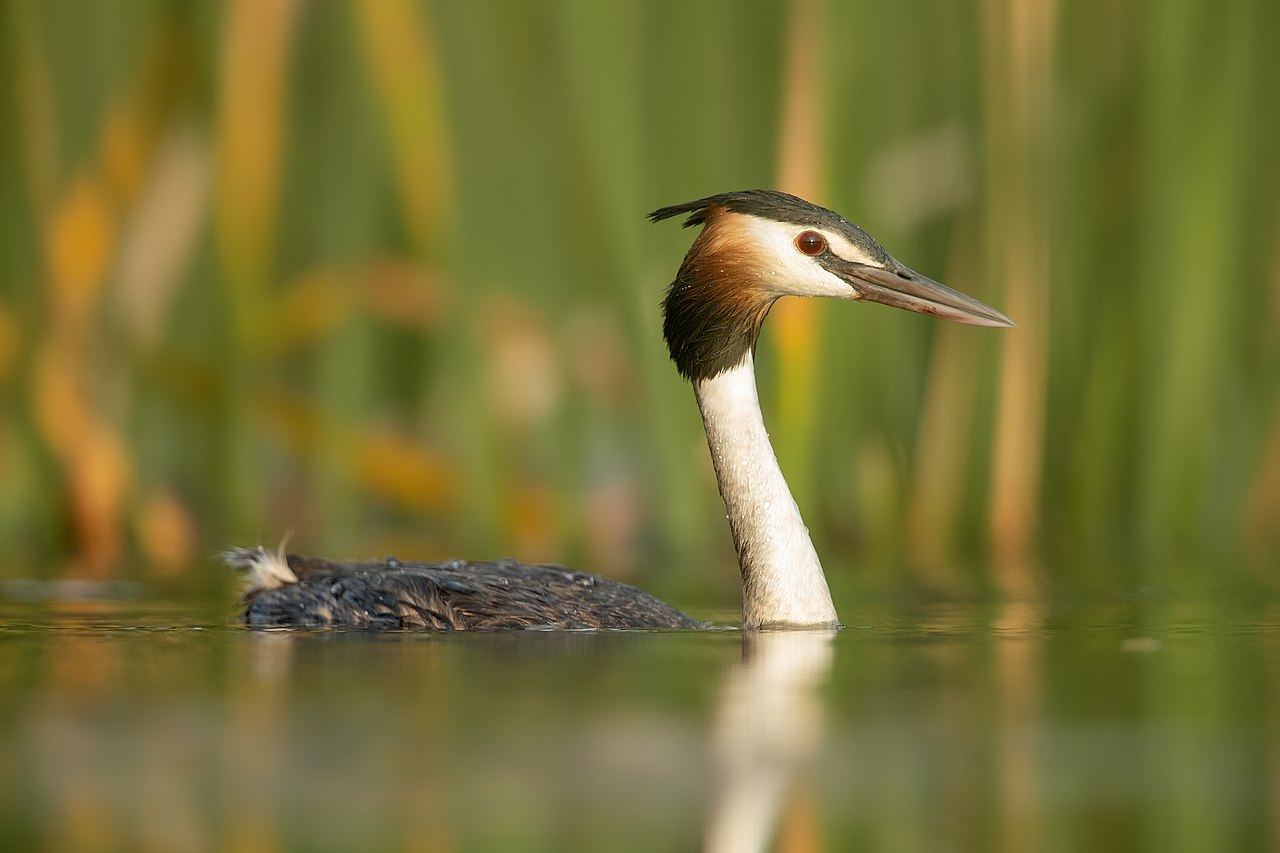
This species is notable for the ornate black double crest and ruff displayed by adults in breeding season and a white face and throat contrasting with darker upperparts. Outside the breeding season the plumage is plainer and the head crests are reduced. It has lobed toes adapted for swimming and a compact body suited to diving.
Behavior and diet
The great crested grebe is an accomplished diver that pursues fish underwater, frequently hunting alone or in loose groups. Its feeding technique includes rapid, underwater pursuit; it swallows small fish whole. It spends much time swimming low in the water and will rarely stray far from reed-fringed water bodies.
Breeding and life cycle
Breeding pairs perform complex reciprocal courtship displays involving head shakes, postures and synchronized movements. They build floating nests anchored to emergent vegetation. Chicks are often carried on the parents' backs while still small, a widely observed grebe behavior that helps protect them from predators and cold water.
Distribution, conservation and importance
Found across much of Europe, parts of Asia, Africa and Australasia in suitable freshwater habitats, the great crested grebe experienced declines in some regions when birds were hunted for their ornate feathers. Legal protection and habitat conservation led to recoveries in many areas, making the species an example of successful conservation measures while remaining dependent on healthy wetlands.
Notable facts and distinctions
- Recognizable breeding head plumes and elaborate courtship make it a flagship species for freshwater birdwatching.
- Its floating nest and back-riding chicks are characteristic behaviors among grebes.
- It is one of the larger grebes in regions where it occurs, often serving as an indicator of lake ecosystem quality.
Related articles
Author
AlegsaOnline.com Great crested grebe (Podiceps cristatus) Leandro Alegsa
URL: https://en.alegsaonline.com/art/40485