
Gothic language (East Germanic)
Extinct East Germanic language of the Goths, best known from Wulfila's 4th‑century Bible translation (Codex Argenteus); a key source for the study of Proto‑Germanic and early Germanic linguistics.
The Gothic language was spoken by the Goths, a Germanic people whose migrations shaped parts of late antique Europe. Gothic occupies the East Germanic branch of the Germanic language family and is now extinct. Surviving material consists largely of translations and fragments preserved in manuscripts and inscriptions; these remain essential for reconstructing features of early Germanic speech and for understanding how Germanic dialects diverged.
Image gallery
3 Images

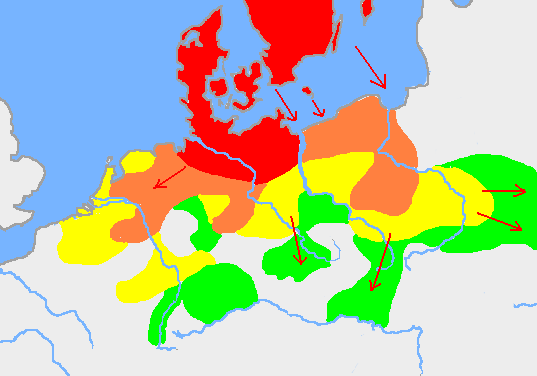
Classification and main characteristics
Classified as East Germanic, Gothic differs in several systematic ways from North and West Germanic languages. It preserved many archaic features of Proto‑Germanic that were lost elsewhere, including a relatively conservative case system and certain consonant and vowel reflexes. Gothic morphology shows a full set of nominal cases and a clear verb conjugation system, which make it valuable for comparative grammar. The written Gothic tradition uses an alphabet adapted by the early Christian missionary traditionally known as Wulfila (Ulfilas), combining elements from Greek and Latin scripts with some unique letters.
History and textual transmission
Gothic spread with the Visigothic and Ostrogothic migrations from the late Roman period into parts of Italy, Spain, and the Black Sea region. Conversion to Christianity among Gothic groups produced a corpus of religious texts. The best known witness is the translation of portions of the Bible attributed to Wulfila in the mid‑4th century, preserved in copies and fragments such as the Codex Argenteus. Additional small fragments, marginal notes, and isolated inscriptions supplement the picture. The language appears to have ceased to be spoken as a community language by about the 8th–9th centuries as Goths assimilated into neighboring populations (chronology).
Importance and study
Although the Gothic corpus is limited, its relative antiquity and conservative features give it outsized importance for historical linguistics. Scholars use Gothic data to test reconstructions of Proto‑Germanic phonology and grammar and to trace the evolution of Germanic languages. Modern editions, grammars, and digital resources support learning and scholarship; see general introductions and resources for beginners and specialists (overview, manuscript studies).
Notable facts and examples
- Wulfila's Bible translation (often called the Wulfila Bible) is the central corpus for Gothic studies; critical manuscripts include the Wulfila translation witnesses and the Codex Argenteus.
- Gothic preserved a three‑gender noun system and multiple cases (nominative, accusative, genitive, dative, and others), offering clear parallels to reconstructed Proto‑Germanic.
- Because it is attested earlier than many other Germanic languages, Gothic provides direct evidence of sound changes and grammatical patterns otherwise only inferable from later languages.
For readers interested in primary texts and facsimiles, specialist libraries and online projects collect photographic reproductions and critical editions that make the Gothic record accessible to students and researchers. The study of Gothic continues to illuminate the linguistic landscape of early medieval Europe and the processes by which languages change and disappear.
Related articles
Author
AlegsaOnline.com Gothic language (East Germanic) Leandro Alegsa
URL: https://en.alegsaonline.com/art/39873
Sources
- glottolog.org : "Gothic"