
GNU Hurd: the GNU project's multiserver microkernel system
GNU Hurd is a collection of servers running on a microkernel, developed to give users maximum control over the GNU operating system through a flexible, extensible multiserver design.
The GNU Hurd is an operating system kernel architecture that departs from the traditional monolithic kernel model. It places a small microkernel at the core and implements most operating system services as separate user-space servers (a "herd" of daemons). This multiserver approach aims to maximize configurability and user control: services can be started, stopped, replaced, or implemented in different languages without rebuilding the kernel. The Hurd project explicitly ties into the GNU philosophy of software freedom, often discussed under the banner of software freedom and the goals of the GNU project.
Image gallery
2 Images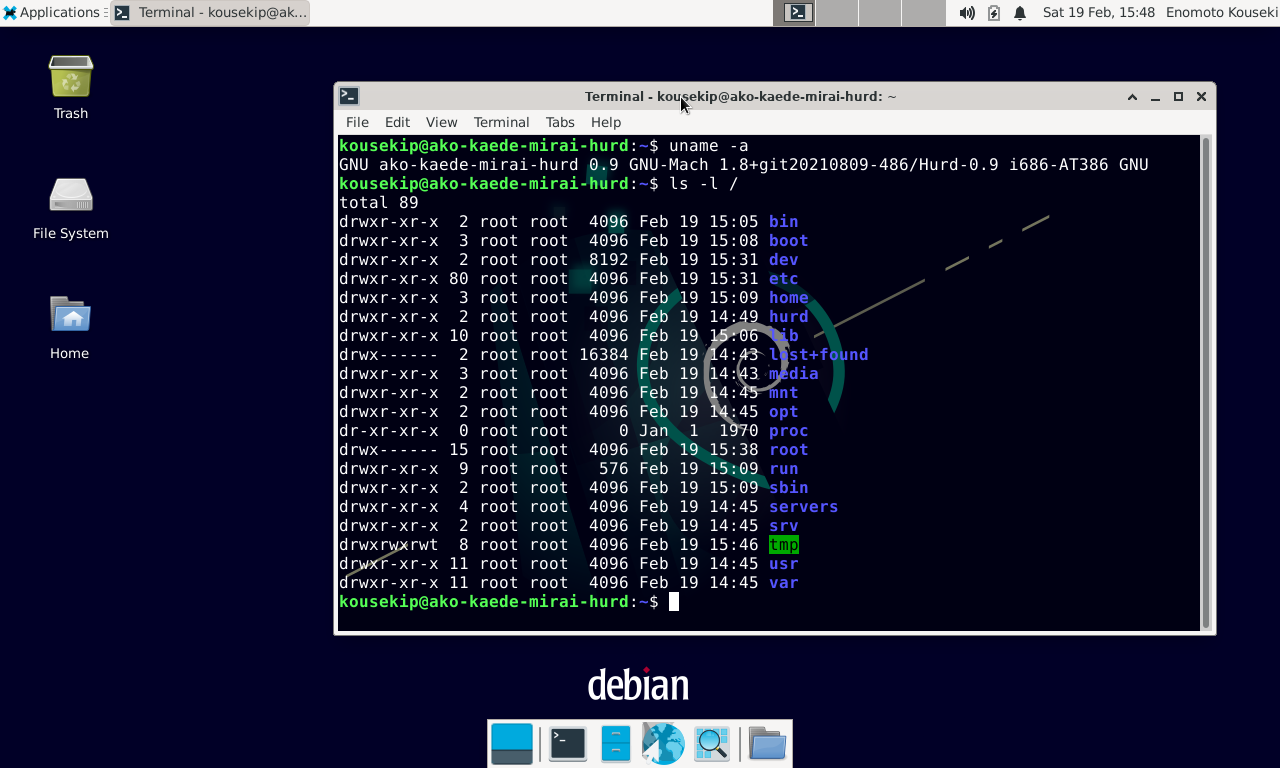

Design and components
At its core, Hurd uses a microkernel to provide minimal primitives such as low-level process and thread management, inter-process communication (IPC), and hardware abstraction. Historically the project has used Mach-derived microkernels, notably GNU Mach, as the base. On top of that microkernel sits a collection of servers that present file systems, network stacks, authentication, and other services to applications. Because these servers run in user space, each service is isolated and can be developed or debugged independently.
Key characteristics include:
- Multiserver architecture: independent servers handle different OS responsibilities.
- Flexible namespaces: servers can export virtual filesystems to represent devices, network connections, and other resources.
- Modularity and extensibility: developers can replace or extend servers without touching the microkernel.
- Rich interposition: programs or users can insert custom servers to change how resources appear and behave.
Origins and historical context
The Hurd originated as the intended kernel for the GNU operating system, an initiative started by Richard Stallman in 1983 to create a complete free operating system. The Hurd development began in 1990 with the goal of providing an alternative to traditional Unix kernels. GNU's tooling and userland utilities were progressing, but a free kernel that matched the GNU design ideals was still under development.
Work on Hurd used a Mach-derived microkernel from Carnegie Mellon University as a starting point. When Linus Torvalds released the Linux kernel in 1991 and the community ported GNU userland to it, many users adopted the GNU/Linux combination because it was immediately usable. Other free-system kernels such as NetBSD and FreeBSD also matured in the following years. These available alternatives reduced early interest in Hurd, slowing its adoption and development pace.
Development, goals, and modern status
The Hurd project's stated objective is to produce a general-purpose kernel suitable for everyday GNU system use that offers maximal control to users and applications. Development has been intermittent and community-driven; various contributors and distributions have at times taken responsibility for packaging and maintaining a Hurd-based system. The Debian project, for example, formed an official effort to port and maintain Debian on Hurd and has published installation images and documentation under the umbrella of Debian.
Technically, Hurd provides interesting research and teaching value: it showcases microkernel design, user-space servers, and advanced namespace and filesystem concepts. However, it has faced challenges including performance overheads inherent to microkernel IPC, limited driver support, and the difficulty of coordinating broad community effort compared with more widely adopted kernels.
Uses, distinctions, and notable facts
While Hurd is not commonly used in production environments, it remains important as an alternative vision of operating system structure. It demonstrates how operating system services can be decomposed into independent servers, enabling experimentation with custom filesystems, security models, and language choices for system services. The Hurd continues to attract contributors interested in free software principles and kernel design, and its codebase and discussions serve as a resource for researchers and enthusiasts.
For readers seeking more context, introductions to the project's philosophy and goals can be found through GNU-related resources and essays, while technical references and historical material discuss the relations among Hurd, the GNU userland, early kernel choices, and the broader free-software ecosystem that also includes Linux. Information about the Free Software Foundation and its advocacy is available via sources tied to the FSF. Community ports and packaging efforts illustrate practical steps taken to run GNU userland on Hurd-compatible microkernels; interested developers can consult project archives and Debian Hurd pages for build instructions and status reports.
Hurd's history intersects with many notable free-software projects and institutions. The project's trajectory reflects early design choices, shifting community priorities, and the practical tension between ambitious research-oriented architectures and the immediate needs of users seeking stable, well-supported systems. For further reading on specific implementations, ports, and development snapshots, explore historical notes and contemporary project pages related to the GNU Hurd, GNU Mach, and the broader GNU ecosystem.
Relevant links: freedom, GNU project, Linux, Richard Stallman, Free Software Foundation, Carnegie Mellon University, Linus Torvalds, NetBSD, FreeBSD, Debian.
Related articles
Author
AlegsaOnline.com GNU Hurd: the GNU project's multiserver microkernel system Leandro Alegsa
URL: https://en.alegsaonline.com/art/39336
Sources
- gnu.org : "hurd-mission-statement"
- linuxuser.co.uk : "Whatever happened to the Hurd? – The story of the GNU OS"
- gnu.org : "advantages"
- gnu.org : "Linux and GNU"
- raphaelhertzog.com : People behind Debian: Samuel Thibault, working on accessibility and the Hurd