
Georges Gilles de la Tourette
French physician Georges Gilles de la Tourette (1857–1904) described the syndrome of involuntary tics that bears his name and contributed to late 19th-century studies of hysteria and hypnotism.
Overview
Georges Albert Édouard Brutus Gilles de la Tourette was a French physician whose name became linked with the neurological condition now called Tourette syndrome. Working in the last decades of the 19th century, he trained under Jean-Martin Charcot and published clinical descriptions that helped distinguish a pattern of involuntary motor and vocal tics from other forms of nervous disorder. His work sat at the intersection of emerging neurology, clinical psychiatry, and studies of suggestion and hypnosis.
Image gallery
3 Images

Early life and education
Gilles de la Tourette was born in Saint-Gervais-les-Trois-Clochers in 1857. He trained as a medical doctor at a time when neurology was only beginning to adopt systematic clinical methods. Early in his career he became associated with the Salpêtrière school in Paris and with the research circle around Jean-Martin Charcot, whose lectures and clinical demonstrations shaped a generation of physicians interested in nervous diseases.
Work and clinical contributions
Gilles de la Tourette published clinical reports that emphasized observable signs and careful description. In 1885 he reported a series of patients with repetitive motor and vocal tics, assembling what became the basis for later recognition of the syndrome that bears his name. He also studied conditions then referred to collectively as hypnotism and hysteria, exploring how suggestion and trance states might relate to functional symptoms. His case series and clinic notes aimed to separate tic disorders from other psychiatric and neurological illnesses.
Key features and importance
- Clinical description: Gilles de la Tourette emphasized involuntary, often sudden motor actions and vocalizations, now called tics.
- Differential diagnosis: He sought to distinguish these tics from seizure disorders, chorea, and hysterical manifestations.
- Legacy: The eponym arose after his reports and through the influence of his mentors and contemporaries; the name persists in both clinical and cultural contexts.
Later life and circumstances
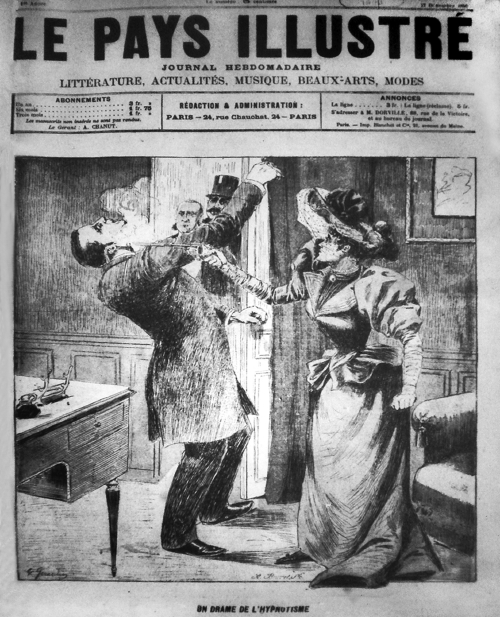
Gilles de la Tourette married and had several children. In 1893 he survived a gunshot wound inflicted by a former patient who alleged coercive hypnosis; the episode coincided with a deterioration in his own mental health. Accounts describe increasing mood instability and ultimately institutional care. He died in 1904 at a psychiatric hospital in Prilly, near Lausanne, and his final years have been the subject of historical interest and some debate. The hospital where he died is recorded in contemporary sources as located in Prilly and the surrounding region; local references also cite Prilly specifically.
Publication and recognition
Gilles de la Tourette's landmark paper assembled multiple cases (often cited as nine initially) with a similar clinical pattern; modern summaries refer to these early case reports when tracing the history of the diagnosis. For primary-material context, contemporary readers can consult descriptions of the case series and the attendant commentary by colleagues such as Charcot, who reportedly helped to popularize the eponym through lectures and reviews. The disorder itself is commonly referred to today as Tourette syndrome, and its study has expanded into genetics, neurology, and behavioural medicine.
Notable facts and distinctions
- Although associated with neurology, Gilles de la Tourette worked when the specialty was still forming; much of his output reflects the overlap of neurology and psychiatry at the time.
- His research into suggestion and trance aligned him with broader European interest in hypnotism; more recent perspectives treat those inquiries as historically significant but limited by the concepts then available.
- Biographical details—such as his birthplace in Saint-Gervais-les-Trois-Clochers and family matters including the loss of a child—appear in archival notices and genealogical records and are often mentioned in short biographies and hospital records (family references).
Gilles de la Tourette remains a figure of medical history: his clinical observations helped define a recognizable syndrome, and his life reflects both the opportunities and the professional hazards of clinical work in his era. For further historical or clinical detail consult specialized histories of neurology and contemporary reviews of Tourette syndrome and 19th-century psychiatry (hypnotism and hysteria context, modern clinical resources).
Related articles
Author
AlegsaOnline.com Georges Gilles de la Tourette Leandro Alegsa
URL: https://en.alegsaonline.com/art/38320
Sources
- commons.wikimedia.org : Georges Gilles de la Tourette
- ncbi.nlm.nih.gov : "Pioneers of movement disorders: Georges Gilles de la Tourette"