
Georg von Békésy
Hungarian biophysicist and Nobel laureate known for demonstrating the traveling-wave mechanics of the cochlea and elucidating physical principles of hearing.
Overview
Georg von Békésy (3 June 1899 – 13 June 1972) was a Hungarian-born biophysicist whose experimental and theoretical work clarified how the inner ear converts sound into nerve signals. He received the 1961 Nobel Prize in Physiology or Medicine for his discoveries concerning the function of the cochlea and the physical mechanism of auditory stimulation.
Image gallery
3 Images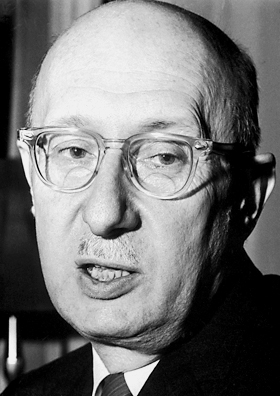


Research and main findings
Békésy showed that sound produces a travelling wave along the basilar membrane inside the inner ear. The wave reaches a frequency-dependent peak at a particular place on that membrane, providing a mechanical explanation for frequency discrimination in mammals. His work tied physical acoustics to biological sensation and reshaped understanding within both biophysics and auditory physiology.
Methods and models
To reveal cochlear mechanics, Békésy combined observations on excised and preserved cochleae with mechanical models and careful measurement of membrane motion. He used optical and stroboscopic techniques and constructed scaled physical models to demonstrate the principles he described. Much of his insight came from comparing measurements across different mammalian specimens.
Career and historical context
Born in Budapest, Békésy trained across disciplines at a time when the boundary between physics and biology was becoming more porous. Over several decades he worked in laboratories in Europe and the United States, contributing to the maturation of auditory science in the mid-20th century. He spent his later years in Honolulu and died there in 1972 in the United States.
Impact and legacy
The concept of a travelling wave and place-dependent peak on the basilar membrane remains central to modern theories of hearing and to practical technologies such as sound analysis and cochlear implants. Békésy's emphasis on quantitative measurement and model building influenced generations of researchers in neuroscience and acoustics and continues to frame experimental approaches to inner-ear function (further reading).
Notable facts
- 1961 Nobel Prize laureate for elucidating the physical mechanism of stimulation within the cochlea.
- Combined physics-based techniques with biological material to reveal how mechanical motion relates to perception.
- His findings provided a physical foundation for technologies and clinical approaches addressing hearing loss.
Related articles
Author
AlegsaOnline.com Georg von Békésy Leandro Alegsa
URL: https://en.alegsaonline.com/art/38169
Sources
- nobelprize.org : "Georg von Békésy - Autobiography"