
Geochronology: methods and applications for dating Earth materials
Geochronology establishes the ages and temporal relationships of rocks, sediments, fossils and planetary materials using relative and absolute dating methods and laboratory techniques.
Geochronology is the scientific discipline that determines the age and temporal sequence of geological and planetary materials — including rocks, sediments, fossils and meteorites. It integrates field stratigraphy, fossil correlations, laboratory measurements and theoretical models to place geological events on absolute or relative time scales. Geochronology provides the temporal framework for reconstructing Earth history, the evolution of life, tectonic processes and the history of the Solar System.
Image gallery
2 Images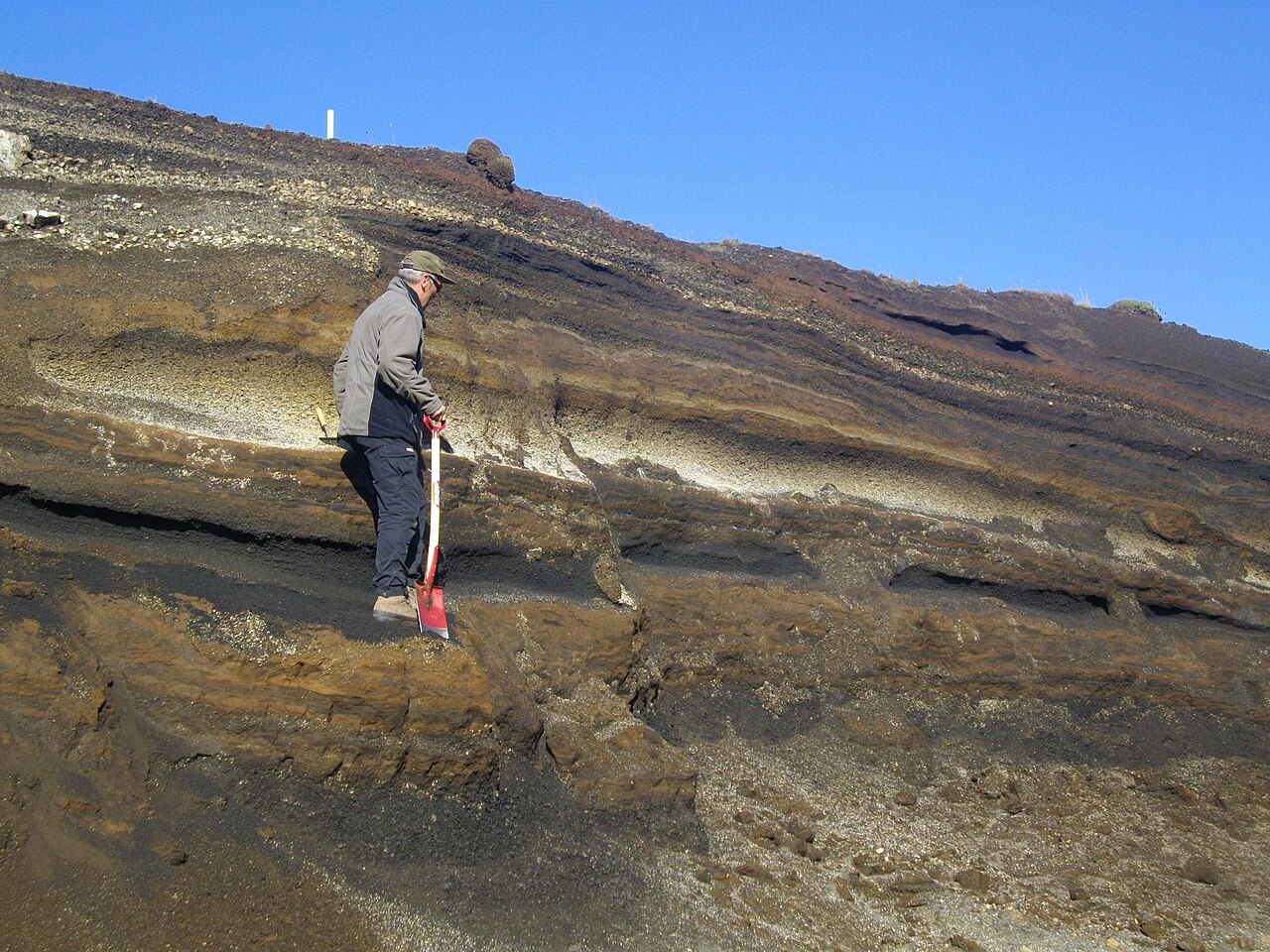

Major methods
- Radiometric dating: Measures the decay of radioactive isotopes to daughter products. Common systems include uranium–lead (U–Pb), potassium–argon (K–Ar) and argon–argon (Ar–Ar), rubidium–strontium (Rb–Sr) and radiocarbon (14C) for recent organic remains. Each system has typical effective age ranges and materials to which it best applies.
- Stratigraphy and biostratigraphy: Relative ordering of sedimentary layers and the use of index fossils allow correlation between sites where absolute dates are absent. Chronostratigraphic frameworks are built by combining relative and absolute data.
- Dendrochronology and varve counting: Annual tree rings and annually deposited sediment layers provide high-resolution calendars for the recent centuries to millennia and can calibrate radiocarbon ages.
- Luminescence dating: Thermoluminescence (TL) and optically stimulated luminescence (OSL) date the last exposure of mineral grains to heat or sunlight, useful in Quaternary and archaeological studies.
- Fission-track and cosmogenic-nuclide dating: Track damage trails from spontaneous fission or use cosmogenic isotopes produced by cosmic rays to determine cooling ages or surface exposure durations.
- Paleomagnetism and tephrochronology: Reversals or secular variation of Earth’s magnetic field recorded in rocks and datable volcanic ash layers (tephra) serve as regional or global time markers.
Core principles and common assumptions
Radiometric techniques rest on known decay rates and measurable parent/daughter ratios. Reliable age estimates require that the system behaved as a closed system since the clock started, that initial conditions are understood or can be corrected for, and that decay constants are accurately known. Concepts such as closure temperature (the temperature below which a mineral retains daughter isotopes) and isochron methods help detect disturbance, inheritance or contamination. Cross-checking results with independent methods strengthens confidence.
History, practice and recent advances
Quantitative geochronology emerged in the early 20th century with the recognition that radioactive decay provides a natural clock. Over decades, improvements in sample preparation, mass spectrometry and calibration have increased precision and broadened the range of datable materials from recent centuries to billions of years. Modern laboratory techniques include high-precision U–Pb methods, accelerator-mass-spectrometry (AMS) for radiocarbon, and laser ablation for in-situ analysis.
Applications and limitations
Geochronology underpins many disciplines: constraining rates of tectonic and volcanic processes, timing evolutionary events in the fossil record, dating archaeological sites, reconstructing past climates, and establishing ages of meteorites and planetary materials. Limitations arise from metamorphic overprinting, diagenetic alteration, low parent or daughter concentrations, and analytical uncertainty. Best practice combines careful field context, multiple complementary methods, appropriate sample selection and transparent reporting of uncertainties.
Looking forward, continued improvements in analytical precision, better calibration of short-lived isotopes, and integrated multidisciplinary studies will refine the geological time scale and deepen understanding of temporal processes on Earth and other planetary bodies.
Related articles
Author
AlegsaOnline.com Geochronology: methods and applications for dating Earth materials Leandro Alegsa
URL: https://en.alegsaonline.com/art/38089
Sources
- ncbi.nlm.nih.gov : ncbi.nlm.nih.gov/pubmed/10800377
- dx.doi.org : dx.doi.org/10.1016/S0012-821X(99)00223-X
- www3.interscience.wiley.com : www3.interscience.wiley.com/journal/72000094/abstract?CRETRY=1&SRETRY=0
- pereplet.ru : pereplet.ru/gorm/dating/vesuvius.pdf
- digitalcommons.library.arizona.edu : "Cosmic background reduction in the radiocarbon measurement by scintillation spectrometry at the underground laboratory of Gran Sasso"
- dx.doi.org : dx.doi.org/10.1016/j.tecto.2014.05.013
- springerlink.com : springerlink.com