
Geoid: Earth's equipotential surface and its role in geodesy
The geoid is the equipotential surface of Earth's gravity field that best fits global mean sea level. It serves as the physical reference for heights and is measured by gravimetry, satellites and sea-surface data.
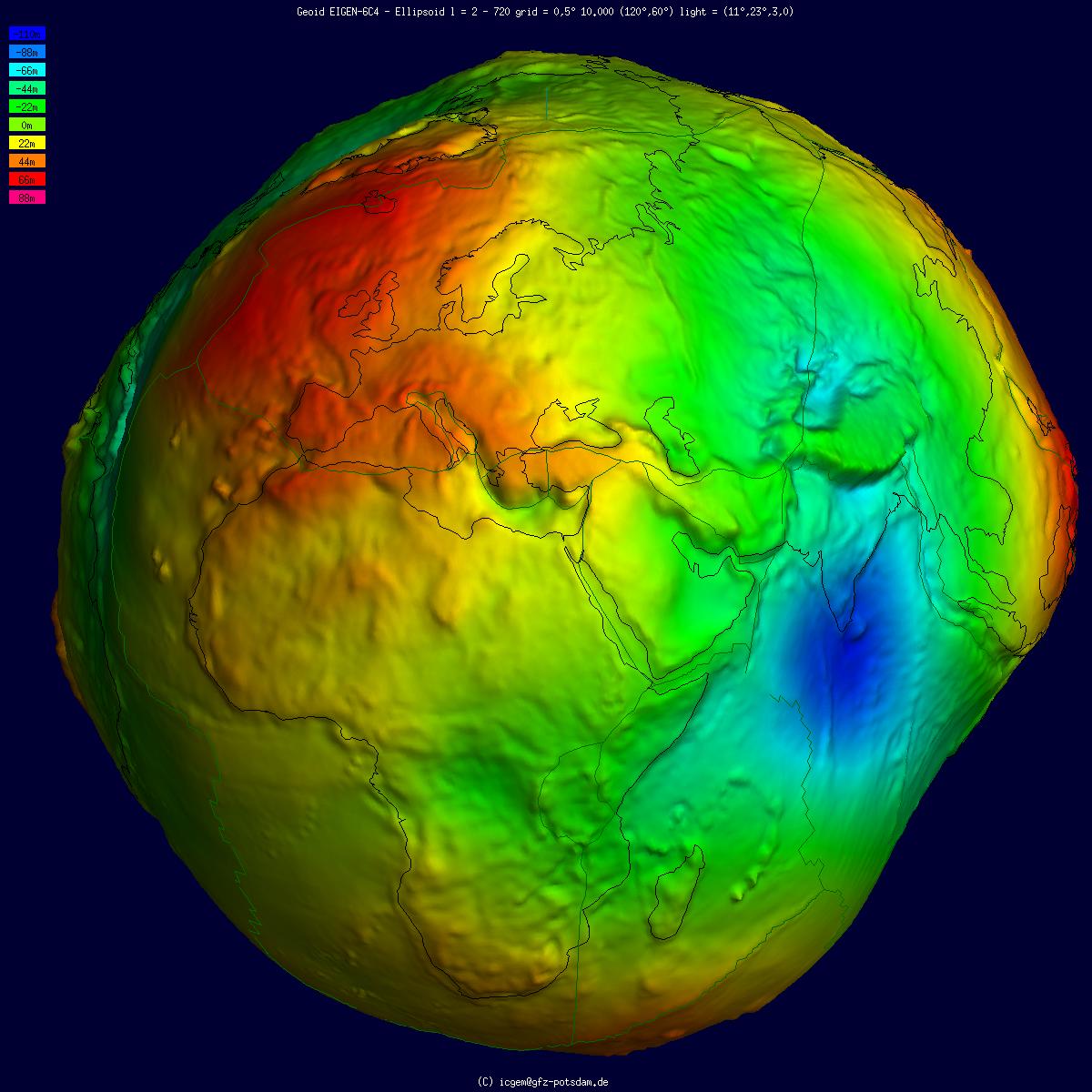
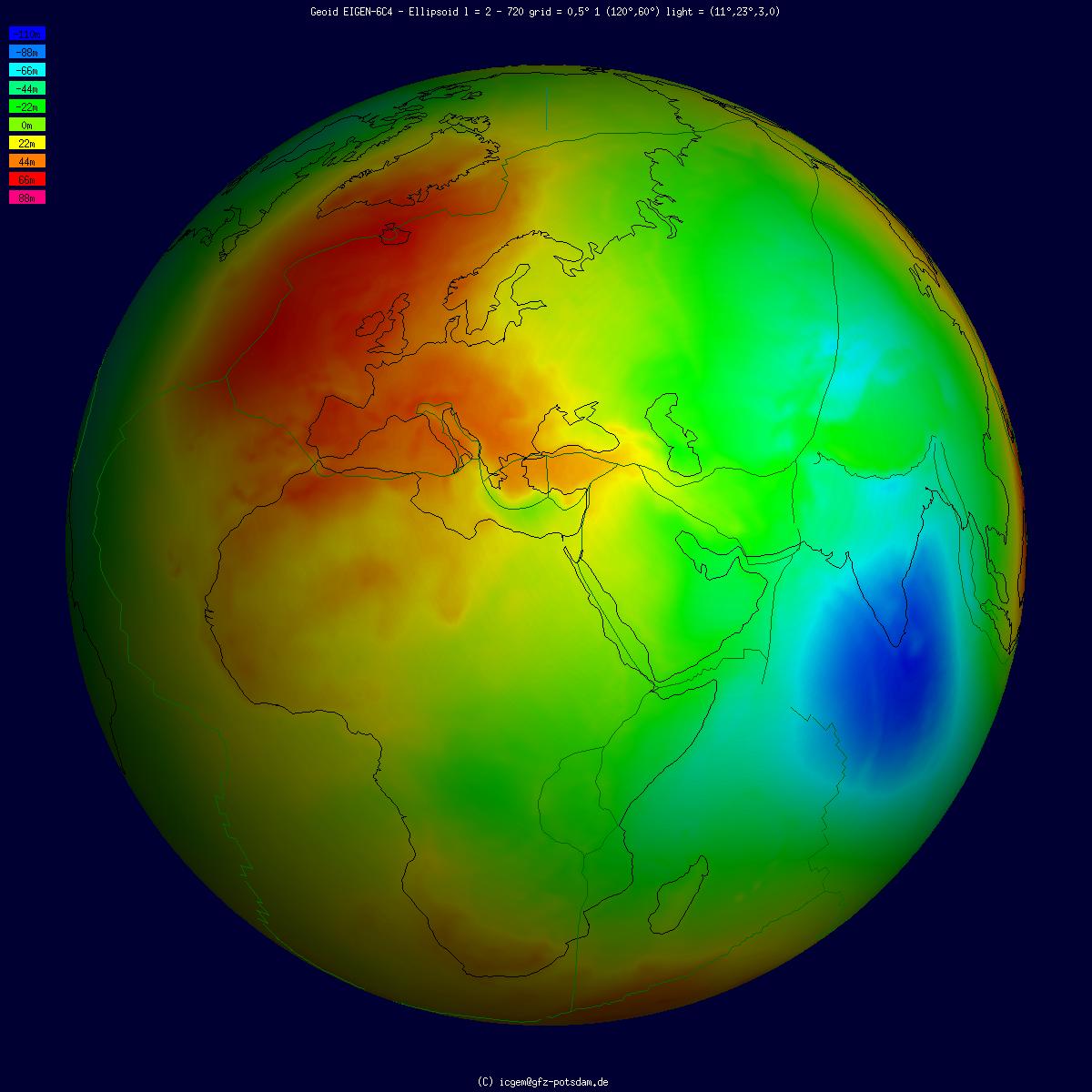
The geoid is a model of Earth's shape defined by gravity and rotation: it is the equipotential surface of the planet's gravity field that would coincide with mean sea level if the oceans were allowed to settle under gravity and centrifugal force alone. Because the geoid follows variations in mass distribution inside Earth, it departs from a simple mathematical ellipsoid in a complex but physically meaningful way. The concept is central to geodesy, the science of measuring Earth's size, shape and gravity field, and it underpins how we define heights and sea level on maps and charts. See a basic overview definition and overview.
Image gallery
9 Images




Definition and geometric character
Formally, the geoid is an equipotential surface of the Earth's gravity field; any point on that surface has the same total potential (gravitational plus centrifugal). Because the Earth rotates, the geoid is not a perfect sphere but resembles an oblate spheroid in overall shape while retaining smaller-scale undulations. Those undulations reflect density variations within the crust, mantle and oceans, and they produce gravity anomalies that geodesists measure. For a simple approximation of Earth's shape, practitioners often use a smooth reference ellipsoid, but the geoid is preferred when physical heights relative to mean sea level are required. For a comparison with simple mathematical models, see geometric models and reference ellipsoid concepts.
How the geoid is measured
Measuring the geoid combines local and global techniques. Ground-based gravimetry and leveling provide high-accuracy local information, while satellite missions and altimetry yield global coverage. Typical data sources include:
- Terrestrial and marine gravity observations and spirit leveling to establish precise local vertical differences (gravimetry).
- Satellite altimetry over the oceans, which measures sea-surface height relative to a reference ellipsoid and helps determine mean sea level patterns (altimetry).
- Satellite gravity missions such as dedicated gravity mapping satellites that infer mass distribution from orbital perturbations (satellite gravity missions).
Uses and practical importance
The geoid is the physical reference for orthometric heights (commonly called elevations) used in engineering, surveying, navigation and flood mapping. Converting positions from GPS (which gives ellipsoidal heights) to meaningful elevations above sea level requires an accurate geoid model. Accurate geopotential information also supports oceanography, where the geoid helps isolate dynamic ocean currents, and geophysics, where gravity anomalies reveal subsurface structures. For applications in mapping and navigation, consult resources on vertical datums and GPS height conversion.
History and scientific development
The geoid concept has roots in classical geodesy and was formalized in the 19th century as scientists sought a physically meaningful surface that represented mean sea level worldwide. Mathematicians and geodesists, including influential figures such as Gauss, developed the theoretical foundations that link gravity theory and measurable surfaces. Advances in instrumentation, surveying techniques and satellites in the 20th and 21st centuries have progressively refined geoid models, allowing centimeter-level accuracy in many regions. For historical context and modern summaries see history and modern geodesy.
Distinctions and notable facts
Key distinctions to remember: the geoid is a physical equipotential surface tied to gravity; the reference ellipsoid is a smooth mathematical approximation used for position computations; and the topographic surface is the actual landscape of mountains and valleys. The geoid does not coincide with mean sea level everywhere because ocean dynamics, temperature and salinity affect local sea surface height; when averaged over time and filtered for transient effects, however, mean sea level follows the geoid closely. Modern geoid models are continuously updated to reflect improved gravity data and are essential for consistent height systems worldwide.
Overall, the geoid bridges theoretical gravity physics and everyday requirements for elevation, sea-level monitoring and understanding Earth's internal structure. Its study draws on observational geodesy, satellite remote sensing and physical geophysics to produce practical models used by engineers, scientists and navigators.
Questions and answers
Q: What is the geoid?
A: The geoid is a 3-D geometrical shape like an orange, which is a specific kind of oblate spheroid.
Q: How is the geoid defined?
A: The geoid is defined as the shape that the surface of the oceans would take under the influence of Earth's gravitation and rotation alone, in the absence of other influences such as winds and tides.
Q: Who defined the geoid and when?
A: The geoid was defined by Gauss, in 1828.
Q: What is the geodesy?
A: The study of Earth's measurements and shapes is called geodesy.
Q: Why use a reference ellipsoid instead of the geoid?
A: For many practical purposes, a simpler shape is used because that makes calculations easier. That shape is called a reference ellipsoid.
Q: How is the shape of the Earth described in basic education?
A: In basic education, the shape of the Earth is described as being like an orange, a sphere but wider round the equator.
Q: Are similar shapes to the geoid found in other celestial spinning spheres?
A: Yes, this shape is produced by all celestial spinning spheres, such as stars and planets. The details differ somewhat in each individual case.
Related articles
Author
AlegsaOnline.com Geoid: Earth's equipotential surface and its role in geodesy Leandro Alegsa
URL: https://en.alegsaonline.com/art/38138
Sources
- ngs.noaa.gov : "What is the geoid?"
- soest.hawaii.edu : soest.hawaii.edu