
Giant star: definition, structure, evolutionary stages, and importance
A giant star is a post–main-sequence star with substantially larger radius and luminosity than a similar-temperature main-sequence star. This article explains types, evolution, and scientific significance.
Overview
A giant star is an evolved star whose outer layers have expanded and brightened compared with a main-sequence counterpart of the same surface temperature. Giants are characteristically much larger in radius and much more luminous than main-sequence stars that share their spectral type. They occupy distinct regions on the Hertzsprung–Russell diagram and represent one of the principal post–main-sequence phases of stellar evolution.
Image gallery
4 Images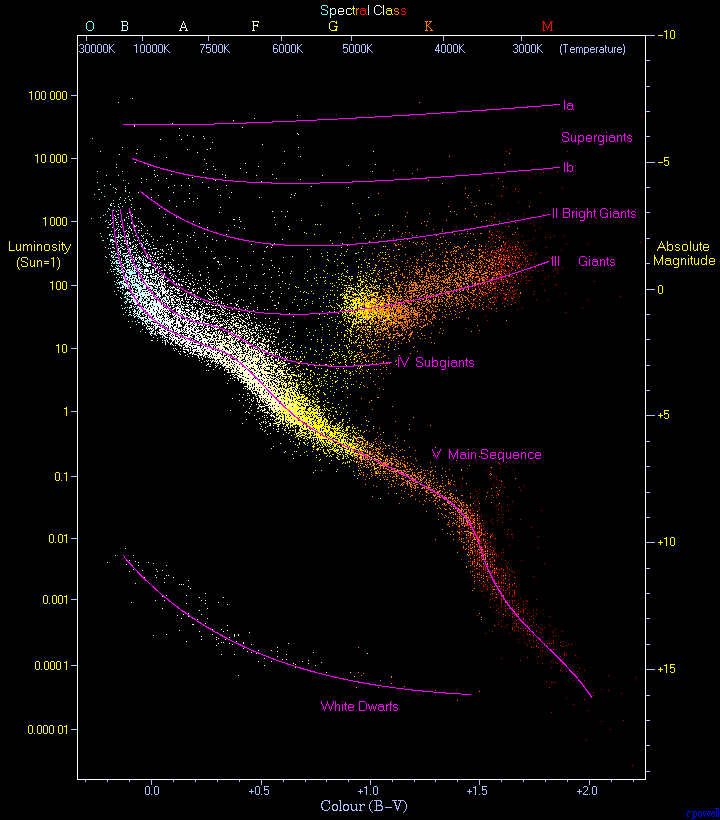


Physical characteristics
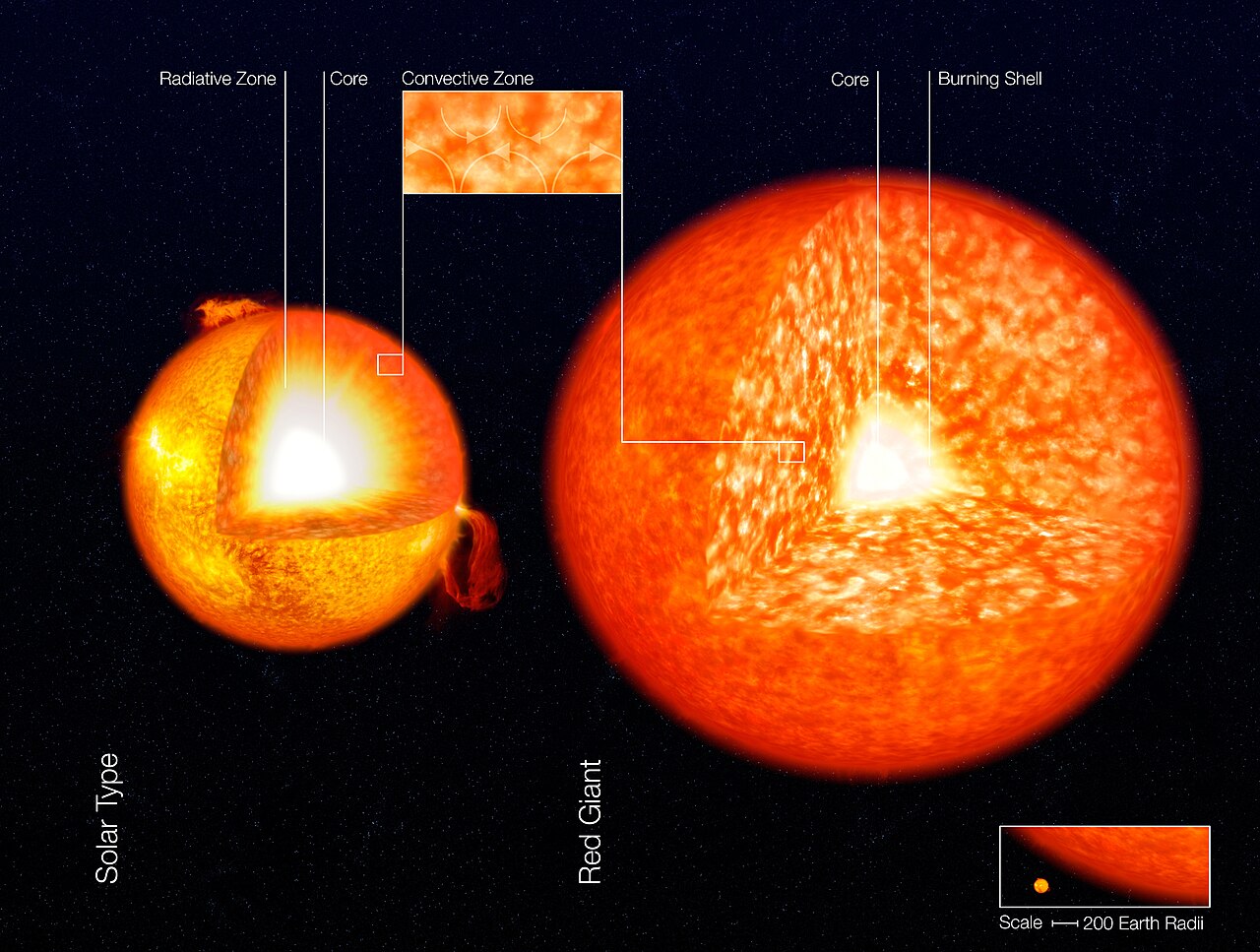
Compared with the Sun, giant stars can reach tens to a few hundred times greater radius or diameter, depending on their mass and stage of evolution. Their luminosity typically exceeds that of a similar-temperature dwarf by large factors; many giants are between ten and several thousand times more luminous than the Sun. Surface gravity is lower than on main-sequence stars, and convection zones often deepen or change, altering surface chemistry and spectra.
Life cycle and evolution
Giant status is usually reached after a star exhausts hydrogen in its core and leaves the main-sequence. The core contracts and heats while hydrogen burning continues in a surrounding shell, causing the outer envelope to expand and cool. Depending on the original mass, stars may experience a helium-flash or smoothly ignite helium in the core, move to the horizontal branch or red clump, and later ascend the asymptotic giant branch. AGB giants can undergo strong mass loss, produce enriched material by nucleosynthesis, and eventually shed envelopes to create planetary nebulae, leaving white dwarf remnants.
Types and classification
- Subgiants: stars just leaving the main sequence and beginning envelope expansion.
- Red giants: cool, luminous giants with extended, reddish envelopes; many examples are well known in the night sky. Red giants are a major subgroup.
- Bright giants: particularly luminous giants that sit above ordinary giants in luminosity class.
- Blue and yellow giants: hotter or intermediate-temperature giants with appropriate spectral types.
- Supergiants and hypergiants: still more extreme in size and brightness and treated as separate classes.
Observational features and significance
Giant stars show broadened spectral lines, surface abundance changes, and often variable brightness; many long-period variables and Mira-type pulsators are AGB giants. Their strong stellar winds enrich the interstellar medium with heavier elements produced by nucleosynthesis, contributing to chemical evolution in galaxies. Certain groups of giants, such as red-clump stars, serve as useful distance indicators because of their relatively uniform luminosities. In planetary systems, expanding giant envelopes can engulf inner planets and radically change system dynamics.
Examples and notable facts
Familiar bright stars observed from Earth include orange and red giants that are easy to recognize to the naked eye. Well-studied examples illustrate different evolutionary states and help calibrate stellar models. Research on giants remains a central tool for understanding stellar structure, late-stage nucleosynthesis, and the life cycles of stars.
For further summaries and visual guides, see introductory and technical resources: general overview, radius measurements, luminosity comparisons, main-sequence context, size scales, solar reference, and red giant specifics.
Questions and answers
Q: What is a giant star?
A: A giant star is a star that is much larger in radius and luminosity compared to a main-sequence star of the same surface temperature.
Q: How big can giant stars be compared to the Sun?
A: Giant stars can be up to a few hundred times the diameter of the Sun.
Q: How bright can giant stars be compared to the Sun?
A: Giant stars can be between 10 and a few thousand times brighter than the Sun.
Q: Do giant stars last longer than most main sequence stars?
A: No, giant stars don't last as long as most main-sequence stars.
Q: What are supergiants and hypergiants?
A: Stars that are still more luminous than giants are referred to as supergiants and hypergiants.
Q: Can a hot, luminous main-sequence star be referred to as a giant?
A: Yes, a hot, luminous main-sequence star may also be referred to as a giant.
Q: What are some sub-divisions of giant class stars?
A: Some sub-divisions of giant class stars are sub-giants, bright giants, red giants, yellow giants, and blue giants.
Related articles
Author
AlegsaOnline.com Giant star: definition, structure, evolutionary stages, and importance Leandro Alegsa
URL: https://en.alegsaonline.com/art/38715
Sources
- atlasoftheuniverse.com : Richard Powell