
Gas turbine locomotive
A railway locomotive powered by a gas turbine as its prime mover; designs have varied between mechanical and electric transmission and saw experimental use in mid‑20th century heavy-haul and high‑speed services.
Overview
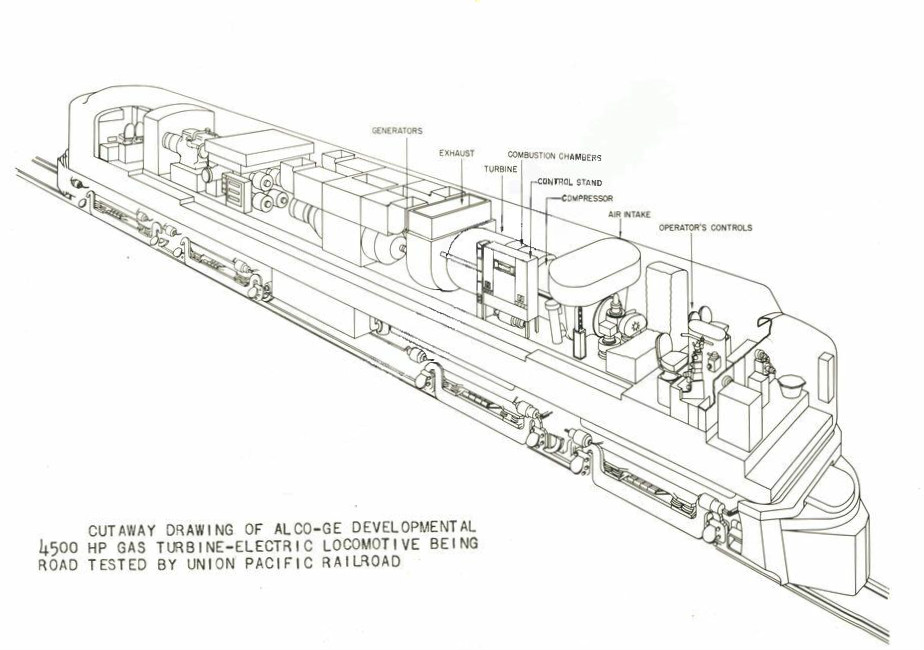
A gas turbine locomotive is a type of railway locomotive that uses a gas turbine rather than a piston diesel engine or electric traction as its main source of power. The turbine converts combustion energy into rotational motion that is transmitted to the wheels either directly, through a mechanical gearbox, or indirectly via an electrical generator and traction motors.
Image gallery
10 Images



Characteristics and variants
Variants fall into two broad categories: turbine-mechanical units where the turbine output drives the wheels through gearboxes, and turbine-electric units where the turbine drives a generator supplying electric traction motors. Turbines tend to offer high power-to-weight ratios, smooth operation and fewer reciprocating parts, but they typically perform best at sustained high speeds and high loads.
History and development
During the mid-20th century several railways and manufacturers experimented with gas-turbine propulsion. In the United States, large gas turbine-electric (GTEL) locomotives were trialed for heavy freight service, while in Europe some high-speed railcars and multiple units used turbine power for non-electrified routes. Prototypes and limited series were built rather than widespread production models.
Uses, advantages and disadvantages
- Advantages: high continuous power, compact size for the power delivered, multi-fuel capability in some designs.
- Disadvantages: poor fuel economy at low power or idle, sensitivity to fuel price, higher noise and maintenance demands for some installations.
Notable facts and modern context
Unlike diesel-electric locomotives, turbine-powered designs did not become mainstream, largely because of operating economics. Interest persists periodically for specialized applications and for hybrid systems where a turbine might charge batteries or provide peak power. The gas turbine locomotive illustrates how alternative prime movers — the term prime mover denotes the main engine — have been explored in rail traction history.
For technical comparisons and historical examples, consult specialized references and preserved examples in railway museums and collections. Further reading can be found at general technical sources on gas turbines.
Related articles
Author
AlegsaOnline.com Gas turbine locomotive Leandro Alegsa
URL: https://en.alegsaonline.com/art/37670