
Amplitude: size and measures of a wave's oscillation
Amplitude describes the maximum displacement of a periodic signal or wave from equilibrium. Common measures include peak, peak-to-peak, and RMS values; it relates to energy and many practical measurements.
Overview
Amplitude is a quantitative measure of how large a periodic variation is, commonly used for waves, oscillations, and repeating signals. In physical contexts it denotes the maximum displacement of a quantity (such as displacement, pressure, electric potential or field strength) from its equilibrium or mean value. Amplitude is expressed in units appropriate to the quantity being measured — metres for mechanical displacement, volts for electrical signals, pascals for sound pressure, and so on. The term usually refers to a non-negative magnitude even though the instantaneous value of the signal can be positive or negative.
Image gallery
1 Image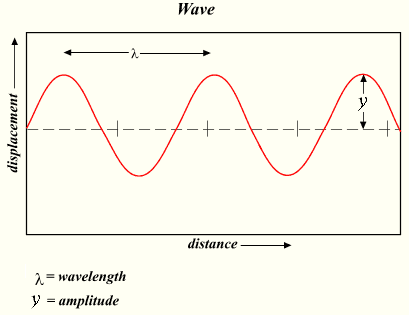
Common measures and definitions
Different conventions are used to report amplitude depending on the application. Typical measures include:
- Peak amplitude: the maximum absolute displacement from equilibrium in one direction.
- Peak-to-peak amplitude: the full vertical span between the maximum positive and maximum negative values of a waveform.
- Root mean square (RMS) amplitude: a statistical measure related to the effective value of a varying quantity; for a pure sinusoid, RMS = peak / √2.
- Envelope or instantaneous amplitude: a slowly varying function that describes how the peak values of a modulated signal change over time.
Physical significance and examples
Amplitude often controls the energy or intensity carried by a wave. In many linear wave systems the energy or intensity is proportional to the square of amplitude, so doubling amplitude typically increases energy by a factor of four. Examples:
- Sound: higher sound pressure amplitude generally corresponds to louder perceived sound, though human loudness perception also depends on frequency and duration.
- Light and electromagnetic waves: the amplitude of an electric or magnetic field determines intensity and power transmitted by the wave.
- Electrical signals: amplitude is the voltage or current excursion that electronic instruments like oscilloscopes display and measure.
- Mechanical vibrations and seismology: recorded amplitudes help characterize motion and estimate released energy in events such as earthquakes.
Distinctions and measurement notes
Amplitude should be distinguished from related wave properties such as wavelength, frequency and phase. Frequency sets how often cycles repeat; amplitude sets how large those cycles are. Although an instantaneous signal value can be positive or negative, amplitude as used in measurement contexts is conventionally the absolute size and therefore non-negative. For non-sinusoidal signals the relationship between peak and RMS depends on waveform shape.
History and analytical context
The formal study of waveforms and their magnitudes developed alongside work in acoustics, optics and electrical engineering. Tools such as Fourier analysis allowed decomposing complex motions into sinusoidal components, each described by amplitude, frequency and phase. In modern practice, amplitude is a central parameter in signal processing, communications (for example amplitude modulation), instrumentation and many branches of physics and engineering.
Measurement techniques and practical considerations
Amplitude is measured with instruments suited to the domain: microphones and sound level meters for acoustics, oscilloscopes and voltmeters for electrical signals, laser vibrometers for mechanical displacement, and seismographs for ground motion. Practical measurement often requires attention to calibration, bandwidth limits and noise, because these factors can bias observed peak or RMS values. For detailed methods and standards see relevant technical references or instrumentation guides, or follow introductory resources on oscillations and signal measurement.
Related articles
Author
AlegsaOnline.com Amplitude: size and measures of a wave's oscillation Leandro Alegsa
URL: https://en.alegsaonline.com/art/3659