
Franz Gürtner: German jurist and Reich Minister of Justice
Franz Gürtner (1881–1941) was a German jurist who served as Reich Minister of Justice from 1932 until his death. He helped adapt the legal system to the Nazi state while maintaining a formal legal framework.
Franz Gürtner was born in Regensburg on 26 August 1881 and died in Berlin on 29 January 1941. Trained and known as a professional jurist, he became a prominent conservative politician and legal official during the waning years of the Weimar Republic and the first decade of Nazi rule. He received military honors in the First World War, including the Iron Cross.
Image gallery
2 Images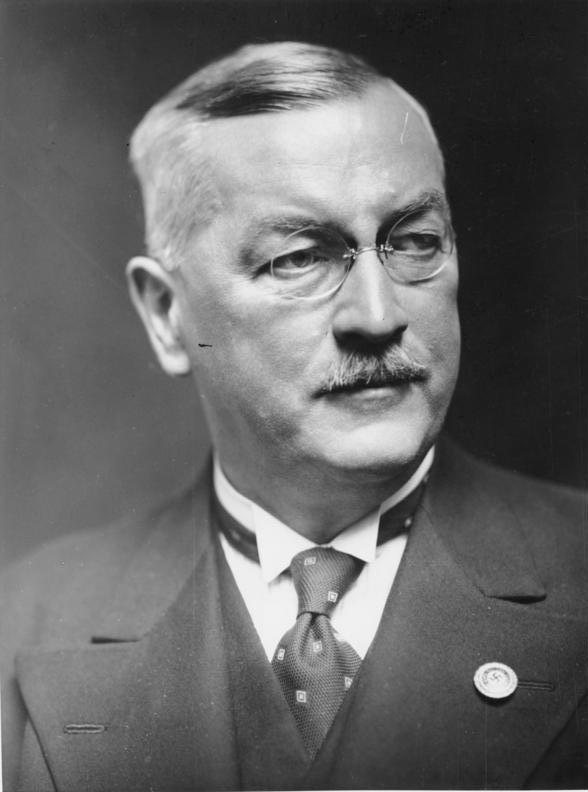

Career and appointment
Gürtner rose through the Bavarian legal and administrative system before entering national office. He was appointed Reich minister with responsibility for justice at the end of January 1932 and retained the portfolio when Adolf Hitler became chancellor in 1933. He remained a member of Hitler's Cabinet until his death, serving under successive governments and navigating a period of radical political change.
Role in the legal consolidation of the Nazi state
Gürtner sought to preserve a notion of legal continuity even as the Nazi leadership enacted sweeping emergency measures and discriminatory legislation. In practice his ministry supervised the adaptation of courts and legal procedures to the regime's aims: enforcing laws that removed political opponents and marginalized Jews and other targeted groups from public life, and integrating emergency decrees into a statutory framework. Though he sometimes resisted extra‑legal violence in principle, his policies helped give the Nazi state a veneer of legality and allowed many repressive acts to proceed with judicial sanction.
Policies, constraints and controversies
- Advocated formal legal procedures while accommodating politically driven legislation.
- Worked to bring prosecutors and judges in line with state priorities, accelerating the politicization of the judiciary.
- Remained a contentious figure among contemporaries: viewed by some as a stabilizing conservative and by others as complicit in legalizing repression.
Gürtner's complex legacy reflects the tensions between professional legalism and authoritarian politics. He joined the Nazi Party during his tenure, a step interpreted by many historians as a capitulation to the regime's demands for loyalty. His death in office ended a decade in which German law was transformed from a means of dispute resolution into an instrument of state power.
For further reading on aspects of Gürtner's life and the period, consult specialized histories of German legal institutions under National Socialism and biographies of key political figures of the era. Contemporary primary documents and court records illustrate how legal structures were repurposed to serve political ends during his ministry.
Related articles
Author
AlegsaOnline.com Franz Gürtner: German jurist and Reich Minister of Justice Leandro Alegsa
URL: https://en.alegsaonline.com/art/36302