
Iron Cross (German military decoration)
A Prussian and German military decoration established in 1813, reissued for later wars. Known for its black iron core and silver frame, several classes, and its wartime-only award history and legacy.
Overview: The Iron Cross is a military decoration first instituted by King Frederick William III of Prussia in 1813. Intended as a visible recognition of merit on the battlefield, it became a recurring German wartime award and a widely recognised military symbol. It was traditionally awarded only during declared wars and was re‑instituted for later conflicts such as the Napoleonic Wars, the Franco-Prussian War, World War I, and World War II. The decoration recognized acts of courage and leadership by soldiers and officers in combat (medal record, German recipients).
Image gallery
1 Image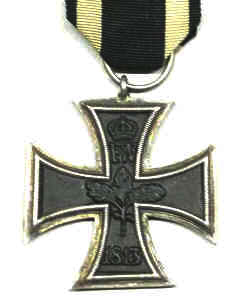
Design and grades
The Iron Cross is most often identified by its black iron core set within a silver or silver‑coloured frame, shaped as a cross pattée. Early issues bore the year of institution on the lower arm; later versions displayed other dates or emblems. Over time a graded system evolved. Common forms include:
- Iron Cross 2nd Class — the basic award for battlefield merit.
- Iron Cross 1st Class — a higher grade, typically worn on the uniform breast.
- Knight's Cross and its higher augmentations (introduced in 1939) — awarded for exceptional leadership and bravery in World War II.
- Grand Cross — conferred rarely, often for senior commanders.
History and evolution
The decoration originated during the Wars of Liberation against Napoleonic rule and was deliberately styled as a national, rather than dynastic, honour. It was reissued by imperial or national authorities when Germany entered major wars in later centuries. During the 1939 reauthorization, changes included additional symbols and new higher grades to reflect the scale of World War II. After 1945 the Iron Cross ceased to be awarded by Germany in its wartime form; the emblem’s association with Nazi-era insignia also prompted controversies and restrictions.
Criteria, recipients and legacy
Traditionally the award was limited to military personnel for acts of bravery, tactical skill, or leadership in combat. Some well-known recipients from the First World War included junior officers who later rose to prominence; for example, Adolf Hitler received Iron Crosses during the First World War. The postwar German state made legal accommodations for veterans: in 1957 a version of the decoration without Nazi symbols was authorised for wear by veterans, allowing denazified devices to be displayed on modern uniform jackets.
Notable distinctions and facts
The Iron Cross is distinct from civilian orders of merit or decorations created after 1945. While the traditional iron‑and‑silver motif is widely recognised, the award’s meaning changed across eras depending on political context and design alterations. Debate over public display of original wartime versions continues; many museums and collections use contextual explanations to present specimens. For further reading and archival references see military collections and national registries (citation, records, recipient lists, conflict histories).
Questions and answers
Q: What is the Iron Cross?
A: The Iron Cross was a medal given to German soldiers for bravery during wartime.
Q: Who created the Iron Cross?
A: The Iron Cross was created by King Frederick William III of Prussia.
Q: When was the Iron Cross first given out?
A: The Iron Cross was first given out on 10 March 1813.
Q: During which wars was the Iron Cross awarded?
A: The Iron Cross was awarded during the Napoleonic Wars, the Franco-Prussian War, the First World War, and the Second World War.
Q: Who received the Iron Cross after World War I?
A: Adolf Hitler received the Iron Cross after World War I.
Q: Is the Iron Cross still given out today?
A: No, the medal is only given in wartime, so no Iron Crosses have been given out since the end of the Second World War in 1945.
Q: What was the purpose of giving the Iron Cross to German soldiers?
A: The purpose of giving the Iron Cross to German soldiers was to recognize their bravery during wartime.
Related articles
Author
AlegsaOnline.com Iron Cross (German military decoration) Leandro Alegsa
URL: https://en.alegsaonline.com/art/48208