
Fornjot (Saturn XLII) — an irregular outer moon of Saturn
Fornjot (Saturn XLII, S/2004 S 8) is a small, retrograde irregular moon of Saturn discovered in 2005. It orbits at ~24.5 million km and is named after a giant from Norse mythology.
Overview
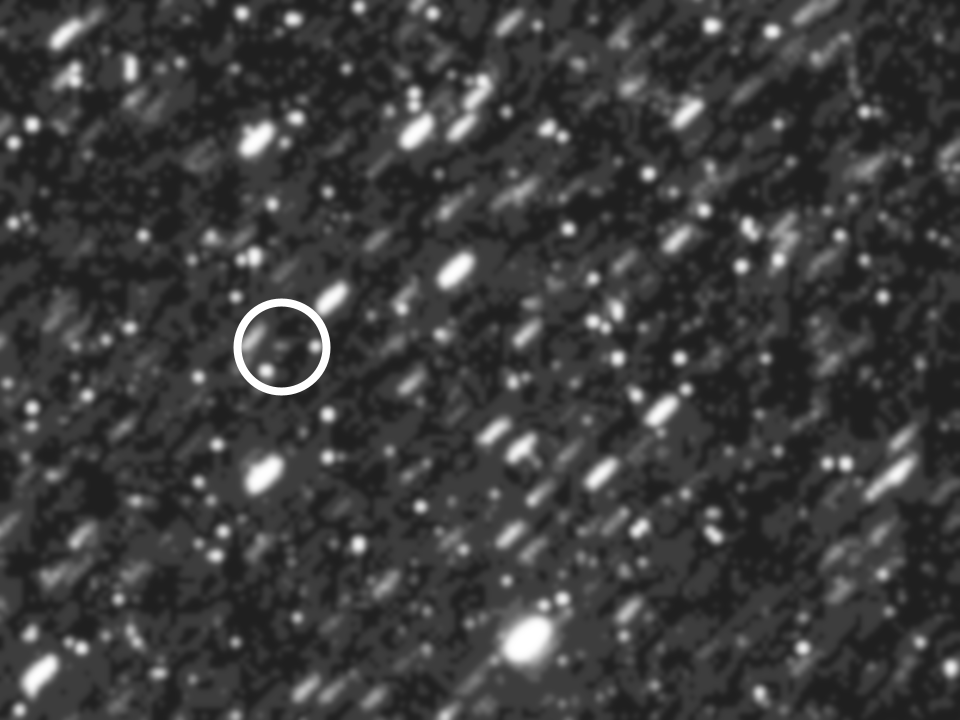
Fornjot, officially designated Saturn XLII and provisionally S/2004 S 8, is one of Saturn's distant irregular satellites. Announced on May 4, 2005, it was identified from images taken between December 12, 2004 and March 11, 2005 by a team that included Scott S. Sheppard and David C. Jewitt, together with Jan Kleyna and Brian G. Marsden. The object is very small and faint compared with Saturn's major moons and is tracked primarily with large ground-based telescopes during favorable apparitions.
Image gallery
4 Images


Physical characteristics
Fornjot is estimated to be roughly 6 kilometres in diameter. This size is derived from its brightness and an assumed low reflectivity typical of outer irregular satellites; the true diameter depends on the unknown surface albedo. Its surface is presumed to be dark and similar to other small, distant moons and minor bodies in the outer Solar System. Because of its small size and distance from Earth, detailed surface properties and composition remain unknown.
Orbit and dynamical properties
Fornjot follows a distant, inclined, and eccentric orbit around Saturn. Key orbital parameters are listed below:
- Average orbital radius: about 24,505,000 km from Saturn.
- Orbital period: 1432 days, reflecting the long time it takes to complete one circuit around the planet.
- Inclination: 168° to the ecliptic (about 152° relative to Saturn's equator), indicating a strongly inclined, retrograde orbit.
- Eccentricity: 0.186, meaning the path is noticeably elliptical rather than circular.
These values identify Fornjot as a retrograde irregular satellite. Its high inclination and retrograde motion suggest it was likely captured by Saturn's gravity rather than having formed in orbit around the planet.
Group membership and name
Fornjot is classed with Saturn's Norse group of moons, a collection of outer satellites that share similar retrograde, inclined orbits and are named for figures from Norse mythology. In April 2007 the moon received the name Fornjot, after a primeval giant or king in Norse tales, who is traditionally cited as the father of Ægir, Kári, and Loge. Naming such moons after mythological giants helps distinguish this family from other irregular satellites that draw on different mythic traditions.
Discovery, observation, and scientific significance
Discovered in a dedicated search for faint outer satellites, Fornjot was first detected on images spanning several months in late 2004 and early 2005. It was given the provisional tag S/2004 S 8 until its orbit was confirmed and a permanent name approved. Like other small, distant moons, Fornjot serves as a data point for studies of satellite capture, collisional history, and dynamical evolution in the Saturn system. By comparing orbits and sizes of the Norse-group satellites, researchers can test models of how these objects were captured and whether some are fragments of larger parent bodies broken up by collisions.
Continued observations are necessary to refine Fornjot's orbit and physical properties. Because it is faint and far from Saturn, high-quality follow-up requires large telescopes and favorable viewing geometry. While it lacks the prominence of Saturn's major moons, Fornjot contributes to the broader picture of how planetary satellite systems acquire and retain small irregular bodies.
Related articles
Author
AlegsaOnline.com Fornjot (Saturn XLII) — an irregular outer moon of Saturn Leandro Alegsa
URL: https://en.alegsaonline.com/art/35705
Sources
- ifa.hawaii.edu : Institute for Astronomy Saturn Satellite Data
- ifa.hawaii.edu : Jewitt's New Satellites of Saturn page
- cfa-www.harvard.edu : IAUC 8523: New Satellites of Saturn
- cfa-www.harvard.edu : MPEC 2005-J13: Twelve New Satellites of Saturn
- cfa-www.harvard.edu : IAUC 8826: Satellites of Jupiter and Saturn