
G-type Main-Sequence Star (Yellow Dwarf)
Overview and characteristics of G-type main-sequence stars: physical traits, internal fusion, life cycle, habitability, and notable examples including the Sun.
Overview
G-type main-sequence stars, often called G V or colloquially "yellow dwarfs," are hydrogen-burning stars that occupy a well-defined region of the Hertzsprung–Russell diagram. The formal spectral designation for these objects is G with a luminosity class V, indicating core hydrogen fusion and stable main-sequence behavior. The most familiar example is our own Sun, which serves as the reference point for much of stellar astrophysics.
Image gallery
5 Images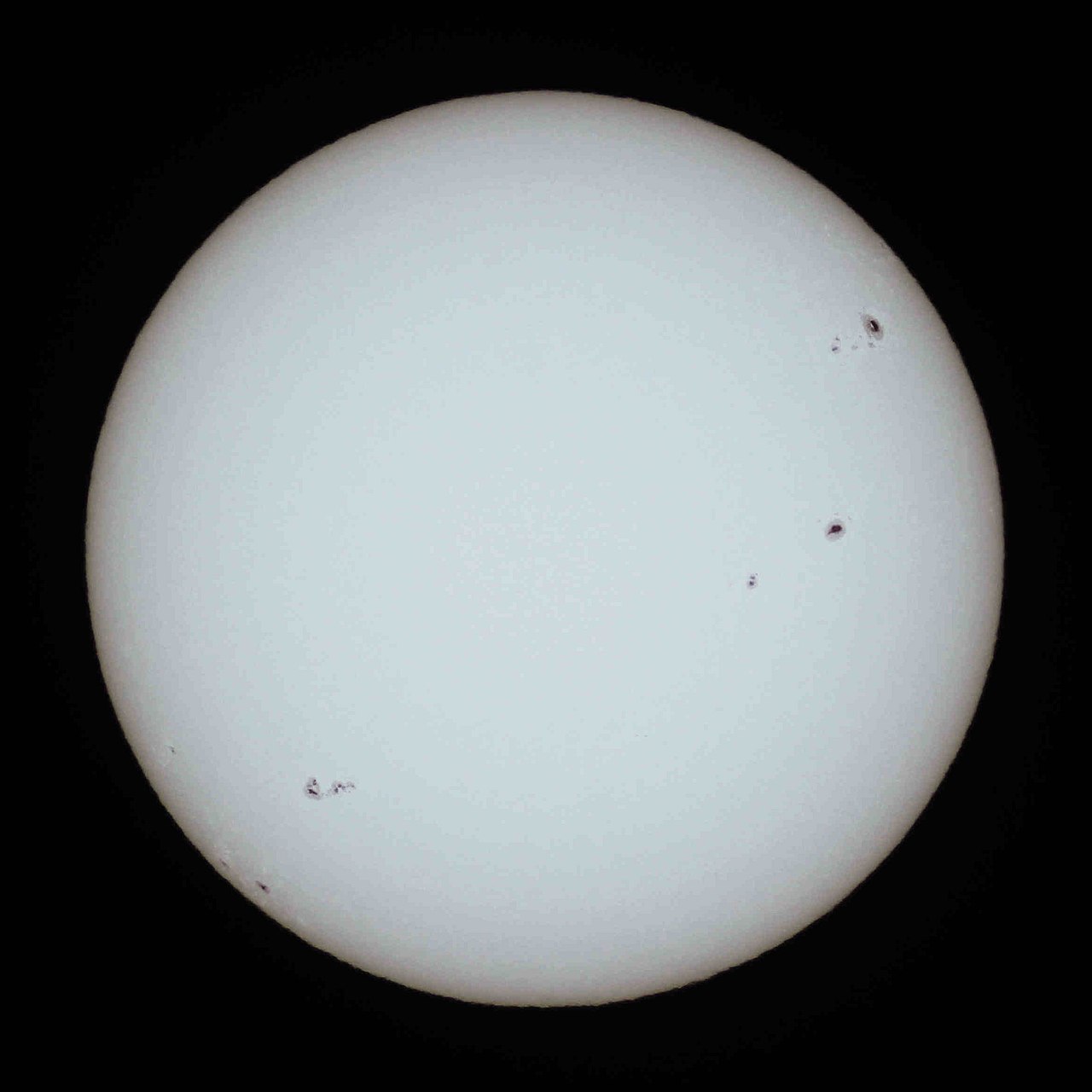



Physical characteristics
G-type main-sequence stars have masses roughly comparable to the Sun—typically within a range around 0.8 to 1.0 solar masses—and surface temperatures that fall approximately between 5,300 and 6,000 K. Their visible color is often described as yellow, but that label is imprecise: many G-type stars appear white to an observer above a planet’s atmosphere because their spectra peak in the yellow-green part of the visible band. Apparent yellow coloration of the Sun when seen from the ground is largely due to scattering effects in Earth’s atmosphere, specifically Rayleigh scattering.
Internal processes and lifetime
On the main sequence, a G-type star generates energy by fusing hydrogen into helium in its core via nuclear fusion, primarily through the proton–proton chain. The Sun, for example, converts hundreds of millions of tons of hydrogen into helium every second and transforms a small fraction of mass into energy (the commonly cited figure is about hundreds of millions of tons fused and roughly a few million tons converted to energy per second). Typical main-sequence lifetimes for G-type stars are on the order of several billion to about ten billion years, long enough to allow planetary systems to develop complex chemistry and, under suitable conditions, life.
Evolution and end states
After a G-type star exhausts the hydrogen in its core, it leaves the main sequence and expands into a red giant. During this phase it can grow to many times its original radius and may resemble well-known red giants such as Aldebaran. Later, the outer layers are expelled, sometimes producing a planetary nebula, while the remnant core cools and contracts to become a white dwarf. The broad sequence—main sequence → red giant → planetary nebula → white dwarf—is the standard evolutionary path for stars of this mass range.
Importance for planets and habitability
G-type stars are scientifically significant because their stable luminosities and lifetimes provide extended periods during which temperate zones, or habitable zones, can exist around orbiting planets. The Sun demonstrates how a G-type star can sustain a biosphere on at least one orbiting world. Because most stars in the galaxy are lower-mass red dwarfs, G-type stars are less common by number but often more familiar observationally due to their brightness.
Notable examples and distinctions
- Sun — the nearest and best-studied G-type main-sequence star.
- Tau Ceti — a nearby G-type star often discussed in exoplanet studies.
- 51 Pegasi — historically important as the host of the first sun-like star shown to have an exoplanet.
- Milky Way context — G-type stars coexist with many more numerous lower-mass stars in our galaxy.
For concise technical references and spectroscopic classification keys, consult introductory materials on spectral classification and resources that describe luminosity classes. Additional observational and historical notes can be found through professional and public archives linked from standard astronomy portals. For basic explanations of scattering and atmospheric effects that alter perceived stellar color, see discussions of Rayleigh scattering and the role of planetary atmospheres.
Each of the link placeholders above points to more detailed treatments of the specific terms and examples: stellar structure, fusion processes, prominent nearby G-type stars, and the late stages of stellar evolution represented by objects such as Aldebaran and transient phenomena like planetary nebulae. For further study, consult catalogs and observational summaries that list stellar properties such as mass, temperature, and spectral subtype.
Other related subjects include the proton–proton fusion chain and energy output metrics (nuclear fusion, energy), quantitative descriptions of mass conversion rates (fusion rate, mass–energy conversion), and specific stellar examples (Tau Ceti, 51 Pegasi), all of which provide context for understanding G-type main-sequence stars within the galactic population.
Questions and answers
Q: What is a GV star?
A: A GV star, or yellow dwarf, is a main-sequence star of spectral type G and luminosity class V on the Hertzsprung-Russell Diagram.
Q: What color are GV stars?
A: GV stars range in color from white for more luminous types like the Sun to very slightly yellow for less massive and luminous types.
Q: How much mass do GV stars have?
A: GV stars typically have masses between 0.8 and 1.0 solar masses.
Q: What is an example of a well-known GV star?
A: The Sun is the most commonly known (and easily seen) example of a GV star.
Q: How long can a GV star fuse hydrogen nuclei together and release energy?
A: A typical GV star can fuse hydrogen nuclei together and release energy for around 10 billion years.
Q: What happens when the hydrogen in a GV star runs out?
A: When the hydrogen runs out, the star will grow to many times its earlier size and become a red giant, eventually losing its outer layers of gas which will form into a planetary nebula while its core cools and shrinks into a small, very dense white dwarf.
Related articles
Author
AlegsaOnline.com G-type Main-Sequence Star (Yellow Dwarf) Leandro Alegsa
URL: https://en.alegsaonline.com/art/37129
Sources
- vendian.org : What color are the stars?
- adsabs.harvard.edu : Empirical bolometric corrections for the main-sequence
- physics.valpo.edu : Stellar Evolution: Main Sequence to Giant
- astronomy.ohio-state.edu : Why does the Sun shine?
- ari.uni-heidelberg.de : Sun
- simbad.u-strasbg.fr : Alpha Centauri A
- simbad.u-strasbg.fr : Tau Ceti
- simbad.u-strasbg.fr : 51 Pegasi
- simbad.u-strasbg.fr : entry