
Francisco (Uranian moon)
Francisco is a small, irregular, non-spherical moon of Uranus discovered in images from 2001 and named for a minor lord in Shakespeare's The Tempest.
Francisco is one of the small, irregular moons orbiting the planet Uranus. It is a non-spherical satellite that was identified in images taken in 2001 and announced in 2003. Like many of Uranus's minor moons, Francisco is tiny compared with the planet's major satellites and is best known from ground-based telescopic surveys rather than spacecraft visits.
Image gallery
8 Images
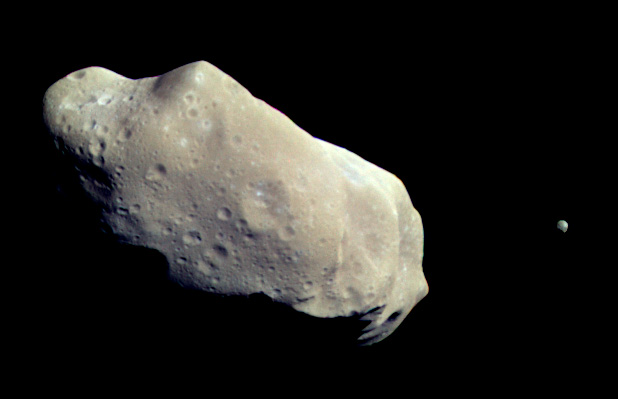


Physical characteristics
Francisco is markedly non-spherical, indicating that its gravity is too weak to pull it into a rounded shape. Observations suggest it is only a few kilometers across, so its surface is expected to be heavily cratered and irregular. Its low brightness and small size make direct study challenging; most information comes from photometry and astrometric tracking rather than detailed imaging.
Orbit and classification
As an irregular moon, Francisco follows an orbit that differs from the regular, equatorial satellites of Uranus. It orbits at a larger distance from the planet than the major moons, and its orbit shows the kind of eccentricity and inclination typical of captured or perturbed small satellites. Researchers group Francisco with other similar distant Uranian moons when studying the system's dynamical history; for more on irregular satellites see irregular satellite dynamics.
Discovery and naming
Francisco was found in images captured in 2001 by teams including Matthew J. Holman and Brett J. Gladman, and it initially received the provisional designation S/2001 U 3. The discovery was reported in 2003 and the moon was assigned the permanent number Uranus XXII. Following the convention of naming Uranian satellites after characters from English literature, the International Astronomical Union approved the name Francisco, after a lord in William Shakespeare's company; see William Shakespeare and the play The Tempest.
Observations and scientific importance
Tiny moons like Francisco are valuable for studies of planetary satellite populations and the processes that capture and evolve small bodies around giant planets. Continued observations refine its orbit and help astronomers understand collisional histories and possible dynamical groupings among Uranus's irregular moons. While Francisco itself is not a target for close spacecraft study, it contributes to the broader picture of how planetary satellite systems form and change over time.
Notable distinctions
- Designation: originally S/2001 U 3, now Uranus XXII.
- Size: very small and non-spherical, likely only a few kilometers across.
- Naming: derived from a Shakespearean character, following IAU naming practice for Uranian moons.
Because Francisco is faint and distant, most public knowledge about it is limited to its discovery circumstances, orbital elements, and its place among Uranus's many irregular satellites. Continued telescopic monitoring remains the primary method to improve our understanding of this minor moon.
Related articles
Author
AlegsaOnline.com Francisco (Uranian moon) Leandro Alegsa
URL: https://en.alegsaonline.com/art/36084
Sources
- arxiv.org : Preprint
- planetarynames.wr.usgs.gov : "Planet and Satellite Names and Discoverers"
- cfa-www.harvard.edu : IAU-NSES
- ssd.jpl.nasa.gov : NASA JPL