
From the Earth to the Moon (Jules Verne)
An overview of Jules Verne’s 1865 science-fiction novel describing a 19th‑century attempt to reach the Moon by a gigantic cannon and the voyage’s characters, themes, and influence.
Overview
From the Earth to the Moon is an 1865 novel by Jules Verne that combines adventure with technical speculation. Written as part of Verne’s Voyages Extraordinaires, the book follows a bold American society’s attempt to send a projectile carrying three men to the Moon. Verne foregrounds detailed calculations, the social context of post‑Civil War America, and a blend of scientific curiosity and romantic daring. The original French title is De la Terre à la Lune; the work is often paired with its sequel, Around the Moon.
Image gallery
4 Images


Plot summary
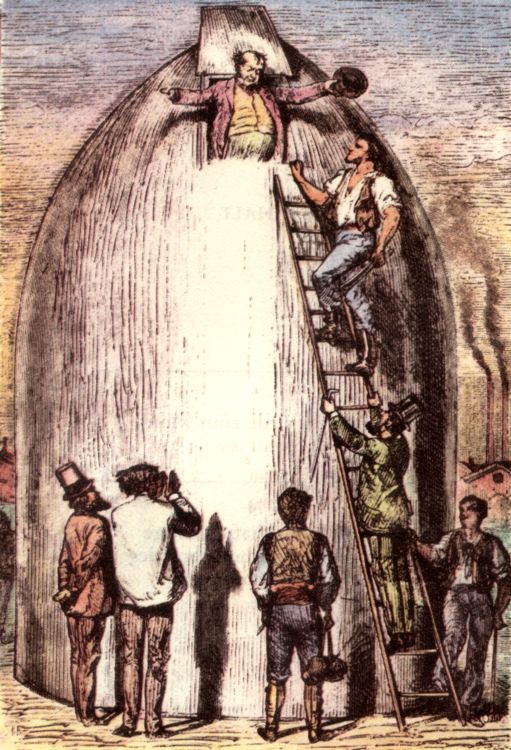
The story centers on a proposal by the Baltimore Gun Club to build an enormous cannon to launch a manned projectile toward the Moon. The club’s members design and construct the weapon and a bullet-shaped cabin intended to hold passengers. Three volunteers—an American engineer, a rival artillery expert, and a French adventurer—occupy the projectile at launch. Verne ends the first volume as the craft ascends toward lunar orbit, leaving the outcome to be resolved in the subsequent volume.
Principal characters
- Impey Barbicane – the club’s president and driving force behind the project.
- Captain Nicholl – a rival artillery specialist whose skills and temperament contrast with Barbicane’s.
- Michel Ardan – a charismatic Frenchman who volunteers to travel inside the projectile.
Science, invention and style
Verne’s text is notable for its careful attention to technical detail: projectile mass, required velocity, and trajectory are treated more like engineering problems than literary set pieces. The proposed weapon — a gigantic cannon often referred to in later commentary — and the enclosed projectile are described with an emphasis on materials and logistics, although modern physics shows a cannon launch would expose occupants to fatal acceleration.
History and reception
Published in the mid‑19th century, the novel captured public imagination and helped shape the emerging genre of science fiction. Contemporary readers admired Verne’s rigor and wit; later generations recognized the book’s role in inspiring interest in space travel. Verne reputedly entrusted the manuscript to a relative and expressed confidence that human travel to the Moon would one day be realized.
Legacy and adaptations
The book influenced writers, inventors, and popular culture: it spawned a direct sequel and numerous adaptations and references in theater, film, and television. Its mixture of adventurous plotting and methodical calculation remains a model for hard‑science fiction. Readers today can approach it as a historical document of scientific optimism and as an entertaining speculative adventure.
Further reading: see the original French edition and modern translations for differences in titles and notes. For an introduction to the novel’s subject and historical context, consult resources about Verne’s work, the depiction of the Moon in 19th‑century fiction, and technical commentaries on cannon‑launch schemes such as the fictional giant cannon concept.
Related articles
Author
AlegsaOnline.com From the Earth to the Moon (Jules Verne) Leandro Alegsa
URL: https://en.alegsaonline.com/art/36813