
Flexagon: folded paper models that reveal hidden faces
A flexagon is a flat folded model, usually made from a paper strip, that can be 'flexed' to reveal hidden faces. Common types include hexaflexagons and tetraflexagons; used in puzzles and math education.
A flexagon is a flat, foldable model that can be manipulated to display faces that were previously hidden inside the structure. Originating as a paper-folding novelty, a flexagon is built so that repeated 'flexing'—a sequence of folds and re-arrangements—brings different panels to the outside. The object is studied both as a recreational puzzle and as a simple physical example of combinatorial and topological ideas in geometry. Many introductory descriptions call it a flat model made from a strip of paper.
Image gallery
6 Images




Forms and naming
Flexagons are identified by the polygonal outline they form and by how many distinct faces they can display. The most familiar families are hexagonal flexagons (hexaflexagons) and square or rectangular types often called tetraflexagons (square or rectangular). A prefix indicates the total number of visible faces including the two sides initially seen; for example, the term hexahexaflexagon denotes a hexaflexagon capable of showing six different faces. The prefix convention is flexible and widely used: see the convention marker prefix in flexagon literature.
Construction and mechanics
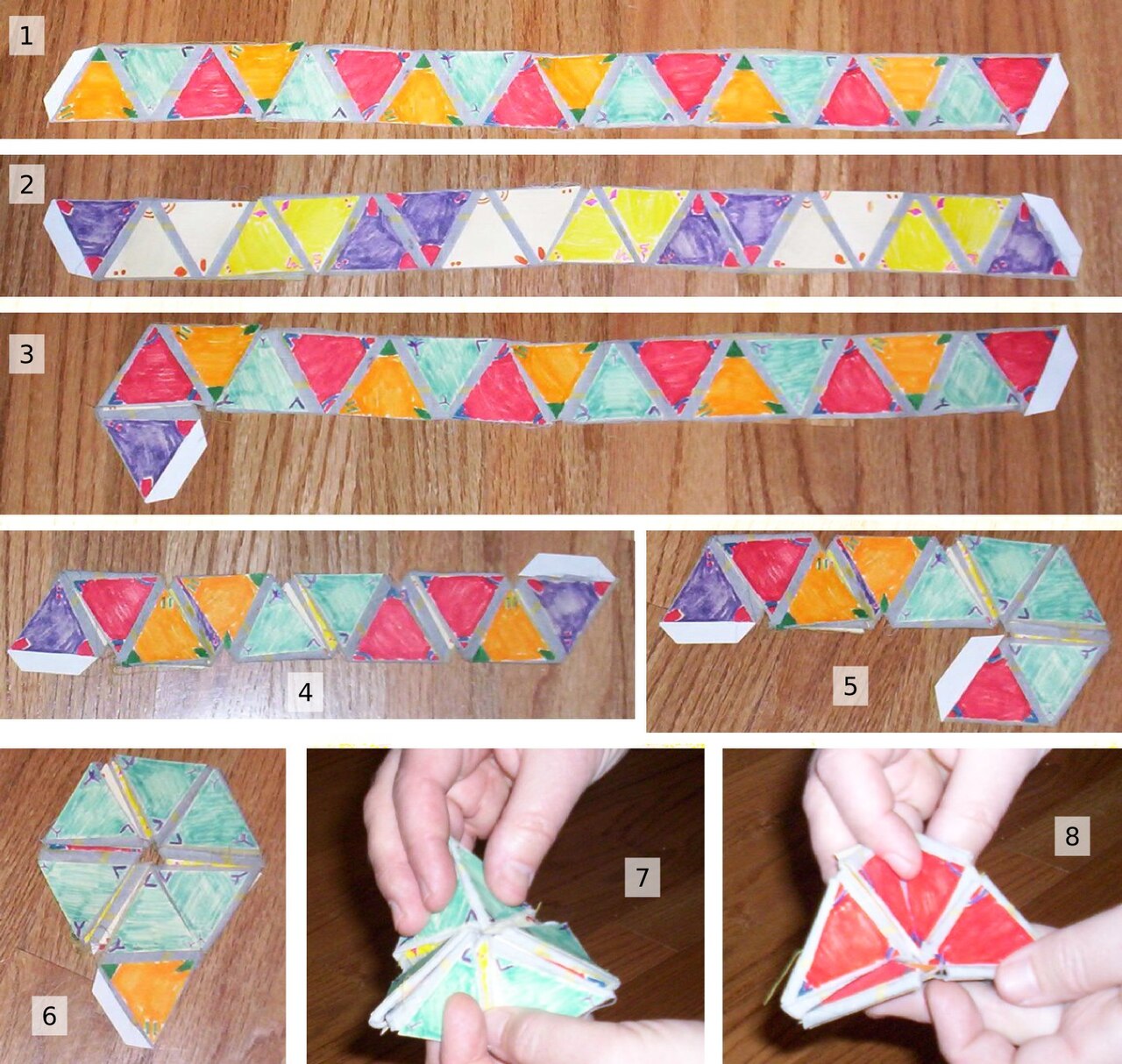
Typical construction begins with a long strip of paper printed or divided into congruent shapes (equilateral triangles for many hexaflexagons). The strip is folded into a cycle and the ends are joined so the strip forms a polygonal ring. Careful creasing and a few standard folding moves allow sections to be tucked and unfolded so interior panels become exterior faces. The art of making the fold pattern and the required sequence of flexes is central to both building and solving flexagon puzzles.
History and study
Flexagons were first noticed in the late 1930s and later popularized among mathematicians and hobbyists in the mid-20th century. Recreational-mathematics writers and puzzle enthusiasts helped spread interest, and subsequent study developed systematic methods for cataloguing face states and flex sequences. Techniques such as the Tuckerman traverse are used to explore which faces are reachable from a given configuration and to map the network of states.
Uses, examples and significance
Flexagons serve several purposes: they are hands-on puzzles, teaching tools that illustrate permutations and adjacency relations, and objects of artistic paper craft. Common examples include the trihexaflexagon (a hexagon with three faces) and larger hexa- variants showing many faces. They also appear in demonstrations about folded surfaces and in collections of mathematical toys.
Notable facts and variations
- Face counting includes both visible sides before any flexing and any additional faces revealed by flexes.
- Materials vary from ordinary paper to sturdier card stock for durable models; colored faces help track configurations.
- Complexity grows quickly with the number of faces; some flexagons have intricate state graphs that are of independent mathematical interest.
For an introduction with diagrams and step-by-step folding patterns, see introductory guides and collections of paper-folding puzzles. Further reading and community examples are widely available in recreational mathematics sources and maker communities (geometry overview, model guides, paper folding, square types, rectangular types, hexagonal types, naming conventions).
Related articles
Author
AlegsaOnline.com Flexagon: folded paper models that reveal hidden faces Leandro Alegsa
URL: https://en.alegsaonline.com/art/35110
Sources
- doi.org : 10.1038/scientificamerican1256-162
- worldcat.org : 4657622161
- freepatentsonline.com : "Changeable amusement devices and the like"