
Exclusive Economic Zone (EEZ): Rights, Limits, History, and Disputes
Overview of the Exclusive Economic Zone (EEZ), its legal basis, rights and duties of coastal states, limits and overlaps, differences from territorial waters and the continental shelf, and common disputes.
Overview
An Exclusive Economic Zone (EEZ) is a maritime area beyond and adjacent to a coastal state’s territorial sea where that state has special rights over the exploration and use of marine resources. In general practice an EEZ extends seaward up to 200 nautical miles (about 370 km) from a nation’s baseline. The coastal state’s authority in the EEZ is focused on economic activities: for example, the right to undertake seabed mining and to regulate commercial fishing. When islands or rocks are entitled to generate maritime zones, the EEZ is measured from the coasts of those features; see the role of islands in delimitation.
Image gallery
1 Image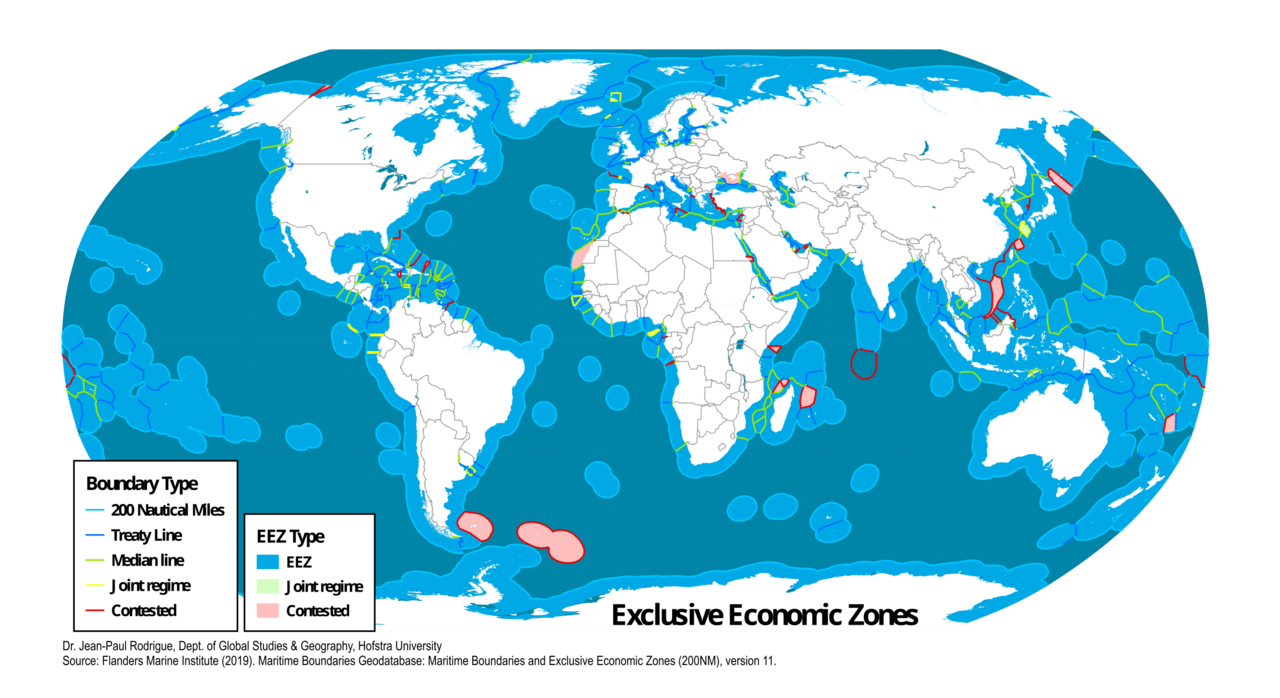
Legal basis and historical development
The EEZ concept was developed during the mid-20th century as coastal states asserted greater control over nearby fish stocks and subsoil resources. Early national claims culminated in a multilateral framework under the United Nations Convention on the Law of the Sea (UNCLOS), which codified rights and duties related to EEZs. While the convention sets the standard 200-nautical-mile limit, many technical and delimitation questions are resolved by bilateral or regional agreements and by international dispute settlement mechanisms.
Rights, duties and jurisdiction
Within its EEZ a coastal state has sovereign rights—not full sovereignty—to explore, exploit, conserve and manage natural resources of the waters, the seabed and its subsoil. Key elements include:
- Exclusive rights to hydrocarbon and mineral exploitation of the seabed and subsoil, including potential deep-sea mining.
- Authority to regulate and license fishing operations and to conserve living marine resources, with an emphasis on sustainable harvests and stock management (fishing control).
- Jurisdiction over the establishment and regulation of artificial islands, installations and structures, and limited enforcement powers regarding customs, fiscal, immigration and sanitary laws.
- The duty to protect and preserve the marine environment and to cooperate with other states on scientific research when appropriate.
Limits, overlaps and dispute drivers
The 200-nautical-mile band is a default rule, but EEZs frequently overlap where neighboring or opposite states are closer than 400 nautical miles. In such cases states negotiate boundaries by agreement, often using equidistance or other equitable principles. Overlaps and rich resource prospects drive many international tensions: notable flashpoints include parts of the South China Sea, Arctic waters where melting ice has opened access to resources, and regions with competing island claims. Delimitation can involve bilateral negotiation, international arbitration, or adjudication under mechanisms provided by UNCLOS.
Differences from territorial waters and navigation freedoms
The EEZ is distinct from the territorial sea, which normally reaches 12 nautical miles from the baseline and within which the coastal state exercises full sovereignty similar to its land territory. In contrast, other states retain freedoms in the EEZ, such as navigation and overflight; foreign ships and submarines may transit EEZ waters without prior authorization provided they do not engage in resource exploitation. The continental shelf concept overlaps with the EEZ for seabed rights and may extend the coastal state's entitlement to the seabed beyond 200 nautical miles in certain cases.
Importance, management and notable facts
EEZs are central to the modern notion of the ocean economy or "blue economy": they determine who benefits from fisheries, offshore energy, marine minerals and emerging industries. Effective management requires scientific assessment, enforcement capacity, regional cooperation and adherence to environmental norms. Disputes over EEZs illustrate how legal principles, geography and geopolitics intersect; practical resolution often combines diplomacy, legal processes and resource-sharing arrangements. For general context on related maritime concepts see links on territorial limits (territorial waters) and the role of islands in maritime claims (islands), and consult resources addressing navigation freedoms (ships and submarines).
Related articles
Author
AlegsaOnline.com Exclusive Economic Zone (EEZ): Rights, Limits, History, and Disputes Leandro Alegsa
URL: https://en.alegsaonline.com/art/32896