
European perch (Perca fluviatilis)
A widespread freshwater predatory fish of Europe and western Asia, known for its greenish body, dark vertical bars and red fins; valued by anglers and important in many freshwater ecosystems.
The European perch (Perca fluviatilis) is a common freshwater fish native to much of Europe and parts of western Asia. It is a medium-sized predatory species often simply called "perch" in Europe. Recognizable by its greenish sides, a series of dark vertical bands, and red or orange fins, the European perch is both ecologically important and popular with recreational anglers and commercial fisheries in some regions.
Image gallery
10 Images


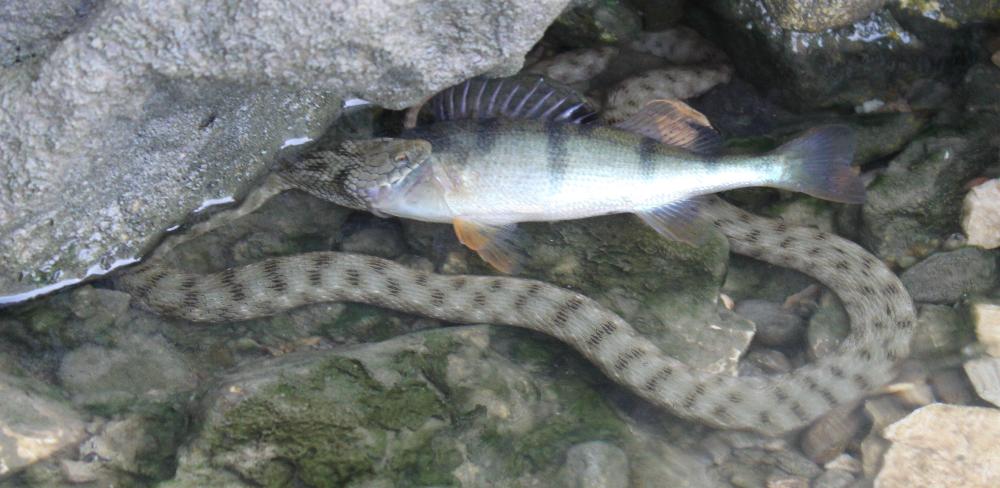
Identification and characteristics
Adult European perch typically measure under 25 cm in many waters, though individuals may grow larger where conditions are favourable. Key identifying features include:
- Body colour: olive-green to bluish-green on the back, fading to lighter flanks and a silvery or whitish belly.
- Dark vertical bars: usually five to nine distinct, transverse stripes along the sides.
- Fins: reddish or orange pelvic, anal and caudal fins; two dorsal fins—one spiny and one soft-rayed—are characteristic of the species.
- Shape: laterally compressed body with a pointed snout and sharp teeth adapted for grasping prey.
Distribution and habitat
European perch are native across most of continental Europe and into parts of Siberia. They inhabit a wide range of freshwater environments including lakes, slow-flowing rivers, reservoirs and ponds. The species tolerates low levels of salinity and may enter brackish zones where rivers meet the sea, such as parts of the Baltic Sea. Populations have also been introduced to other continents, where they can become invasive and alter local ecosystems.
Diet, behaviour and life cycle
Perch are opportunistic predators. Juveniles feed mainly on plankton and small invertebrates, while larger individuals take insects, crustaceans, worms and small fish. Feeding activity often peaks around dawn and dusk. Reproduction typically occurs in spring: eggs are laid in long gelatinous ribbons attached to submerged vegetation or other structures, where they hatch into free-swimming larvae that gradually shift to a piscivorous diet as they grow.
Human uses and ecological importance
European perch are valued by anglers for their fighting ability and taste, and they are harvested both recreationally and commercially in some areas. Ecologically, perch influence freshwater food webs as mid-level predators: they help regulate populations of smaller fish and macroinvertebrates, and in turn provide food for larger predators. Where introduced outside their native range, perch can compete with and prey upon native species, sometimes leading to declines in biodiversity.
Taxonomy, similar species and notable facts
The species belongs to the genus Perca, which also includes the yellow perch (Perca flavescens) native to North America. Perch may be confused with other spiny-finned predatory fish such as young pike-perch (Sander spp.), but the combination of vertical bars and red fins is distinctive. Anglers often employ light tackle, lures or baited hooks to catch perch, and the species is commonly used in freshwater fisheries management and stocking programs. For regional distribution details see resources on European freshwater fishes via continental databases such as those for Europe.
Overall, the European perch is a resilient and adaptable fish whose presence shapes many freshwater communities and supports recreational fisheries across its native and introduced range.
Related articles
Author
AlegsaOnline.com European perch (Perca fluviatilis) Leandro Alegsa
URL: https://en.alegsaonline.com/art/32620
Sources
- fishbase.org : Perca fluviatilis Linnaeus, 1758