
Eta (Greek letter)
Eta (Η, η) is a letter of the Greek alphabet. Historically a consonant, it later became a long e vowel and today represents /i/. It has numeric value 8 and is used in science and mathematics.
Eta is a letter of the Greek alphabet, written as uppercase Η and lowercase η. Its role in Greek has changed over time: in very early inscriptions it represented an /h/ consonant, in Classical Greek it marked a long vowel often transliterated as "ē", and in Modern Greek it is pronounced like the English "ee" sound. In the system of Greek numerals eta has the value eight.
Image gallery
2 Images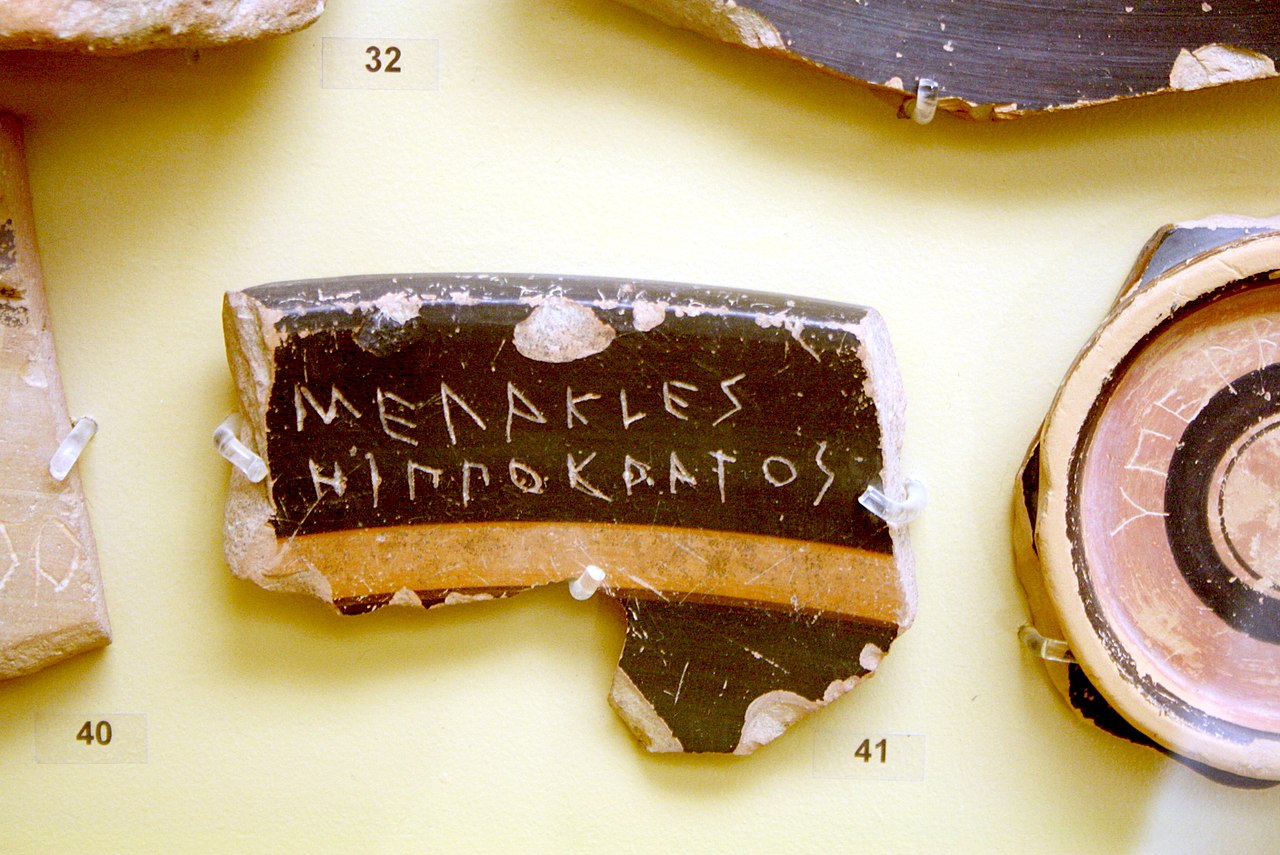

Form and historical development
The letter derives from a Phoenician consonant and was adapted into Greek alphabets with evolving phonetic value. As Greek phonology shifted, the symbol came to represent a long mid-front vowel and later merged with the high front vowel in spoken forms. Its graphic form influenced other writing systems: the Roman H and certain Cyrillic letters such as И trace their shapes to the same ancestral sign.
Common uses and meanings
Beyond its alphabetic and numeric roles, eta is widely used as a symbol across disciplines. Notable usages include:
- Mathematics: the lowercase η appears in names of special functions such as the Dirichlet eta function and in other contexts like the Dedekind eta function.
- Physics and cosmology: η often denotes conformal time in cosmological equations and appears as a symbol in field theory and relativity.
- Engineering and telecommunications: η commonly stands for efficiency, for example the efficiency of a transmitter or a conversion process.
- Economics: η is used to denote elasticity measures, such as price elasticity of demand, as a convenient mathematical symbol.
Typographic and linguistic notes
Uppercase and lowercase forms are used according to language and typographic conventions. In scientific contexts the lowercase form is especially common as a variable name or symbol. When reading historical texts, recognizing whether the letter represents a consonant or vowel depends on the period: early epigraphic Greek preserves the older consonantal use, while later literary texts reflect vowel values.
Eta's long history and its adoption into other alphabets make it an interesting example of how a single character can change function and spread across languages and technical fields. For further general background see resources on the Greek alphabet and the Greek numeral tradition.
Related articles
Author
AlegsaOnline.com Eta (Greek letter) Leandro Alegsa
URL: https://en.alegsaonline.com/art/32339