
Erie Canal
19th-century artificial waterway in New York linking the Hudson River to Lake Erie. Completed in 1825, it opened Great Lakes trade to the Atlantic, reshaped settlement and commerce, and remains part of New York's canal system.
Overview
The Erie Canal is a historic man-made waterway in the state of New York that links the Hudson River (Hudson River) to Lake Erie. By connecting the Great Lakes to the Atlantic Ocean, the canal created the first continuous inland route between the American interior and international maritime trade. Authorized in the early 19th century and opened in 1825, the canal transformed transportation and commerce in the northeastern United States.
Image gallery
10 Images


Design and construction
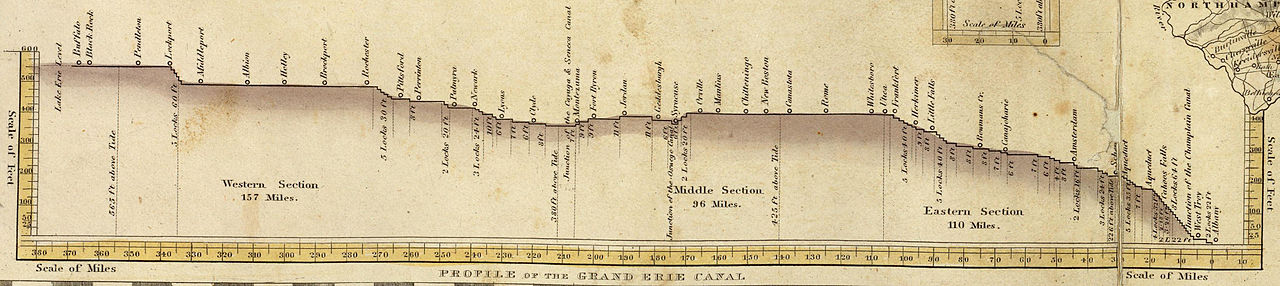
Construction began after authorization in the first decades of the 1800s and employed large teams of laborers, engineers, and carpenters. The route followed river valleys and required a system of locks, aqueducts and towpaths to handle changes in elevation and to cross tributaries. Early boats were towed by mules or horses along the banks; later improvements allowed larger barges and steam-powered craft. The original canal was repeatedly enlarged and straightened in subsequent decades to accommodate heavier traffic.
Economic and social impact
By greatly reducing the cost and time of moving goods between the Midwest and the East Coast, the canal stimulated agricultural settlement, industrial development and urban growth. Cities and towns such as Buffalo, Rochester and Syracuse grew as commercial centers. The canal also helped New York City emerge as the nation’s premier port by channeling western trade to its docks. Markets expanded, immigration increased, and inland areas became more integrated with coastal commerce.
Later history and present use
Railroads later overtook the canal for long-distance freight, but the Erie Canal remained important for regional transport well into the 19th and early 20th centuries. Today the historic route is preserved within the New York State Canal System and is used largely for recreation, tourism and limited commercial navigation. Restoration and conservation efforts have emphasized its cultural heritage, engineering landmarks and scenic value.
Notable facts
- The Erie Canal was sometimes derided as “Clinton’s Folly” during planning, after New York State governor DeWitt Clinton who championed it.
- Its locks and aqueducts were early examples of large-scale American civil engineering and influenced later inland waterways.
- As a transportation innovation, the canal played a significant role in westward expansion, regional specialization and the 19th-century American economy.
For further reading on technical details, historic maps and present-day management see additional resources: overview, river context, Great Lakes link, lake system, ocean access, and urban effects.
Related articles
Author
AlegsaOnline.com Erie Canal Leandro Alegsa
URL: https://en.alegsaonline.com/art/31918