
Electronic Delay Storage Automatic Calculator (EDSAC)
EDSAC was an early British stored‑program computer built at Cambridge under Maurice Wilkes. It used mercury delay‑line memory, first ran programs in 1949, and influenced early commercial computing and software practice.
Overview
The Electronic Delay Storage Automatic Calculator, commonly called EDSAC, was an early British computer developed to provide a practical, reliable service for scientific research. Designed and built at the University of Cambridge Mathematical Laboratory by a team led by Maurice Wilkes, EDSAC introduced several operational practices and technical choices that shaped postwar computing at Cambridge and beyond. The project is frequently cited as one of the first successful implementations of the stored‑program concept in an electronic machine; the design and launch established Cambridge as an early centre of computing research and service.
Image gallery
8 Images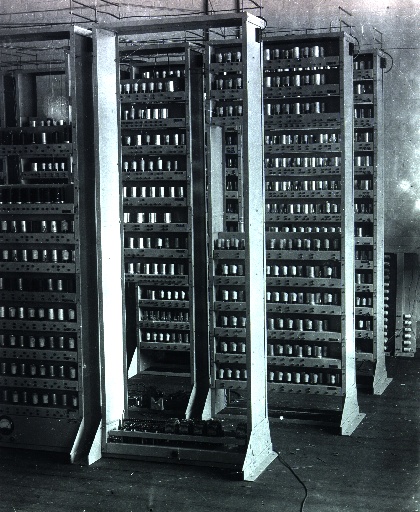

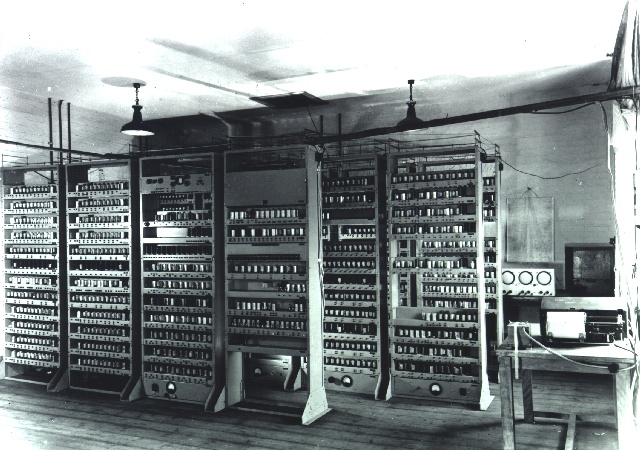


Design and components
EDSAC combined vacuum‑tube electronics with a form of serial memory known as mercury delay‑line storage. That memory stored sequences of bits as acoustic pulses in columns of mercury, producing a compact but sequential access store suitable for the machine's instruction stream. Program and data were prepared offline (for example on punched paper tape) and loaded for execution; results were delivered to printed output. The machine's instruction set and peripherals were modest by later standards but carefully matched to the needs of numerical computation, which was its primary purpose.
Development and first operation
Work on EDSAC began in the late 1940s after its designers studied contemporary ideas about stored programs and electronic computation. Under Wilkes's leadership the team completed a working machine that executed its first programs on 6 May 1949. Early runs included calculations such as a table of square numbers and a routine to list prime numbers, demonstrating the system's usefulness for routine mathematical tasks. Accounts of these initial demonstrations are often cited when describing EDSAC's operational debut.
Uses, software innovations and influence
EDSAC was intended as a service machine for university researchers, and it helped establish several software practices that became standard. Operators maintained a library of reusable subroutines, an early example of structured program reuse and distribution. The machine also hosted early experimental software such as simple interactive games; one well‑known program implemented a noughts‑and‑crosses game and is frequently mentioned as an early computer game example. EDSAC's practical achievements inspired follow‑on machines and commercial adaptations.
Legacy and notable connections
Commercial interest in EDSAC's design led to collaboration with the British firm J. Lyons & Co. Ltd., which adapted ideas from Cambridge to produce the LEO I business computer. Cambridge continued to iterate on the concept with successors that refined reliability, speed and programming support. EDSAC's place in computing history rests on its role as a functioning stored‑program computer, its contributions to early software practice, and its status as a training ground for engineers and programmers who carried its lessons into industry and other research labs.
- First practical runs and demonstrations took place on 6 May 1949; early examples included tables of squares and prime numbers (square table, prime list).
- Developed at the University of Cambridge Mathematical Laboratory (Cambridge lab) by a team under Maurice Wilkes and colleagues.
- Recognised as an early stored‑program machine (stored‑program) and associated with early software experiments including a simple game (early game).
- EDSAC is often discussed in histories of computing as a source of practical techniques and as an ancestor of the LEO commercial system (EDSAC project).
For further reading and archival material, modern accounts and reproductions of programs and documentation are available from university collections and computing history projects. These sources elaborate EDSAC's construction details, operating routines and the social context in which one of Britain's first serviceable electronic computers operated.
Related articles
Author
AlegsaOnline.com Electronic Delay Storage Automatic Calculator (EDSAC) Leandro Alegsa
URL: https://en.alegsaonline.com/art/30744