
ELIZA — early natural language chatbot and psychotherapy simulation
ELIZA is a 1960s program by Joseph Weizenbaum that processed simple natural language input. Its DOCTOR script mimicked a Rogerian therapist and exposed limits of pattern-matching conversation.
Overview
ELIZA is an early computer program developed in the mid-1960s that processed and responded to typed human input in a way that resembled conversation. Written at the Massachusetts Institute of Technology, ELIZA demonstrated how simple syntactic techniques could produce outputs that some people interpreted as intelligent or empathic. The project is often cited in discussions of artificial intelligence, human–computer interaction, and the limitations of simulated understanding. For background on the idea of computers handling human language see natural language.
Image gallery
3 Images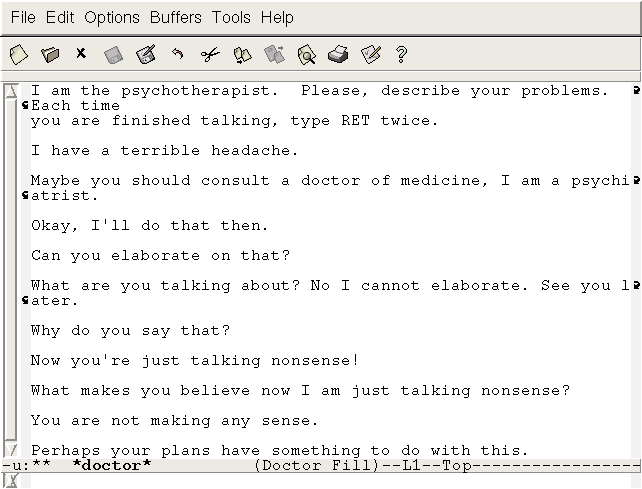


Design and techniques
ELIZA did not understand meaning in the human sense. Instead it used pattern-matching rules, substitution routines and scripted replies to transform user input into questions or comments that encouraged further conversation. The most famous script, called DOCTOR, imitated a nondirective psychotherapist and relied on a few simple operations:
- keyword detection — locate trigger words in user input;
- pattern matching — map input structures to response templates;
- pronoun and phrase reflection — convert "I" to "you" and vice versa to create follow-up questions;
- fallback replies — generic prompts when no specific pattern matched.
These methods are described in accessible accounts of early conversational programs and technical retrospectives. For more on the underlying pattern techniques see pattern matching.
History and authorship
ELIZA was created by Joseph Weizenbaum at MIT between 1964 and 1966 as an experiment in natural language processing and human–computer interaction. The DOCTOR script was intentionally simple and modeled after Rogerian psychotherapy to keep replies open-ended and reflective. Weizenbaum later chronicled his experience and reaction when users attributed understanding and emotion to ELIZA; his critiques contributed to broader ethical and philosophical debates about computers and human judgment. See work by Weizenbaum for context: Joseph Weizenbaum.
Examples and observable behavior
Typical interactions show ELIZA turning statements into questions. A user remark such as "My head hurts" could elicit "Why do you say your head hurts?" and a statement like "My mother hates me" might prompt "Who else in your family hates you?" These simple transformations often make the conversation feel natural despite the absence of real comprehension. This phenomenon, where people attribute greater understanding to a system than is warranted, became known informally as the "ELIZA effect." Accounts of how users responded to ELIZA—sometimes seriously—helped highlight how interface design shapes perception. For accounts of contemporary reactions see responses and reactions.
Impact and legacy
Although primitive by modern standards, ELIZA was one of the first chatbots and influenced later work in conversational agents, user interface design, and AI philosophy. It is taught as a classic example in computing courses because it demonstrates how minimal algorithms can produce striking social effects. ELIZA's code and scripts circulated widely, inspiring hobbyists and researchers to create new conversational programs. For the evolution of early chatterbots and follow-on systems, consult historical surveys at chatterbot histories.
Notable distinctions: ELIZA is not an example of semantic understanding or machine empathy; it is a rule-driven simulator that leverages linguistic structure and human interpretive tendencies. Its importance lies less in technical sophistication and more in the questions it raised about how humans interact with machines and attribute mental states to them.
Questions and answers
Q: What is ELIZA?
A: ELIZA is an early program that is able to process natural language.
Q: How did ELIZA operate?
A: ELIZA operated by processing users' responses to scripts.
Q: What was the most famous script used by ELIZA?
A: The most famous script used by ELIZA was called DOCTOR.
Q: What was the DOCTOR script?
A: The DOCTOR script was a simulation of a Rogerian psychotherapist.
Q: Who created ELIZA and when was it created?
A: ELIZA was created by Joseph Weizenbaum between 1964 to 1966 at MIT.
Q: How did DOCTOR respond to words not in its small list?
A: When words weren't in DOCTOR's small list, it might respond with a question like, "Why do you say that?" or "Who else in your family hates you?"
Q: How was ELIZA programmed?
A: ELIZA was programmed using simple pattern matching techniques.
Related articles
Author
AlegsaOnline.com ELIZA — early natural language chatbot and psychotherapy simulation Leandro Alegsa
URL: https://en.alegsaonline.com/art/30862
Sources
- doi.org : 10.1145/365153.365168
- cogs.susx.ac.uk : Machines and Thought: The Legacy of Alan Turing